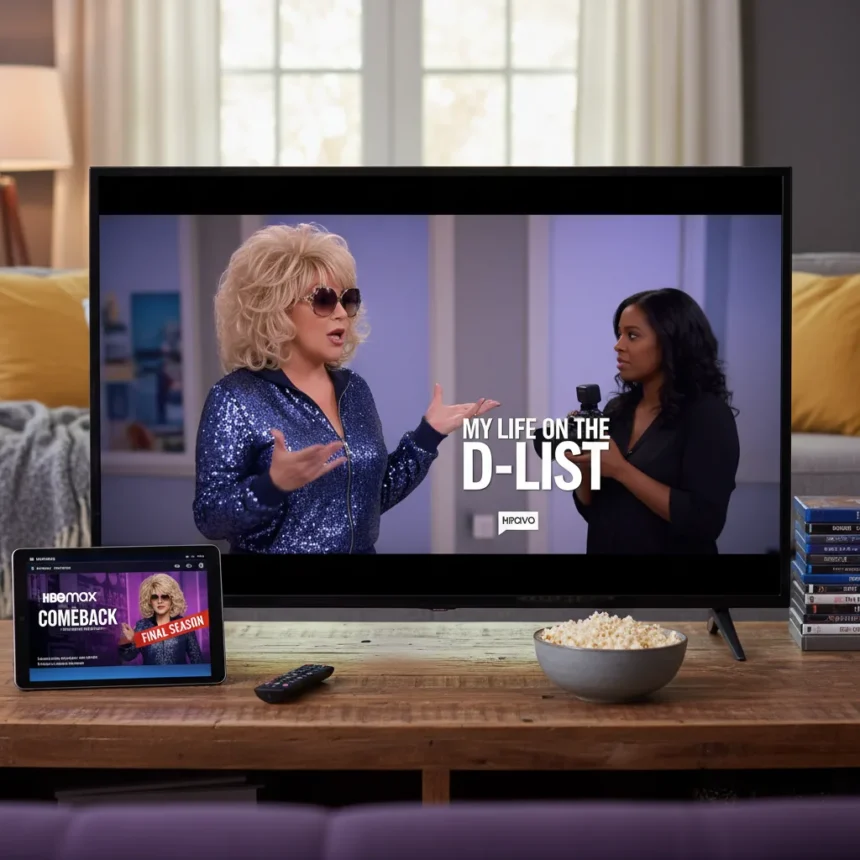
The Comeback season 3 arrives on HBO Max starting March 22, with new episodes dropping Sundays at 10:30pm ET, and the season is already sprinting toward its finale. After binging all three seasons this week, it’s impossible to ignore a glaring omission from the critical conversation: nobody’s compared this scripted comedy to My Life on the D-List, the forgotten Bravo reality series that feels like its actual DNA.
Key Takeaways
- The Comeback season 3 premieres March 22 on HBO Max with weekly Sunday episodes at 10:30pm ET
- Lisa Kudrow returns as Valerie Cherish, with co-creator Michael Patrick King steering the revival
- My Life on the D-List is the overlooked reality TV show that mirrors The Comeback’s satirical core
- The Comeback Official Podcast features Lisa Kudrow and Michael Patrick King breaking down episodes
- Season 3 introduces AI sitcoms and writer-less sets, pushing Valerie’s Hollywood chaos further
Why The Comeback Season 3 Matters Right Now
The Comeback season 3 represents something rare in television: a scripted comedy that returns after a decade away and actually justifies its resurrection. Valerie Cherish, the delusional aspiring actress played by Lisa Kudrow, hasn’t aged a day in the show’s logic, and the writers have smartly weaponized her against a 2025 entertainment landscape she’s completely unequipped to navigate. Episode 305, titled “Valerie Lights a Candle,” shows Valerie taking control of an AI-generated sitcom while managing a writer-less set—a premise that feels both absurd and uncomfortably plausible.
What makes The Comeback season 3 work is its refusal to soften Valerie’s character for modern sensibilities. She’s still insufferable, still delusional, still convinced her terrible ideas are gold. The season earns itself by leaning into the original show’s heightened style rather than diluting it with sentimentality. This is where the comparison to My Life on the D-List becomes impossible to ignore.
The Forgotten Bravo Show That Predicted The Comeback
My Life on the D-List is arguably the most underrated reality television series ever made, yet it sits in near-total obscurity while The Comeback gets revival treatment and critical retrospectives. The show documented the messy, delusional, often painful reality of someone convinced they deserved more fame than the entertainment industry was willing to grant them. Sound familiar?



The Comeback is essentially My Life on the D-List filtered through a scripted lens, with Lisa Kudrow playing a character who embodies the same desperate energy, the same refusal to accept her place in the Hollywood hierarchy, the same baffling confidence in the face of repeated rejection. Where the reality show captured genuine awkwardness and humiliation, the scripted version amplifies it into dark comedy. Both are studies in the psychology of ambition meeting the indifference of an industry that doesn’t care.
The question isn’t whether The Comeback was directly inspired by My Life on the D-List—that’s unverified speculation. The question is why critics and audiences haven’t made the connection when it’s so obvious. The two shows are asking the same question: what happens to someone who refuses to accept that they’re not the star of the story?



What The Comeback Season 3 Gets Right About Hollywood Delusion
The Comeback season 3 introduces new chaos that feels tailor-made for 2025: AI-generated content, creator economics, and the collapse of traditional television infrastructure. Valerie’s attempt to control an AI sitcom while navigating a set without writers captures something real about the current entertainment moment—the technology moves faster than anyone can process, and the people in charge are often the least equipped to understand it.
Lance Barber returns as Paulie G, Valerie’s on-and-off love interest, bringing a more vulnerable side to the character that the podcast reveals was carefully developed. The podcast itself, hosted by Evan Ross Katz with Lisa Kudrow and Michael Patrick King, becomes a meta-commentary on the show—breaking down how the writers heightened the original style, how the character evolved, why certain episodes land harder than others. It’s the kind of supplementary content that only works if you’re already invested in the show’s world.
Should You Stream The Comeback Season 3?
If you’ve never seen The Comeback, start with season one. The original run is merciless in its portrayal of Valerie—she’s not sympathetic, not secretly talented, not misunderstood. She’s simply delusional, and the show finds comedy in the gap between her self-perception and reality. Season 3 assumes you understand that dynamic and pushes it into stranger territory.
If you want the full experience, subscribe to HBO Max and watch The Comeback season 3 weekly starting March 22. Then immediately search for My Life on the D-List and watch it in whatever corner of the internet still hosts it. The comparison will reframe both shows and explain why one became a cult classic while the other disappeared entirely.



What happens in The Comeback season 3 episode 305?
In Episode 305, “Valerie Lights a Candle,” Valerie takes control of an AI-generated sitcom and navigates a writer-less set while reuniting with Paulie G. The episode represents the season’s turn toward more heightened, original-style storytelling that critics found more satisfying than the earlier episodes.
Is The Comeback season 3 worth watching if I haven’t seen the earlier seasons?
No. The Comeback season 3 builds on years of character development and running jokes. Start with season one to understand Valerie’s psychology and why her delusions are so central to the show’s dark comedy.
Where can I watch The Comeback season 3?
The Comeback season 3 streams exclusively on HBO Max, with new episodes arriving Sundays at 10:30pm ET starting March 22. HBO Max is the streaming home for HBO originals, Max Originals, DC content, Harry Potter, Friends, The Big Bang Theory, movies, documentaries, true crime, adult animation, and live sports and news.
The real value of The Comeback season 3 isn’t just in watching Valerie fail spectacularly in a world she doesn’t understand—it’s in recognizing that failure as a mirror held up to the entertainment industry’s actual dysfunction. And once you see that reflection, My Life on the D-List stops being a forgotten reality show and becomes essential viewing for understanding how The Comeback captured something true about ambition, delusion, and the price of refusing to accept your place.
Edited by the All Things Geek team.
Source: TechRadar