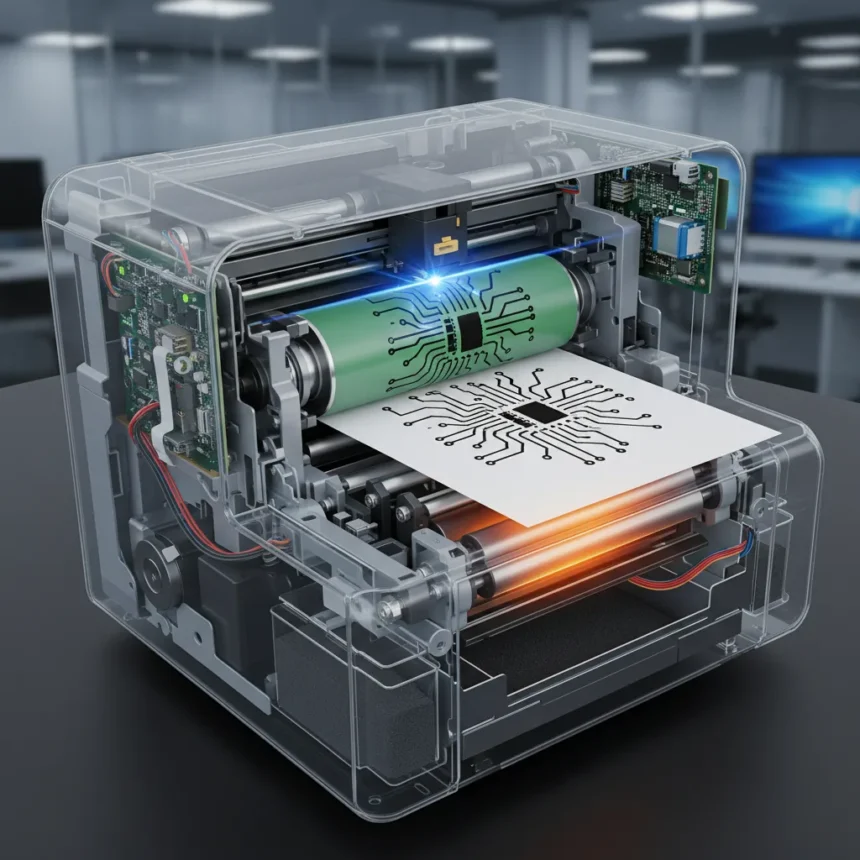
How laser printers work is far more intricate than most users realize. These machines rely on laser beams, precisely positioned lenses, and mirrors to transfer toner onto paper in a process that has remained largely unchanged since its inception in the 1960s. The result: a warm document that emerges from your printer because the internal components operate at skin-searing temperatures.
Key Takeaways
- Laser printers use high-speed laser beams to target sections of a positively charged photoreceptor drum.
- The laser neutralizes drum sections, creating negatively charged spaces that form the printed design.
- Toner, not ink, is the printing material used in laser printers.
- Internal components operate at extremely high temperatures, making printed documents feel warm.
- Laser printer technology originated in the 1960s and remains fundamentally unchanged.
The Photoreceptor Drum: The Heart of Laser Printing
At the core of every laser printer sits a photoreceptor drum that begins each print cycle in a positively charged state. This drum is the canvas upon which your document is painted—not with ink, but with precisely targeted laser light. The drum’s initial positive charge is essential to the entire mechanism; without it, the subsequent steps that create your printed image cannot occur.
The photoreceptor drum rotates continuously as the printer processes your document. As it turns, the laser beam strikes specific sections based on your document’s content. Where the laser hits, the positive charge neutralizes, leaving behind negatively charged spaces that form the actual design you want to print. Think of it as selective erasure: the laser removes positive charge in a pattern, and what remains is the blueprint of your page.
Laser Activation and Charge Neutralization
The laser inside your printer activates and deactivates at extraordinarily high speed, firing thousands of times per second to map out your document line by line. This rapid pulsing allows the printer to target precise sections of the photoreceptor drum with remarkable accuracy. The laser does not paint continuously; instead, it turns on and off in rapid succession, creating a digital representation of your page on the drum’s surface.

When the laser beam strikes the positively charged drum, it neutralizes those specific sections, creating negatively charged spaces that form the printed design. These negatively charged areas act as a magnet for toner particles, which are drawn to the drum in the exact pattern of your document. The precision of this process—controlled by mirrors and lenses that direct the laser beam—determines the quality and sharpness of your final print.
Why Your Printed Documents Feel Warm
If you have ever pulled a page straight from a laser printer, you know it feels noticeably warm. This is not accidental; it is a direct result of how laser printers operate. The internal components, including the fuser unit that bonds toner to paper, reach extreme temperatures during operation. These components operate at skin-searing temperatures to melt toner particles onto the paper permanently.



The heat is necessary for the final step of the printing process. Once toner particles have been transferred to the paper, they must be fused—melted slightly and bonded—to create a permanent image. Without this heat, the toner would simply brush off the page. This is why laser-printed documents emerge warm from the machine and why you should be careful handling them immediately after printing.
Toner: The Printing Material That Is Not Ink
A common misconception is that laser printers use ink, but they do not. Instead, they use toner, a fine powder composed of plastic particles and colorants. Toner behaves very differently from liquid ink. It does not soak into paper; instead, it sits on the surface and is fused by heat. This fundamental difference explains why laser prints are more durable, water-resistant, and longer-lasting than inkjet prints.
Toner particles are attracted to the negatively charged sections of the photoreceptor drum through electrostatic force. Once the toner-covered drum rolls past the paper, these particles transfer to the page, still in the exact pattern created by the laser. The subsequent heating process bonds them permanently, creating a crisp, professional-looking print that resists fading and water damage far better than traditional ink.
How Laser Printers Compare to Inkjet Alternatives
While inkjet printers spray liquid onto paper, laser printers use electrostatic attraction and heat fusion. This architectural difference gives laser printers several advantages: faster print speeds, sharper text, and lower cost-per-page over time. Inkjet printers excel at color photo printing, but for high-volume text documents and professional use, laser printers remain the standard. The technology gap between the two approaches is fundamental—one uses light and heat, the other uses liquid and absorption.



Why This Technology Still Matters
Laser printer technology emerged in the 1960s, yet these machines remain nearly identical in principle to their predecessors. The laser, the drum, the toner, the heat—all are essential components that have not been substantially reimagined in decades. This longevity speaks to the elegance of the original design. While digital technology has advanced exponentially, the physical process of laser printing has proven so effective that manufacturers have found little reason to overhaul it.
Can a laser printer overheat from continuous use?
Yes, laser printers can overheat if used continuously without breaks. The internal components already operate at extremely high temperatures, and extended use without cooling periods can cause the printer to throttle performance or trigger thermal shutdowns. Most modern laser printers include cooling systems and thermal sensors to prevent damage, but allowing brief rest periods between large print jobs is recommended for optimal machine longevity.
Why does laser printer toner cost more than inkjet ink?
Laser printer toner is more expensive per unit because it is a manufactured powder compound rather than liquid ink, and it yields significantly more pages per cartridge. While the upfront cost is higher, the cost-per-page for laser printing is substantially lower than inkjet printing over time, making laser printers more economical for high-volume printing environments.
Is the laser in a laser printer dangerous?
The laser inside a laser printer is contained within a sealed chamber and poses no danger during normal operation. The printer’s safety interlocks prevent the laser from firing when the machine is open. However, the internal components operate at skin-searing temperatures, so users should never attempt to disassemble a laser printer while it is powered on or immediately after use.
Understanding how laser printers work reveals why they remain indispensable in offices and homes worldwide. The marriage of laser precision, electrostatic attraction, and heat fusion creates a printing process that is simultaneously elegant and robust. Your next printed page is the result of 1960s engineering that still outperforms most alternatives today.
Edited by the All Things Geek team.
Source: TechRadar