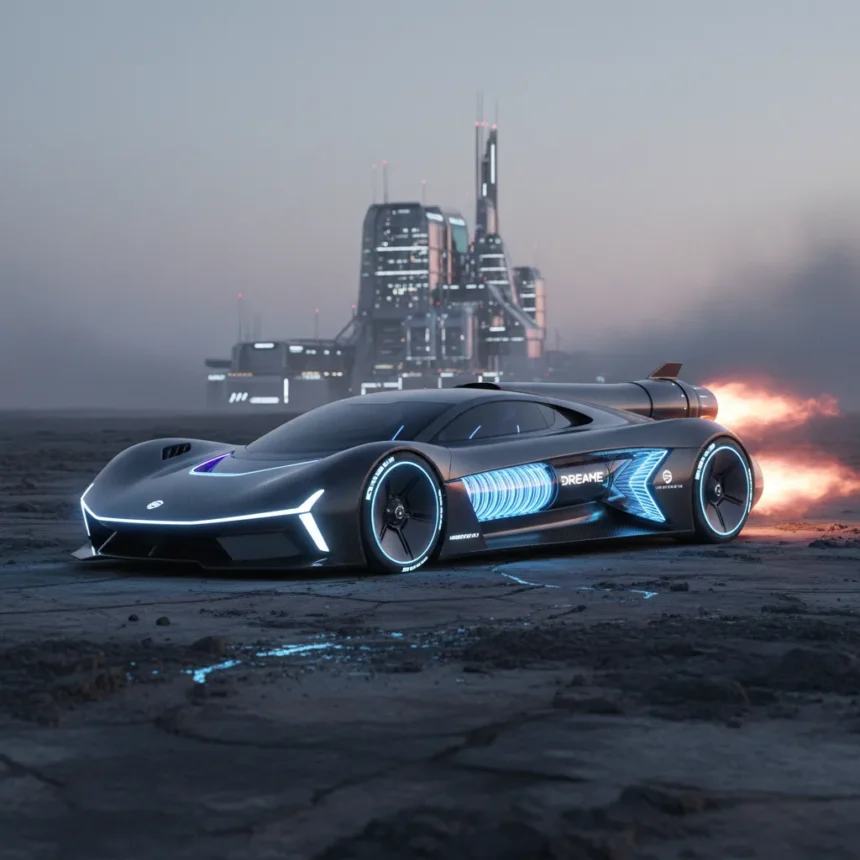
The Dreame Nebula NEXT 01 Jet Edition hypercar concept debuted on April 27, 2026, at Dreame Next in San Francisco, marking an audacious pivot from robot vacuums to rocket-powered supercars. A Chinese smart-home appliance brand known for floor cleaners just unveiled a vehicle with dual solid-fuel rocket boosters capable of accelerating from 0 to 100 km/h (0 to 62 mph) in 0.9 seconds—faster than any production car on Earth. The question nobody asked: should they?
Key Takeaways
- Dreame Nebula NEXT 01 Jet Edition achieves 0-100 km/h in 0.9 seconds using dual rocket boosters with 100 kN maximum thrust
- SkyTour Intelligent Chassis Architecture 2.0 features 14 degrees of freedom and sub-1-millisecond response time
- Solid-state sulfide battery claims over 450 Wh/kg energy density in lab tests, with pathway to 800 Wh/kg
- Limited production targeted for 2027 in China only; two-motor version priced around $114,000 equivalent
- Third-generation autonomous driving architecture supports L2++ urban navigation and L3+ fully unmanned capability
Why a Vacuum Company Built a Rocket Car
Dreame Technology roots this project in the SkyAxis Program at Tsinghua University, a research initiative spanning over a decade under founder Yu Hao. The company previously showed the Nebula 1 concept—a 1,876 hp EV supercar—at CES, signaling serious automotive ambitions beyond the living room. But the Jet Edition takes the absurdity to another level. The dual solid-fuel rocket booster system delivers 100 kN maximum thrust with a 150-millisecond response time, firing within 50 milliseconds of each other with thrust deviation under 5 percent. For context, the ThrustSSC land speed record holder—the jet-powered car that broke the sound barrier in 1997—produced 223 kN of thrust. This hypercar produces half that, concentrated vertically through two rear wheels.
The 0.9-second 0-100 km/h sprint exists because Dreame’s engineers refused to accept conventional limits. No production EV touches this acceleration. Tesla’s Roadster—still vaporware after a decade—promised similar performance without rockets. The Dreame Nebula NEXT 01 Jet Edition actually shows hardware. Whether it works at scale remains the unsolved problem.
The Chassis Does More Than Survive the Rockets
The SkyTour Intelligent Chassis Architecture 2.0 is where Dreame’s smart-home DNA meets hypercar engineering. The system features full wire control with 14 degrees of freedom—meaning no mechanical linkages between steering wheel and wheels, no hydraulic lines, just electrical signals. Electromagnetic active suspension, dry wire-controlled braking, a turning radius under 5 meters, tank-turn capability, tire-burst stabilization, and sub-1-millisecond response time create a vehicle that reacts faster than human reflexes. Energy consumption drops over 50 percent compared to conventional architectures.

This is where the vacuum company’s sensor expertise pays off. Dreame manufactures LiDAR units for its robot vacuums. The DHX1 LiDAR, developed under the Nebula Next program, debuts on this hypercar as the autonomous driving sensor. The vehicle runs third-generation VLA (Vision Language Architecture) and World Model technology, supporting L2++ autonomous driving for full-scenario urban navigation and L3+ for fully unmanned operation. In theory, you summon the car with your phone, and it navigates city streets alone while you’re elsewhere. In practice, regulators worldwide have not approved L3+ driving, and China’s roads present a different challenge than the test tracks where this concept was validated.
The Battery Problem Nobody Wants to Admit
Dreame claims a sulfide-based solid-state battery with 60 Ah capacity and single-cell energy density exceeding 450 Wh/kg in laboratory tests, with a pathway to 800 Wh/kg. Current lithium-ion cells max out around 240-300 Wh/kg. If real, this battery would reshape EV range and weight. CTP 4.0 integration removes crossbeams and longitudinal beams, freeing up interior space. The company states the battery is in mass-production preparation phase.



Solid-state batteries have promised revolution for fifteen years. Every major automaker—Toyota, BMW, Samsung—has announced solid-state programs. None have delivered production vehicles. Dreame’s lab numbers look impressive. Moving from lab to factory, then to vehicles operating in real climates, represents a leap of faith. The company offers no independent verification of energy density, cycle life, thermal stability, or cost-per-kWh. Marketing claims about eliminating accident root causes through battery safety sound reassuring and unsubstantiated.
Production Plans and Geographic Limits
Dreame targets limited production in 2027 for the Chinese market. The four-motor version carries premium pricing (exact figures unstated). The two-motor variant costs roughly $114,000 equivalent—comparable to the HiPhi Z, a Chinese EV SUV. A factory partnership with BNP Paribas outside Berlin suggests European assembly for some models, though the Nebula NEXT 01 Jet Edition remains China-only. North American availability is off the table; Canadian entry remains uncertain. This is a car built for a single market, with limited units, at a price tier reserved for collectors and enthusiasts.
Eight years elapsed from the start of Dreame’s automotive project to this concept debut. That timeline suggests serious engineering work, not just render farms and press releases. Yet eight years to a concept car, not production units, is also a cautionary tale. The company must now compress design validation, safety certification, manufacturing scale-up, and regulatory approval into a single year—an engineering feat that dwarfs the rocket boosters.
Why This Matters Beyond the Spectacle
Dreame’s Nebula NEXT 01 Jet Edition signals that Chinese tech companies are willing to bet billions on automotive moonshots. Tesla proved the playbook: build an EV that breaks conventional assumptions, generate hype, secure funding, iterate toward production. Dreame is executing that playbook with rockets. The solid-state battery research, the autonomous driving stack, the wire-controlled chassis—these are not marketing theater. They represent genuine technical ambition.



The hypercar itself will never sell in volume. But the technologies trickling down to Dreame’s mass-market EV lineup could reshape the industry. A wire-controlled chassis with sub-millisecond response times in a $40,000 sedan changes driver experience. Solid-state batteries in a $25,000 compact EV extend range and reduce charging time. The rocket boosters? Those stay on the concept car. Everything else is fair game for production.
Is the Dreame Nebula NEXT 01 Jet Edition actually coming to market?
Dreame targets limited production in China starting in 2027. The company has factory partnerships in place and claims mass-production preparation for the solid-state battery. However, no confirmed order books exist, no independent crash tests have occurred, and regulatory approval timelines remain opaque. Treat 2027 as an aspiration, not a guarantee.
How does the Dreame Nebula NEXT 01 Jet Edition compare to Tesla’s Roadster?
Tesla’s next-generation Roadster promises similar 0-60 acceleration through electric motors alone, without rocket boosters. Both vehicles remain concepts with no confirmed production dates. Dreame’s approach uses rockets; Tesla relies on battery power and motor efficiency. The Roadster targets global markets; the Nebula NEXT 01 is China-only. Neither has delivered a production vehicle.
Can a vacuum company actually build a hypercar?
Dreame has invested over a decade in automotive research through the SkyAxis Program and demonstrated hardware at a major auto show. The company manufactures LiDAR sensors, autonomous navigation software, and electrical control systems—all critical hypercar technologies. However, scaling from concept to production, managing supply chains for rocket fuel and solid-state batteries, and navigating global safety regulations are challenges that have humbled established automakers. Dreame’s smart-home expertise helps, but it is not a substitute for automotive manufacturing experience.
The Dreame Nebula NEXT 01 Jet Edition is real hardware, not vaporware. Whether it becomes a production car or remains a concept depends on whether Dreame can execute the hardest part: manufacturing at scale without cutting corners. The rockets are the easy part.
Edited by the All Things Geek team.
Source: TechRadar