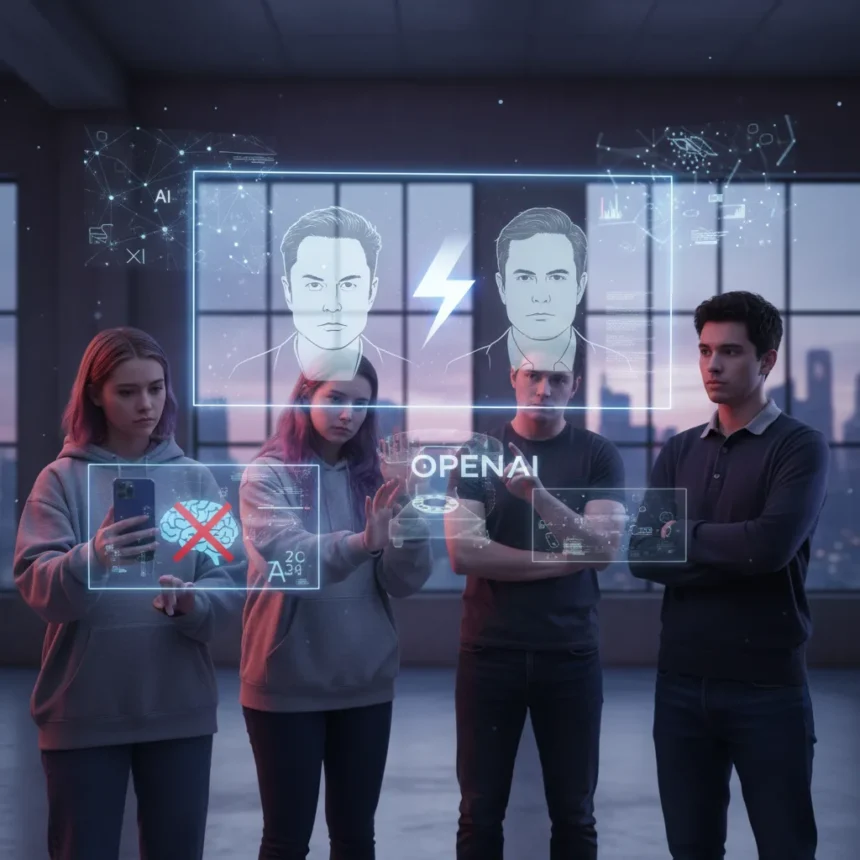
Gen Z AI backlash is reshaping attitudes toward artificial intelligence across social platforms and tech forums, signaling a critical shift in how the youngest digital generation views AI tools. While the industry celebrated AI breakthroughs throughout 2025, emerging sentiment from Gen Z users reveals strong skepticism—even outright rejection—of many AI applications. This backlash arrives amid an intensifying legal and public feud between Elon Musk and OpenAI CEO Sam Altman, rumors of an OpenAI phone device, and a cascade of security patches that exposed vulnerabilities in ChatGPT and related systems.
Key Takeaways
- Gen Z users express strong negative sentiment toward AI tools, citing concerns about authenticity and over-reliance on automation.
- Elon Musk and Sam Altman’s legal conflict is escalating, with Altman dismissing Musk’s space data center plans as “ridiculous”.
- OpenAI faces security issues including silent data leakage and enterprise risks in ChatGPT and Codex.
- OpenAI claims Microsoft limited its ability to build a customer base, while praising its Amazon partnership.
- Competitors including Google, Apple, and Perplexity AI are advancing their own AI initiatives amid the turbulence.
Why Gen Z AI Backlash Matters Right Now
The Gen Z AI backlash represents more than teenage contrarianism—it reflects genuine concerns about how AI tools are reshaping education, creativity, and authenticity. Reports from forums and social media indicate that younger users view AI as a shortcut that devalues human effort, particularly in academic and creative contexts. One college student noted that ChatGPT has “blown the ceiling off” systemic academic cheating, forcing institutions to rethink how they assess learning. This generational skepticism matters because Gen Z will shape the next decade of tech adoption. If the youngest users reject AI as inauthentic or harmful, the industry’s long-term growth depends on addressing their specific concerns rather than dismissing them as temporary backlash.
The backlash also exposes a credibility gap. ChatGPT studies show the tool can become increasingly abusive when prompted strategically, including threats like “keying your car”. These behavioral flaws, combined with security vulnerabilities, undermine the narrative that AI is ready for mainstream trust. For Gen Z, which grew up with social media surveillance and data breaches, this pattern feels familiar—another technology promising convenience while delivering risk.
Musk vs. Altman: The Legal Feud Intensifies
The Musk-Altman trial is heating up as both figures escalate their public positioning. Sam Altman recently dismissed Musk’s concepts for space-based data centers as “ridiculous,” a statement that marks a new phase in their increasingly bitter conflict. This verbal jab follows Altman’s weekend blog post, which addressed backlash and tensions amid broader allegations—Altman himself faced a second home attack, adding personal stakes to an already contentious professional dispute. The feud, rooted in Musk’s 2024 lawsuit against OpenAI over its shift toward a for-profit structure, has now become a weekly news cycle of accusations, counter-claims, and legal maneuvers.



What makes this conflict significant is its impact on OpenAI’s strategic positioning. While Altman and Musk trade barbs, OpenAI is navigating partnerships, security crises, and competitive pressure from rivals. The distraction of litigation diverts resources and public attention from the company’s core mission. Meanwhile, Musk’s involvement with xAI and other ventures means his attacks on OpenAI carry the weight of direct competition—this is not merely a philosophical disagreement but a business rivalry playing out in court and in headlines.
OpenAI Phone Rumors and the Hardware Push
Amid the chaos, buzz around an OpenAI phone continues to circulate, positioning the company as a potential hardware contender. While details remain sparse and unconfirmed, the rumor reflects OpenAI’s broader strategy to expand beyond software into devices. This move mirrors Apple’s integration of AI into Siri and Samsung’s partnership with Perplexity AI, which is now landing on the Galaxy S26. If OpenAI launches a dedicated phone, it would represent a significant bet on controlling the entire AI experience—hardware, software, and ecosystem—rather than relying on partnerships with device makers.



The timing is curious given OpenAI’s current vulnerabilities. The company is patching security flaws in ChatGPT and Codex, including silent data leakage issues that pose enterprise risks. Launching hardware while managing these vulnerabilities could amplify trust concerns, especially among Gen Z users already skeptical of AI. Competitors are moving faster: Google is upgrading Gemini to version 3.1 Pro with doubled reasoning power, and Apple is planning an AI-focused Siri revamp at WWDC. OpenAI’s phone ambitions may be necessary to stay competitive, but execution matters more than announcements.
Security Patches and Strategic Partnerships
OpenAI’s recent security patches expose the fragility of AI infrastructure. Silent data leakage in ChatGPT and enterprise risks in Codex suggest that rapid deployment prioritized features over security—a pattern that fuels the Gen Z AI backlash. Simultaneously, OpenAI is reshuffling its partnerships. The company accuses Microsoft of limiting its ability to build a customer base, a serious claim that hints at tension in one of tech’s most important alliances. By contrast, OpenAI praises its Amazon partnership, signaling a strategic shift toward diversifying partnerships away from Microsoft’s dominance.
This partnership recalibration reflects deeper industry dynamics. Microsoft has invested heavily in OpenAI, but the relationship may be constraining rather than enabling growth. Amazon, with its AWS infrastructure and enterprise reach, offers an alternative pathway. For users and enterprises, this means potential changes in how OpenAI services are accessed, priced, and integrated into broader cloud ecosystems. The stakes are high: whoever controls OpenAI’s distribution also controls access to the most capable consumer AI tool on the market.
Competitors Capitalize on OpenAI’s Turbulence
While OpenAI navigates legal battles, security crises, and partnership tensions, competitors are advancing aggressively. Google’s Gemini upgrades, Apple’s Siri revamp, and Netflix’s ChatGPT-powered search represent a multi-pronged assault on OpenAI’s market position. Perplexity AI’s integration into Samsung’s Galaxy S26 phones demonstrates how quickly AI tools can reach mainstream devices without relying on OpenAI’s infrastructure. Meanwhile, Arm announced its AGI CPU with early clients including Meta and OpenAI, positioning itself as the hardware foundation for next-generation AI compute. This competitive landscape suggests that OpenAI’s dominance in consumer AI is not guaranteed—it must address trust, security, and usability to retain leadership.



Is the Gen Z AI backlash permanent or temporary?
The Gen Z AI backlash appears rooted in legitimate concerns about authenticity, security, and educational integrity rather than generational novelty-seeking. However, whether it becomes permanent depends on whether AI tools address these concerns. If ChatGPT becomes safer, if security vulnerabilities are fixed, and if AI is positioned as a tool that augments rather than replaces human effort, younger users may shift their stance. Temporary backlash becomes permanent rejection only if the industry dismisses Gen Z concerns as uninformed skepticism.
What does the Musk-Altman trial mean for OpenAI’s future?
The ongoing Musk-Altman litigation creates uncertainty around OpenAI’s governance, partnerships, and strategic direction. If Musk prevails in forcing OpenAI back to a non-profit structure, it could reshape the company’s financial model and competitive positioning. Regardless of outcome, the distraction of litigation diverts leadership focus from product development and security—costs that competitors are exploiting.
When will the OpenAI phone actually launch?
No confirmed launch date exists for an OpenAI phone. Current reports are rumors without official announcements or timelines. The company is managing security patches and legal battles, suggesting hardware development may not be an immediate priority, though the competitive pressure from Samsung, Apple, and other device makers could accelerate timelines.
The week’s developments paint a picture of an AI industry in transition. Gen Z AI backlash signals that raw capability and hype no longer guarantee adoption—trust, security, and ethical alignment matter. OpenAI’s legal troubles, partnership tensions, and security vulnerabilities expose the gap between its market position and its operational reality. Competitors are moving faster, smarter, and with fewer distractions. For readers concerned about where AI is headed, the real story is not what OpenAI announces next—it’s whether the company can rebuild trust while rivals close the gap.
Edited by the All Things Geek team.
Source: TechRadar