




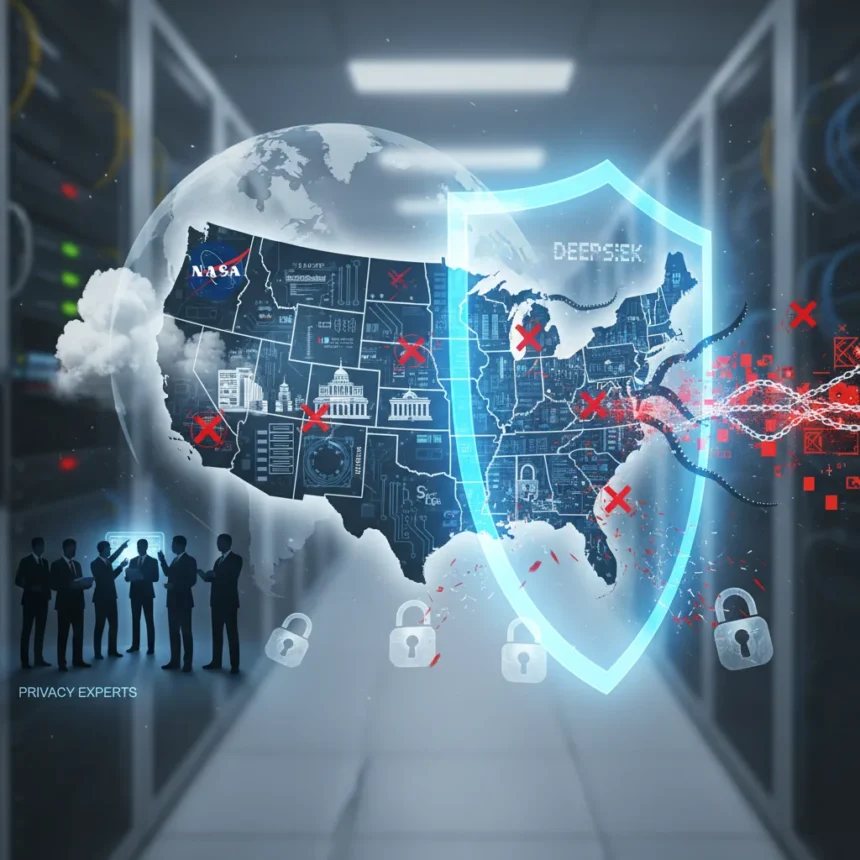
US government bans AI tools from China represent an escalating conflict between national security concerns and the rapid expansion of artificial intelligence into everyday life. DeepSeek AI, a Chinese chatbot that launched in January 2025 and quickly disrupted the US stock market, has been blocked by NASA, the US Navy, and other government agencies over what experts describe as outright dangerous privacy practices. The move signals a broader shift in how Washington views foreign AI technology—and what it means for regular users trying to decide which tools are safe to use.
Key Takeaways
- DeepSeek AI was banned by NASA, US Navy, and other US agencies after a January 2025 cyberattack exposed critical privacy flaws
- Italy became the first country to ban DeepSeek, citing data privacy and ethical concerns
- DeepSeek’s privacy policy vaguely states users “may” have rights to their data without specifying scope or deletion procedures
- Trump’s “America’s AI Action Plan” prioritizes deregulation of US AI firms while targeting foreign competitors like DeepSeek
- VPNs offer limited protection against the risks posed by tools like DeepSeek; experts recommend simply avoiding the app
Why US government bans AI tools from China are happening now
The decision to ban DeepSeek and similar tools stems from a perfect storm of technical failure and geopolitical tension. On January 27, 2025, DeepSeek suffered a large-scale cyberattack that exposed the inadequacy of its security infrastructure. What followed was the revelation that its privacy practices were fundamentally broken. The company’s privacy policy uses deliberately vague language, stating that users “may have certain rights with respect to your personal information” depending on location, and “may” have the right to delete data—without specifying what data can actually be deleted or how long the company retains it. For government agencies handling classified information and sensitive employee data, this ambiguity is unacceptable. NASA and the US Navy moved quickly to block access, recognizing that using a tool with such weak privacy safeguards could expose national security information to foreign actors.
The timing matters. DeepSeek’s rapid rise in January 2025 caught the American AI industry off guard. President Trump called the company’s success a “wake up call” for US AI competitiveness, but the security implications went beyond mere market disruption. When a foreign company’s tool gains millions of US users in weeks and then suffers a major breach, the government has little choice but to restrict its use in sensitive contexts. Italy became the first country to take similar action, banning DeepSeek entirely and citing both data privacy and ethical concerns.
The privacy problem with tools like DeepSeek
DeepSeek’s privacy failures are not accidental—they reflect a fundamental difference in how Chinese companies approach user data compared to Western standards. The vague language in its privacy policy is a red flag. When a company says users “may” have rights to their personal information, it means those rights are not guaranteed. When it refuses to specify what data can be deleted, users have no way to verify whether their conversations, location data, or contact information are actually being removed from the company’s servers. For a tool that millions of people use to ask questions and have conversations, this creates an enormous risk.
The cyberattack in January 2025 proved this was not theoretical. Once DeepSeek’s security was breached, the vague privacy policy became a liability. Attackers could access user data without clear restrictions on what the company had collected or how long it retained information. For government employees, contractors, or anyone handling sensitive information, using DeepSeek means accepting the possibility that your conversations could be intercepted, stored indefinitely, and accessed by hostile actors. VPNs offer only limited protection against these risks because they cannot hide your activity from DeepSeek itself—the company still sees everything you type. The safest approach, according to security experts, is to avoid downloading the app entirely.
How Trump’s new AI plan reshapes the landscape
While the US government bans AI tools from China, President Trump’s “America’s AI Action Plan” announced in 2026 takes a different approach to domestic AI companies. The plan scraps Biden-era regulations and prioritizes deregulation, allowing major US firms like OpenAI to operate with fewer restrictions. This creates a two-tier system: foreign AI tools face bans and scrutiny, while American companies get a green light to expand. The plan may also withhold federal AI funding from states that impose stricter AI privacy laws, effectively pressuring states to align with the federal deregulatory approach.


This policy shift reveals the true nature of the government bans. They are not primarily about protecting users—they are about protecting US market dominance. DeepSeek threatened to disrupt the US AI industry by offering a capable alternative at a lower cost. The privacy concerns are real, but they also serve a geopolitical purpose. Meanwhile, American AI companies continue to expand their reach into government agencies. OpenAI recently reached an agreement with the Department of War to deploy its models in classified networks, with the company claiming it built technical safeguards to address safety concerns. The contrast is stark: foreign tools are banned for privacy risks, while domestic tools are given access to classified military systems.
What this means for your AI tool choices
For everyday users, the implications are straightforward but unsettling. The US government bans AI tools from China limit your access to certain options, but they also reflect legitimate security concerns that you should take seriously. If you value your privacy, you should assume that using a tool like DeepSeek means accepting the risk that your data could be accessed, retained indefinitely, or sold to third parties. The vague privacy policy is not a minor inconvenience—it is a sign that the company does not prioritize protecting your information.
At the same time, you should be aware that American AI tools are not automatically safer. The difference is regulatory and geopolitical, not necessarily technical. OpenAI, Claude, and other US-based tools operate under less restrictive privacy rules than their Chinese counterparts, but they still collect your data and use it to improve their models. The government bans create the illusion of safety by removing foreign competitors, but they do not guarantee that your data is secure or private. Your best protection is to use AI tools sparingly for sensitive information and to read privacy policies carefully—even when they are written in clear language rather than vague corporate-speak.
Will other countries follow Italy’s lead?
Italy’s decision to ban DeepSeek entirely, citing data privacy and ethical concerns, suggests that other nations may follow. The European Union has historically been more protective of user privacy than the United States, and the combination of DeepSeek’s cyberattack and vague privacy policy may trigger broader restrictions across Europe. If major markets ban the tool, DeepSeek’s global expansion will stall, and the company will face pressure to improve its privacy practices or withdraw from those regions entirely.



The US government bans AI tools from China are likely to remain in place as long as the security concerns persist and the geopolitical tension between the US and China continues. However, the broader question is whether these bans actually protect users or simply protect US market dominance. The answer is probably both—but the second concern is driving policy more than the first.
Is DeepSeek safe to use if I already downloaded it?
If you have already downloaded DeepSeek, the risk depends on what information you have shared with the app. If you have only used it for general questions and have not logged in with personal information, your exposure is limited but not zero—the app still sees your IP address and usage patterns. If you have logged in or shared any personal details, you should delete the app immediately and consider changing passwords for accounts that may be linked to your DeepSeek profile. VPNs provide only partial protection because they cannot hide your activity from DeepSeek itself.
What should I use instead of DeepSeek?
US-based alternatives like ChatGPT, Claude, and other domestically developed AI tools are available without government restrictions. These tools have their own privacy concerns—they collect your conversations to improve their models—but they operate under greater regulatory oversight and do not have the same cyberattack history as DeepSeek. If privacy is your primary concern, you should review the privacy policies of any AI tool before using it, regardless of where it is based.
The US government bans AI tools from China highlight a critical moment in the global AI race. Foreign competitors are being shut out not just because of security flaws, but because they threaten American technological dominance. That does not mean the bans are wrong—DeepSeek’s privacy practices genuinely are inadequate—but it does mean you should be skeptical of claims that American tools are automatically safer. The real lesson is that no AI tool is truly private, and you should treat every chatbot as if it is collecting and storing your data indefinitely.
This article was written with AI assistance and editorially reviewed.
Source: Tom's Guide