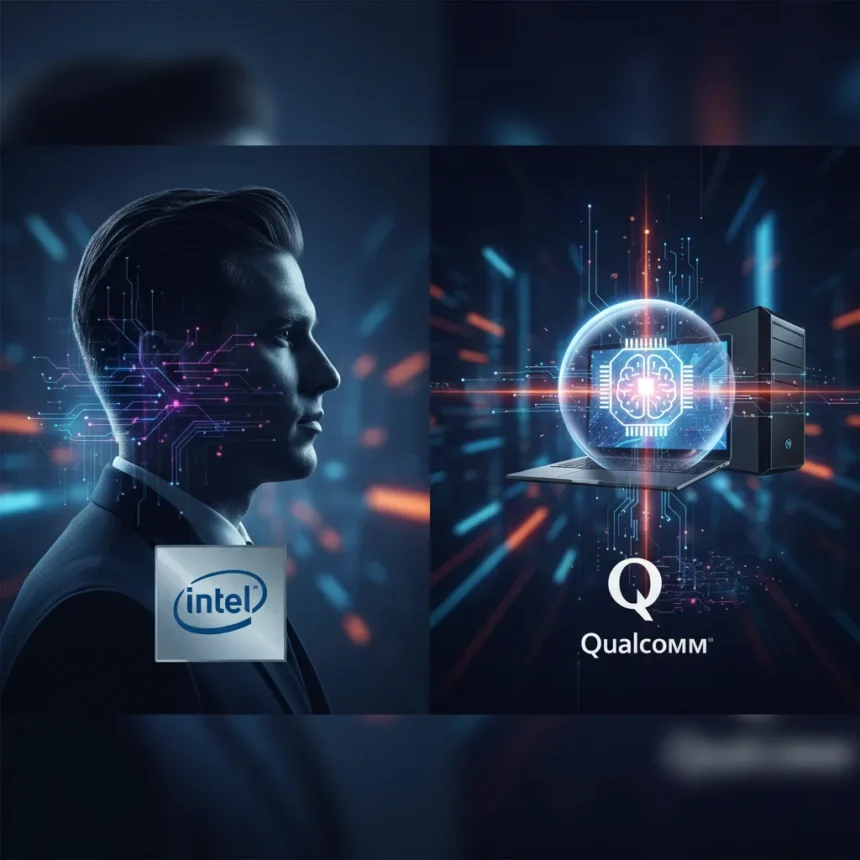
Intel’s appointment of Alex Katouzian as executive vice president and general manager of the Client Computing and Physical AI Group signals a fundamental shift in how the chipmaker plans to compete beyond traditional processors. Katouzian, who spent more than 25 years at Qualcomm Technologies most recently overseeing mobile, compute, and extended reality platforms, joins Intel on May 4, 2026, as the company doubles down on AI-driven computing at the edge.
Key Takeaways
- Alex Katouzian appointed to lead Intel’s Client Computing and Physical AI Group after 25+ years at Qualcomm
- Role focuses on aligning consumer CPUs with emerging physical AI systems including robotics and autonomous machines
- Pushkar Ranade named chief technology officer to advance quantum and neuromorphic computing strategies
- This marks Intel’s second major executive hire from Qualcomm in recent moves
- Strategic shift targets AI PCs, edge inference scaling, and next-generation physical AI devices
Why Intel Is Betting on Physical AI and Edge Computing
Intel CEO Lip-Bu Tan framed this leadership change as essential to reimagining client computing beyond the traditional PC market. The company is positioning itself at the intersection of AI PCs, edge inference, and physical AI systems—robotics, autonomous machines, and other AI-enabled devices that operate independently of cloud infrastructure. This is not merely a product refresh; it represents a strategic acknowledgment that the future of computing extends far beyond laptops and desktops.
Katouzian’s 25-year tenure at Qualcomm gives him direct experience scaling compute platforms across mobile, XR, and emerging edge devices. His appointment suggests Intel recognizes that competing in the next decade requires expertise in distributed AI workloads, not just raw processor performance. The move also reflects Intel’s urgency: the chipmaker faces intensifying competition from both Qualcomm and ARM-based solutions in mobile and edge markets.
Intel’s Second Raid on Qualcomm Leadership
This is not Katouzian’s first executive departure from Qualcomm to Intel—the company has now made a second significant hire from its rival. Such poaching signals confidence in Intel’s strategic direction but also underscores Qualcomm’s loss of senior talent. For Qualcomm, losing a 25-year veteran overseeing critical mobile and compute divisions is a notable setback, even as the company remains dominant in smartphone processors.



Comparatively, Qualcomm’s strength lies in its entrenched position in mobile SoCs and its established relationships with smartphone manufacturers. Intel’s advantage, by contrast, is manufacturing capacity and process node leadership—assets that matter less in pure mobile but critical for scaling edge AI devices that demand both performance and power efficiency. Katouzian’s hire bridges that gap by bringing mobile-first expertise into Intel’s manufacturing-first culture.
Pushkar Ranade Steps Into CTO Role Amid Tech Shifts
Alongside Katouzian’s appointment, Pushkar Ranade was named chief technology officer, transitioning from interim CTO. Ranade’s mandate includes advancing technology strategy in quantum computing and neuromorphic computing—emerging fields where Intel sees long-term competitive advantage. These appointments together suggest Intel is restructuring its leadership to address both near-term market demands (AI PCs, edge inference) and longer-term technological bets (quantum, neuromorphic systems).



The timing matters. AI infrastructure is shifting toward the edge as enterprises and consumers seek lower latency, reduced cloud dependency, and privacy-preserving inference. Intel’s traditional strength in x86 processors for data centers and PCs positions it well to capture this transition—but only if the company can convince developers and OEMs that its client computing roadmap aligns with physical AI realities.
What This Means for the PC Market and Beyond
Katouzian’s focus on aligning client computing with physical AI systems implies Intel is preparing for a future where PCs are no longer the primary client device. Robotics, autonomous vehicles, industrial AI systems, and smart edge devices will demand processors optimized for inference, real-time decision-making, and power efficiency—not just raw compute. This reframing could reshape how Intel designs and markets consumer processors over the next 3-5 years.
For PC makers and consumers, the immediate question is whether Intel’s new leadership will accelerate innovation in AI PC capabilities—features like on-device generative AI, real-time language processing, and privacy-preserving inference that don’t require cloud connectivity. Katouzian’s track record at Qualcomm suggests he understands how to scale such capabilities across hardware and software ecosystems. Whether Intel can execute at the same pace as competitors remains an open question.
Does this hire change Intel’s competitive position?
Katouzian’s appointment strengthens Intel’s bench in edge AI and physical systems strategy, but competitive position depends on execution. Hiring a veteran does not automatically translate to market share gains—Intel must deliver products that developers and OEMs actually prefer. The hire signals intent and brings relevant expertise; the market will judge whether that translates to better client computing platforms.


Why did Katouzian leave Qualcomm after 25 years?
The research brief does not disclose Katouzian’s specific reasons for the move. Executive transitions typically involve a combination of new opportunities, strategic alignment, and compensation. Intel’s focus on physical AI and edge computing may have aligned with Katouzian’s vision better than Qualcomm’s current strategic priorities, but the exact motivations remain undisclosed.
What is physical AI in the context of client computing?
Physical AI refers to AI systems deployed in physical devices—robots, autonomous machines, drones, industrial equipment—rather than cloud servers or traditional computers. In Intel’s framing, physical AI includes any edge device that runs AI inference locally, from autonomous vehicles to smart factory equipment. Client computing in this context means processors that power these edge AI devices, not just traditional PCs.
Intel’s appointment of Katouzian reflects a calculated bet that the next wave of computing growth lies in distributed, edge-deployed AI systems rather than cloud-centric architectures. Whether that bet pays off depends on whether the company can translate Katouzian’s expertise into products that developers and manufacturers actually choose. For now, the hire signals that Intel is serious about competing beyond processors and into the broader ecosystem of AI-driven edge devices.
Edited by the All Things Geek team.
Source: Tom's Hardware