


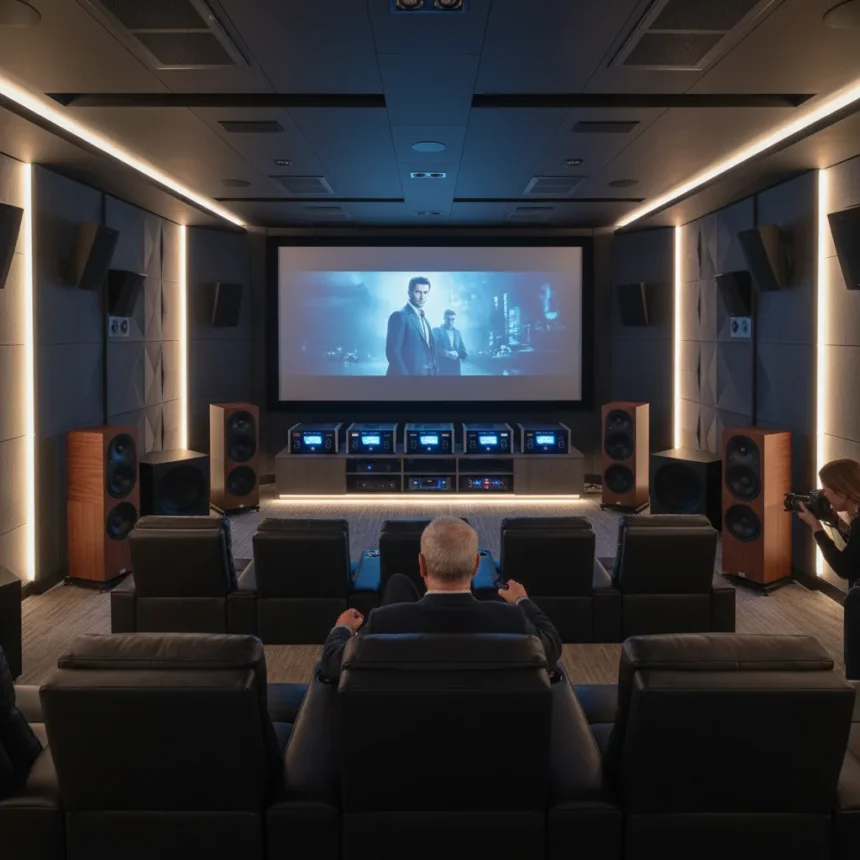
A 29-speaker home theatre system built around McIntosh amplification has achieved something rare: validation from a professional mastering engineer whose day job involves optimizing sound in industry-standard studios. The system, demonstrated at a What Hi-Fi? event, combines 24 speakers with 5 subwoofers in an Auro-3D immersive configuration that prompted the engineer to declare it the finest non-studio viewing experience he’d encountered.
Key Takeaways
- 29-speaker setup includes 9 Revel PerformaBe F328Be floorstanders, 12 Concerta2 M16 bookshelves, 3 Concerta2 C25 centers, and 5 custom dual 18-inch subwoofers
- Powered by 13 McIntosh MI1288 amplifiers delivering over 13,000W total (8 x 125W per amp into 8 ohms)
- Supports Dolby Atmos, DTS:X, and Auro-3D; controlled via McIntosh MX100 A/V processor
- Oscar-winning mastering engineer praised the system as the best home movie experience outside professional mastering studios
- Extensive room acoustics treatment with panels, bass traps, and diffusers optimizes sound isolation and clarity
Anatomy of a Studio-Reference Home Theatre System
The home theatre system represents a deliberate architectural choice: prioritize speaker count and amplifier power over compact elegance. Each of the 13 McIntosh MI1288 amplifiers handles specific zones within the immersive soundfield, distributing the burden of driving 24 speakers across a topology designed for precision rather than convenience. The front three channels—left, center, right—anchor the presentation using Revel PerformaBe F328Be floorstanders, three-way designs with beryllium tweeters and midrange drivers engineered for cinema-grade imaging accuracy. The system extends vertically and horizontally through 12 Revel Concerta2 M16 bookshelves positioned as height and width surrounds, collapsing the boundary between listener and soundfield. Five custom-built dual 18-inch subwoofers, engineered specifically for this installation, handle low-frequency reproduction down to 10Hz, a depth rarely experienced outside professional cinema environments.
The acoustic envelope matters as much as the components themselves. The demonstration room underwent extensive treatment with acoustic panels, bass traps, and diffusers designed to eliminate reflections that would muddy imaging or smear transient detail. Without this foundation, even premium speakers and amplifiers degrade into colored, room-dependent presentations. The What Hi-Fi? reviewer noted that bass response felt so controlled and deep it created a physical sensation—the sandworm from Dune materialized not as a theoretical low-frequency event but as a tactile presence threatening to breach the floor.
Why This Home Theatre System Impressed an Oscar Winner
An Oscar-winning mastering engineer attended the demonstration and, upon exiting, offered a statement that cuts to the heart of why this system matters: outside of the mastering studio itself, this was the best place he’d watched his movie. That observation carries weight because mastering studios represent the reference standard—rooms where sound engineers finalize theatrical mixes, where every decibel and frequency balance reflects intentional creative choice. For a professional whose work involves optimizing sound for cinema distribution to declare a residential installation competitive with his workspace suggests the system crosses from enthusiast territory into professional-grade territory.

The achievement stems from several overlapping factors. The Auro-3D format, still gaining adoption relative to Dolby Atmos, delivers object-based audio that renders three-dimensional soundscapes rather than channel-based approximations. The McIntosh amplification chain, with its reputation for reliability and transparency, avoids the coloration that can accumulate across multiple amplifier stages. The Revel speakers, chosen for their imaging precision in this specific configuration, maintain coherence across the 24-unit array. Collectively, these decisions prioritize fidelity over convenience, a trade-off that resonates with professionals but challenges mainstream adoption.
The Cost and Complexity Trade-Off
A fully realized home theatre system of this caliber exceeds £500,000 in total investment, including custom room construction and acoustic treatment. Individual component costs reflect professional-grade pricing: each Revel PerformaBe F328Be pair costs approximately £15,000, while each McIntosh MI1288 amplifier runs around £12,000. These figures place the system beyond the reach of casual enthusiasts, positioning it instead as a bespoke installation for collectors, filmmakers, and audio professionals willing to prioritize sonic accuracy over budget constraints.


The complexity extends beyond cost. A 29-speaker system demands meticulous calibration, careful speaker placement, and acoustic measurement to avoid phase cancellation and frequency response anomalies. The McIntosh MX100 A/V processor handles this coordination, but the installation itself requires expertise. This is not a plug-and-play proposition—it is a custom integration project that demands collaboration between acousticians, installers, and the end user.
How This System Compares to Typical High-End Home Theatres
Most high-end home theatre installations use 7 to 11 speakers: front left, center, right, side surrounds, rear surrounds, and perhaps heights. This home theatre system doubles the speaker count and quadruples the amplifier investment. The distinction matters because immersive audio formats like Auro-3D and DTS:X exploit object-based rendering—they place sounds in three-dimensional space rather than assigning them to discrete channels. A 29-speaker array captures this dimensionality more completely than a conventional 7.1 or 9.1 layout. The trade-off is installation complexity and cost that make sense only for those pursuing professional-grade results rather than consumer-friendly convenience.
What Format Does This System Support?
The home theatre system supports three immersive audio standards: Dolby Atmos, DTS:X, and Auro-3D. Atmos, developed by Dolby, has achieved the widest adoption in theatrical and streaming contexts. DTS:X, its competitor, offers similar object-based capabilities. Auro-3D, the format that shaped this particular installation, emphasizes height channels and precise vertical localization—sounds can move convincingly above the listener’s head. The McIntosh MX100 A/V processor decodes all three, allowing the system to handle content from theatrical releases, streaming services like Apple TV+ and Amazon Prime Video, and specialized Auro-3D demonstrations.
Is a 29-speaker home theatre system practical for typical homes?
No. A 29-speaker system requires dedicated space, professional installation, extensive acoustic treatment, and over £500,000 in investment. Typical homes lack the physical footprint, electrical infrastructure, and acoustic isolation needed. This system exists for filmmakers, audio professionals, and collectors pursuing reference-grade fidelity—a narrow but passionate audience.



What makes McIntosh amplifiers suitable for this installation?
McIntosh amplifiers are valued for transparency and reliability across extended listening sessions. The MI1288 units, each delivering 8 x 125W into 8 ohms, offer sufficient headroom to drive Revel speakers without compression or distortion. The distributed amplification approach—13 amps handling different zones—avoids the thermal stress and crosstalk that can accumulate in single, high-power amplifiers managing complex speaker arrays.
Can you build a similarly immersive system with fewer speakers?
Yes, though with compromises. A 7.1 or 9.1 configuration with high-quality components can deliver excellent immersive audio, particularly with height channels. However, the 29-speaker array’s advantage lies in precise object localization and seamless panning across the listening space. Fewer speakers mean larger gaps in the soundfield coverage, reducing the convincingness of three-dimensional effects. For professional applications, the expanded speaker count justifies the added complexity.
The 29-speaker home theatre system represents an inflection point in consumer audio: the moment when residential installations can credibly claim parity with professional mastering environments. That claim, validated by an Oscar-winning engineer, matters not because it will inspire mass adoption—the cost and complexity preclude that—but because it demonstrates what becomes possible when budget constraints disappear and fidelity becomes the only metric that matters. For a narrow audience of serious enthusiasts and professionals, that achievement redefines what home theatre can be.
Edited by the All Things Geek team.
Source: What Hi-Fi?