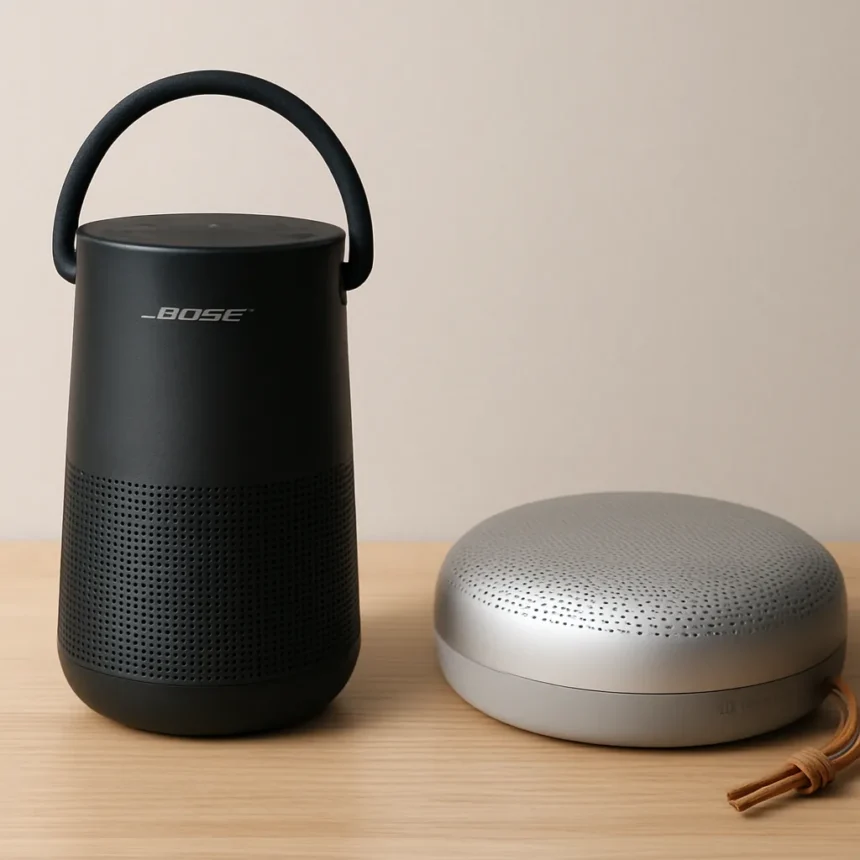
The Bose SoundLink Plus vs Beosound A1 3rd Gen is the premium portable speaker showdown that matters most in 2025. Both sit in a similar price bracket, both target listeners who refuse to compromise on sound quality, and both have been tested extensively — across more than 40 Bluetooth speakers — to determine which one actually earns a place in your bag. The answer is less obvious than the brand names suggest.
What Makes the Bang & Olufsen Beosound A1 3rd Gen Different
The Beosound A1 3rd Gen is a compact Bluetooth speaker from Bang & Olufsen, updated in 2025 with a significantly upgraded internal architecture. It runs two 30W Class D amplifiers powering an 82.5mm woofer — the largest in its class — alongside a 15mm tweeter, and supports SBC, AAC, and aptX Adaptive codecs over Bluetooth 5.1. That woofer size is not a marketing footnote. It translates directly into deeper bass extension and a room-filling quality that smaller drivers simply cannot replicate at this form factor.
Battery life is where the 3rd Gen makes its clearest generational leap. At conservative volumes, it delivers 24 hours of playback — up from 18 hours in the 2nd Gen — and testing by Rtings recorded 24.3 hours in practice. The circular design is deliberate: it disperses sound evenly regardless of orientation, which matters when you are placing a speaker on a table surrounded by people rather than pointing it at a wall. IP67 waterproofing and a replaceable battery round out a build that is genuinely premium rather than just expensively branded.
Bose SoundLink Plus vs Beosound A1: Sound Quality Compared
This is where the Bose SoundLink Plus vs Beosound A1 comparison gets genuinely interesting. The B&O A1 3rd Gen delivers clearer vocals, a wider soundstage, better instrument separation, and more spacious mids than comparable Bose models. If you listen to acoustic music, jazz, or anything with layered instrumentation, the B&O’s presentation feels more open and precise. The Bose approach — heard across the SoundLink range including the Revolve+ II and Flex — tends toward a balanced, crowd-pleasing tuning that works well for pop and podcasts but can feel less controlled in the low end.



The SoundLink Plus is a physically larger speaker, with a volume of 1,997.64 cm³ compared to the B&O’s 813.69 cm³. More cabinet volume generally helps with bass presence, but size alone does not determine sound quality. The B&O compensates with its larger woofer and dual-amp configuration, achieving deeper bass from a smaller enclosure. For pure sonic performance in this category, the B&O A1 3rd Gen holds a measurable advantage — Rtings rates it at 7.1 versus 5.3 for the Bose SoundLink Flex 2nd Gen on their speaker scoring scale.
Battery Life, Range, and Everyday Practicality
Battery endurance is a decisive factor for portable speakers, and the Beosound A1 3rd Gen wins this category outright. Its 24-plus hours of tested battery life dwarfs the Bose SoundLink Flex 2nd Gen’s 6.6 hours in equivalent testing, and it comfortably outlasts the SoundLink Plus’s 20-hour rating. The B&O also achieves a Bluetooth range of 334.6 feet (approximately 102 metres), which is exceptional for a speaker this size.


For calls, the Beosound A1 3rd Gen includes a three-microphone array with FarField technology, designed to capture your voice clearly even at a distance. The Bose SoundLink Plus supports phone-based Siri and Google Assistant integration. Both are functional for voice use, but the B&O’s dedicated microphone hardware gives it an edge in call quality. The B&O app also offers Beosonic EQ presets for sound customisation, while Bose leans on voice assistant passthrough rather than deep in-app tuning.
How Does the Beosound A1 3rd Gen Compare to JBL and Other Rivals?
The premium portable speaker market is crowded. The JBL Charge 6 offers 24 to 28 hours of battery life at a lower price point, and the Dali Katch G2 stretches to 30 hours. If battery life is your only criterion, both are worth considering. But neither matches the Beosound A1 3rd Gen’s combination of aptX Adaptive codec support, dual-amp hardware, and Scandinavian build quality. The JBL Flip 7 sits at 12 hours and targets a more casual listener. The B&O is explicitly aimed at people who want audiophile-grade performance in a portable form — and it delivers on that promise more convincingly than anything else at its size.
Is the Bang & Olufsen Beosound A1 3rd Gen worth the premium price?
Yes, for the right listener. The 3rd Gen’s upgrades over the 2nd Gen — larger woofer, higher-power amplification, extended battery, aptX Adaptive support — are substantive rather than cosmetic. If you are upgrading from the 2nd Gen or choosing between B&O and Bose for the first time, the 3rd Gen justifies its premium positioning. If you primarily listen at high volumes outdoors and care less about soundstage nuance, a Bose model’s balanced tuning may suit you better.
Does the Bose SoundLink Plus have better bass than the Beosound A1?
Not in practice. The Bose SoundLink Plus is a larger physical enclosure, which can help with low-frequency output, but the Beosound A1 3rd Gen uses the largest woofer in its class — 82.5mm — driven by a dedicated 30W Class D amplifier. The B&O produces deeper, more controlled bass despite its smaller cabinet. Bose models in this range tend toward a balanced profile that can sound less precise in the low end by comparison.



Which Bluetooth speaker should I buy in 2025 for audiophile sound?
If sound quality and battery endurance are your priorities, the Bang & Olufsen Beosound A1 3rd Gen is the stronger choice. Its hardware specifications, codec support, and tested performance place it ahead of the Bose SoundLink Plus for discerning listeners. The Bose remains a solid, reliable option for those who prefer a more forgiving tuning and a larger physical form factor. But if you are spending premium money and want the speaker that sounds closest to a proper hi-fi system in your pocket, the B&O is the one worth buying.
The Bose SoundLink Plus vs Beosound A1 3rd Gen debate ultimately comes down to priorities: Bose offers familiarity and a proven balanced sound, while Bang & Olufsen delivers a more technically accomplished speaker with better battery life, a wider soundstage, and hardware built for serious listening. For most audiophile-minded buyers, the B&O A1 3rd Gen is the harder choice to argue against.
Where to Buy
$239.99 at Amazon | Check Amazon
This article was written with AI assistance and editorially reviewed.
Source: TechRadar