



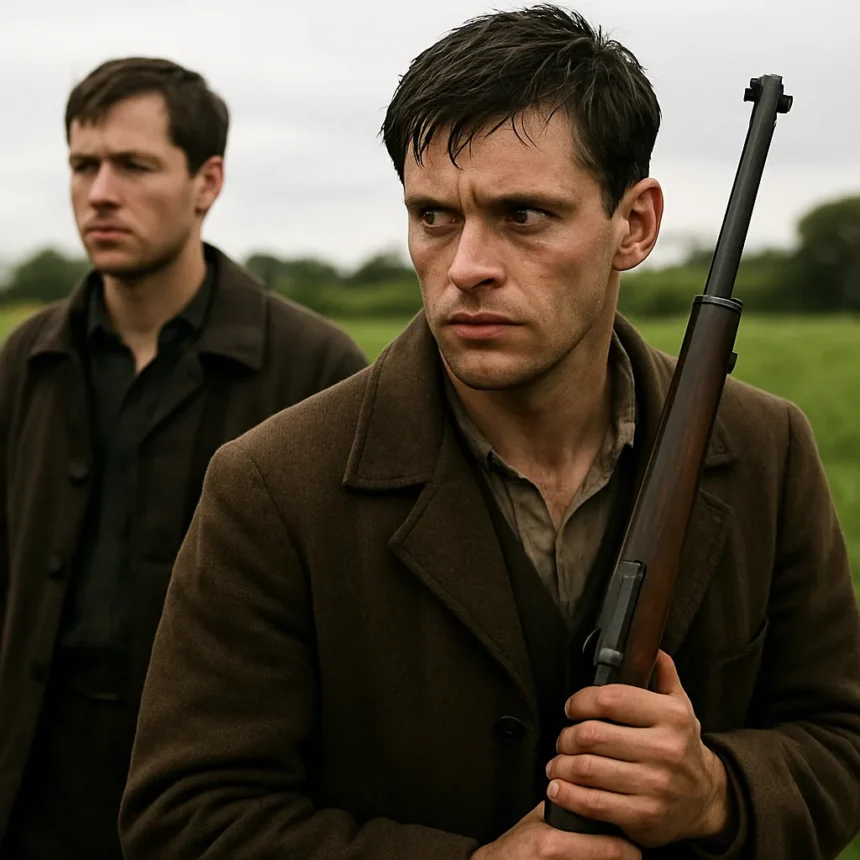
The Wind That Shakes the Barley is a 2006 Irish war drama directed by Ken Loach that follows two brothers divided by the Irish War of Independence and Civil War, starring Cillian Murphy as IRA member Damien O’Donovan. As the film approaches its 20th anniversary in 2026, it deserves renewed attention this St. Patrick’s Day—not as sentimental nostalgia, but as one of cinema’s most unflinching examinations of how revolutionary ideals shatter under the weight of compromise and betrayal.
Key Takeaways
- The Wind That Shakes the Barley won the Palme d’Or at Cannes and explores the Irish War of Independence and Civil War through two brothers.
- Cillian Murphy stars as Damien O’Donovan, a young doctor who abandons his medical career to join the IRA after witnessing British brutality.
- The film’s central conflict pits anti-Treaty IRA members against the pro-Treaty Irish Free State, splitting Damien and his brother Teddy.
- Ken Loach preserves working-class Irish accents and rejects glossy Hollywood treatments of Irish history.
- The film ends with Damien executed by his own brother’s forces, refusing to compromise his principles.
Why The Wind That Shakes the Barley Still Matters
Two decades after its release, The Wind That Shakes the Barley remains the rare historical drama that refuses easy answers. The film opens in County Cork in 1920, where Damien prepares to leave for a London hospital position. That plan collapses when British Black and Tans murder a young man for refusing to answer to an English name and beat a train driver who refuses to transport them. Damien’s transformation from doctor to soldier is not heroic—it is desperate, almost accidental, born from witnessing state violence that demands response.
What separates The Wind That Shakes the Barley from conventional war cinema is its refusal to mythologize armed struggle. The IRA column raids Royal Irish Constabulary barracks for weapons and assassinates Auxiliaries, but the film dwells equally on the cost of betrayal. When IRA member Chris Reilly informs on his comrades under coercion from a landowner, both the informant and his coercer are executed—a moment Damien himself carries out despite their friendship. This is not revenge fantasy. It is the grinding machinery of revolutionary justice, morally necessary and spiritually corrosive.
The film’s most devastating sequence involves Sinéad Sullivan, Damien’s sweetheart and a member of Cumann na mBan, the women’s IRA organization. After an ambush, Auxiliaries retaliate by looting and burning her farmhouse, shearing her head and wounding her scalp in a display of sexual violence that the film refuses to soften or contextualize. This brutality is not incidental to the plot—it is the engine driving the cycle of retaliation and counter-retaliation that consumes the entire nation.

The Civil War Fracture That Destroys Everything
The true tragedy of The Wind That Shakes the Barley emerges when the War of Independence ends and the Anglo-Irish Treaty arrives. Teddy, Damien’s brother, accepts Michael Collins’ compromise—the Irish Free State that preserves British sovereignty over Northern Ireland. Damien, influenced by socialist ideology and James Connolly’s vision of a unified socialist republic, rejects the treaty as a betrayal. The brothers, who fought side by side against British occupation, now face each other as enemies.
This is where the film transcends historical drama and becomes something closer to tragedy. Damien is captured during a raid on a barracks—a raid led by his brother’s Free State forces. Imprisoned, Teddy pleads with him to reveal the location of hidden anti-Treaty rifles, promising to spare his life if he complies. Damien refuses. He will not trade his principles for survival. Teddy, bound by duty to his new government, orders his brother’s execution. The film ends not with victory or defeat, but with the erasure of everything the brothers fought for—consumed by the machinery they helped create.



How The Wind That Shakes the Barley Differs From Hollywood Convention
Director Ken Loach won the Palme d’Or at Cannes for this film, and that recognition reflects its artistic refusal to compromise. Hollywood treatments of Irish history typically soften the edges, offering catharsis or redemption. Loach offers neither. He preserves working-class Irish accents instead of adopting neutral broadcast English. He shoots in natural light and uses non-professional actors alongside established performers, creating an immediacy that feels documentary rather than theatrical.
The film’s unblinking depiction of British occupation—the Black and Tans, the Auxiliaries, the systematic torture—drew criticism from English political conservatives who argued the film exaggerated British brutality. This criticism itself is revealing. The violence Loach depicts is historically documented. What conservatives objected to was not inaccuracy but visibility. The Wind That Shakes the Barley refuses to let viewers distance themselves from imperial violence by framing it as regrettable but necessary.
Why You Should Watch This St. Patrick’s Day
St. Patrick’s Day in popular culture has become a carnival of green beer and plastic leprechauns, severed entirely from Irish history. The Wind That Shakes the Barley offers an antidote—not a celebration of Irish identity, but an excavation of the cost of independence. It asks uncomfortable questions: What is the difference between revolutionary justice and revenge? At what point does compromise become betrayal? Can ideals survive contact with power?
These are not abstract questions. They resonate in every conflict where competing visions of justice collide. Damien’s refusal to trade his principles for survival, even when facing execution by his own brother, is not presented as noble—it is presented as the logical endpoint of an impossible situation. There is no triumph here, only the recognition that some choices, once made, cannot be unmade.


Is The Wind That Shakes the Barley historically accurate?
The film dramatizes real events from the Irish War of Independence and Civil War, and while some sequences are compressed or reimagined for narrative purposes, the core historical framework is sound. The brutality of British occupation, the IRA’s armed resistance, the Civil War split over the Treaty, and the executions of anti-Treaty fighters all occurred. What distinguishes Loach’s approach is his focus on individual cost rather than grand historical sweep.
Can I watch The Wind That Shakes the Barley on streaming?
The research brief does not specify current streaming availability or rental options for the film. Check your local streaming services or rental platforms for current availability.
Why did Damien refuse to reveal the rifles’ location?
Damien’s refusal stems from his commitment to the anti-Treaty IRA cause and his belief that revealing the location would betray the movement’s principles. His brother Teddy, now commanding Free State forces, offers him life in exchange for the information, but Damien chooses principle over survival—a choice that leads to his execution.
Twenty years after its release, The Wind That Shakes the Barley remains uncompromising in its vision and devastating in its conclusion. This St. Patrick’s Day, skip the festivities and watch a film that honors Irish history by refusing to sentimentalize it. Loach’s masterpiece demands your attention precisely because it offers no comfort, no easy answers, and no redemption—only the hard clarity of what independence actually costs.
Where to Buy
This article was written with AI assistance and editorially reviewed.
Source: Tom's Guide