





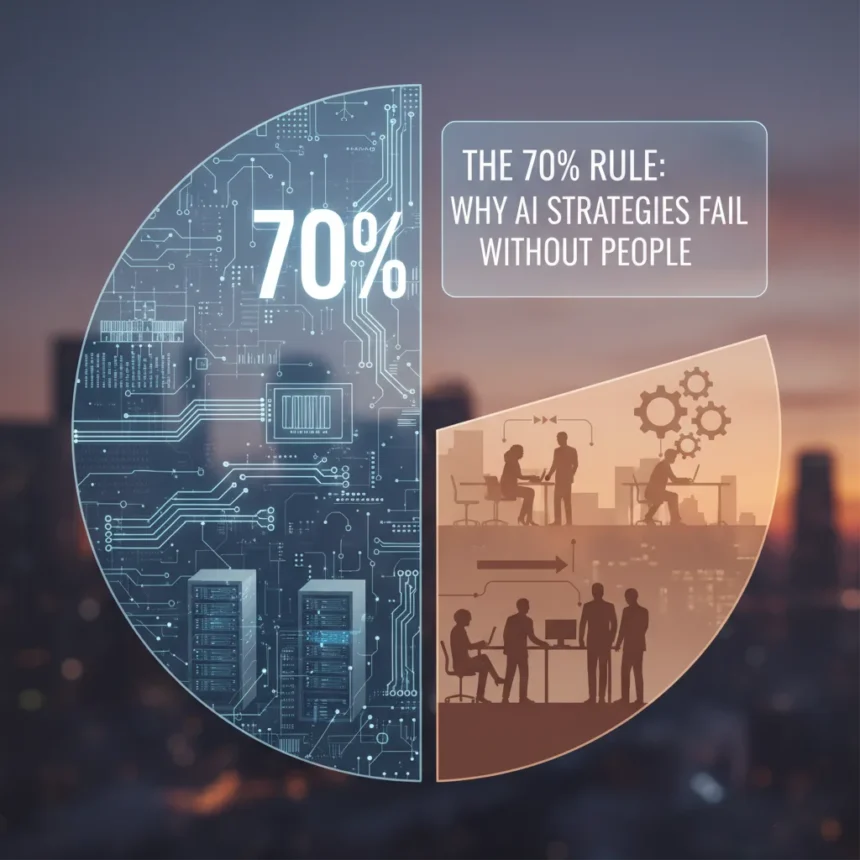
The 70% rule AI strategy exposes a fundamental misalignment in how enterprises approach artificial intelligence. According to BCG research, successful AI adoption requires roughly 70% effort on people and processes, 20% on technology and data, and just 10% on algorithms and models. Yet most organizations invert this entirely, pouring 80% of budgets into platforms and tools while starving the human side of transformation. The result: AI projects stall, employees reject new tools, and boards wonder why their multimillion-dollar investments yield nothing.
Key Takeaways
- The 70% rule AI strategy allocates 70% of effort to people and processes, not technology infrastructure.
- MIT Sloan research confirms 70% of AI’s value depends on complementary human and organizational investments.
- Organizations that prioritize people see 2.3 times more engaged employees and 1.5 times higher performance.
- CHRO-CIO partnerships yield 15 times more productivity in AI initiatives than siloed approaches.
- Common failure: companies spend 80% on platforms, triggering rejection, workarounds, and stalled adoption.
Why Technology Alone Cannot Drive AI Adoption
The commoditization of AI models has fundamentally changed the game. Mid-market companies now access the same frontier models from OpenAI, Anthropic, and Google that enterprises use. The technology is no longer the differentiator—organizational change is. A company with Claude or GPT-4 but no strategy for integrating AI into workflows will see adoption rates collapse. Employees will ignore the tool, return to manual processes, or create workarounds that bypass AI outputs entirely, like typing data into Excel after an AI system has already processed it.
This is not a technology problem. It is a people problem. BCG’s research is unambiguous: AI agents fundamentally change how work gets done and by whom. The lion’s share of leadership effort must go into redesigning roles, managing change, and training the workforce to provide the right oversight and guidance to AI agents. Without this foundation, the best model in the world sits unused.
The 70% Rule AI Strategy in Practice: A Budget Breakdown
For a mid-market company with a $2 million AI transformation budget, the 70% rule AI strategy translates into roughly $1.4 million allocated to people and processes. This is not training courses alone. Manager enablement includes coaching teams on AI tools, shifting performance evaluation criteria to account for AI-assisted work, supporting managers through identity changes as their roles evolve, and creating communities where teams share learning. Communication infrastructure means regular all-hands updates on progress, transparent channels for employees to flag issues, and genuine feedback loops on what is working and what is not.



The remaining $600,000 covers technology infrastructure and models. This is not negligible—data systems and platforms matter. But they serve the people strategy, not the reverse. Technology without organizational readiness is overhead. People equipped with the right tools, clear role definitions, and ongoing support create exponential returns.
The Engagement and Productivity Multiplier
Companies that adopt a human-centric approach to the 70% rule AI strategy see measurable returns. Organizations with human-centric AI approaches report 2.3 times more engaged employees and 1.5 times higher performance. The most powerful pairing: when a Chief Human Resources Officer partners with a Chief Information Officer from day one, AI initiatives yield 15 times more productivity than when these functions operate in silos.



This is not because HR executives suddenly understand algorithms. It is because they understand the psychological, organizational, and cultural dimensions of change. They know how to identify daily users, assess comfort levels with AI, ensure ongoing training, and create space for experimentation. They know that technology without trust fails. HR and IT working together from the start embed change management into the transformation rather than bolting it on as an afterthought.
Where Organizations Fail Without the 70% Rule
The predictable failure pattern repeats across enterprises. Rejection happens first: employees avoid tools due to busyness, confusion, or skepticism. Then come workarounds—manual processes that bypass AI entirely, creating the illusion of adoption while gutting the value. Finally, the transformation stalls. Leadership concludes AI is overhyped. The real issue was never the technology.
A common mistake in mid-market companies is starting with HR chatbots—a safe, contained use case that feels like progress. But BCG research finds 70% of AI value lives in core business functions like R&D, innovation, and marketing, not in HR automation. Focusing first on HR chatbots is technically easy but strategically misguided. It trains the organization to see AI as a tool for cost-cutting in support functions rather than as a lever for competitive advantage in revenue-generating work.
The Workflow Redesign Imperative
The 70% rule AI strategy requires more than change management—it demands workflow redesign. AI integration is not additive. It does not sit on top of existing processes. Successful adoption means automating information gathering, pattern recognition, and routine decision-making so AI becomes embedded in how work flows. A sales team does not use AI to generate proposals and then manually review each one in the old system. Instead, the entire proposal workflow redesigns around AI’s strengths, with humans handling judgment calls and relationship nuance.



This redesign is the 70% work. It is harder than buying software. It requires mapping every role affected, understanding resistance points, building new skill sets, and reinforcing where human expertise remains irreplaceable. It is also where the real value lives.
What Does the 70% Rule AI Strategy Mean for 2026?
AI prominence at board level has not translated into operational impact, largely because people and process investments remain underfunded. The corrective shift in 2026 is toward slower, more human-led transformations and stronger HR-CIO partnerships from day one. Organizations will stop chasing the latest model and start asking whether their people are ready to use the models they already have.
As one practitioner put it: The technology will be there when you are ready for it. Your people will not wait forever. That captures the urgency. Talent attrition, skill gaps, and organizational inertia do not pause while enterprises debate infrastructure. The 70% rule AI strategy is not a budget formula—it is a recognition that transformation is fundamentally about people.
How should a company start implementing the 70% rule?
Start with a people readiness assessment: identify who will be daily users, gauge comfort levels with AI, and honestly assess training and experimentation time available. Then pair HR and IT leadership to co-design the transformation roadmap. Allocate budget proportionally—70% to roles, processes, and change; 20% to infrastructure; 10% to models. Communicate relentlessly and transparently about tool decisions and progress.
Can the 70% rule apply to small companies or startups?
The principle applies universally, though execution scales differently. A startup with 50 people might spend less absolute dollars on people and processes but allocate the same percentage of resources. The core insight—that organizational readiness matters more than technology sophistication—holds regardless of company size.
What happens if a company ignores the 70% rule?
Organizations that invert the 70% rule and spend 80% on platforms and tools typically see employee rejection, workarounds that bypass AI, and stalled adoption. The technology sits unused while leadership blames the tool rather than the implementation strategy. Budget wasted, transformation delayed, competitive advantage lost.
The 70% rule AI strategy is not a constraint—it is a liberation. It shifts focus from technology procurement to organizational capability, from tool selection to human readiness, from board-level announcements to ground-level adoption. Companies that embrace this shift will pull ahead in 2026. Those that do not will watch their AI investments become expensive monuments to misplaced priorities.
Edited by the All Things Geek team.
Source: TechRadar




