





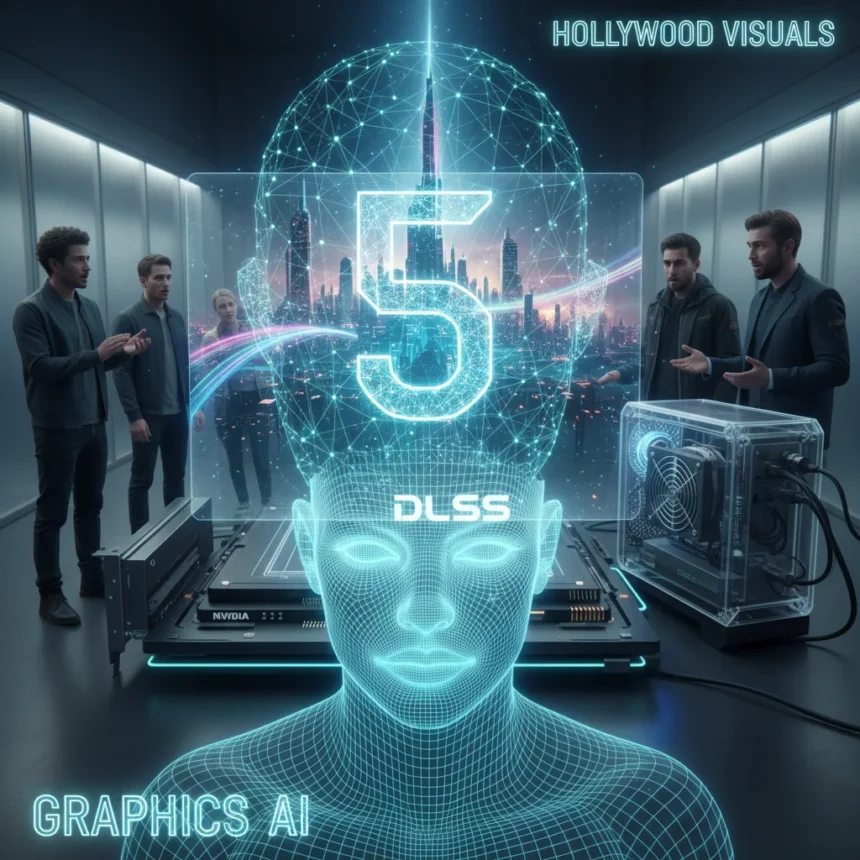
Nvidia DLSS 5 is a real-time neural rendering system announced at GTC 2026 on March 16, designed to infuse game pixels with photorealistic lighting, materials, and scene understanding. The technology processes color and motion data from each frame and outputs enhanced visuals at up to 4K resolution, targeting a Fall 2026 launch for GeForce RTX GPUs. Jensen Huang, Nvidia’s founder and CEO, called it “the GPT moment for graphics”—a comparison that captures both the ambition and the skepticism the announcement has already triggered in the development community.
Key Takeaways
- Nvidia DLSS 5 uses generative AI to enhance pixels with photorealistic lighting and material properties in real time.
- The technology launches Fall 2026 and works with existing GeForce RTX hardware.
- Major studios including Bethesda, Capcom, and Ubisoft have committed to supporting Nvidia DLSS 5 in upcoming titles.
- Demos required dual RTX 5090 GPUs, raising questions about consumer viability.
- Developer reactions range from enthusiasm about creative control to concern over compute requirements and visual artifacts.
What Nvidia DLSS 5 Actually Does
Nvidia DLSS 5 operates differently from traditional upscaling. Instead of stretching lower-resolution images, it uses a trained neural model to generate missing pixels with physically plausible lighting and material responses. The system understands scene semantics—whether a surface is skin, fabric, hair, or translucent material—and renders subsurface scattering, light interaction, and environmental lighting (front-lit, back-lit, overcast) accordingly. This is a departure from Nvidia’s earlier DLSS 4.5, which drew 23 out of 24 pixels via AI but operated within narrower constraints.
The technical pipeline is lean: the game supplies color and motion vectors per frame; Nvidia DLSS 5 outputs enhanced frames trained end-to-end on single frames. The result, in theory, is consistent frame-to-frame visuals that rival offline rendering without the performance penalty. Nvidia positioned this as the most significant graphics breakthrough since real-time ray tracing arrived in 2018.
Why Developers Were Caught Off Guard
The surprise was not that Nvidia announced a new DLSS version—it was the leap in ambition. Developers expected incremental refinements to frame generation and upscaling. Instead, Nvidia unveiled a generative AI system that claims to replace hand-crafted rendering pipelines. Todd Howard, studio head at Bethesda Game Studios, acknowledged the shift: “With DLSS 5 the artistic style and detail shine through without being held back by the traditional limits of real-time rendering”. That statement reveals both the promise and the tension. Generative AI in games has faced resistance from artists and technical directors who feared losing control over visual outcomes. Nvidia DLSS 5 attempts to solve that by training the model end-to-end on single frames, preserving artist intent while automating pixel generation.


Yet the demos themselves complicated the narrative. Nvidia showcased Nvidia DLSS 5 on path-traced renderings of Resident Evil Requiem and Oblivion Remastered, each powered by a pair of RTX 5090 GPUs—one for rendering, one for the Nvidia DLSS 5 component. That hardware pairing is not a consumer option. Early viewer reactions noted visual artifacts: faces appeared uncanny, and some results looked what commenters called “gross” in their smoothness. The gap between the demo’s promise and its visual execution has already seeded doubt.
The Studio Support and Fall 2026 Launch
Nvidia has secured commitments from major publishers: Ubisoft, Bethesda, Capcom, Tencent, and Warner Bros. Games. Bethesda plans to integrate Nvidia DLSS 5 into Starfield and future titles. Capcom’s Jun Takeuchi framed the technology as a tool for cinematic immersion: “DLSS 5 represents another important step in pushing visual fidelity forward, helping players become even more immersed in the world of Resident Evil”. EA SPORTS FC, Death Stranding 2, and Crimson Desert are also in the pipeline. The breadth of support suggests confidence—or at least a willingness to experiment. Fall 2026 gives studios six months to integrate and optimize the technology, though what “optimize” means for a generative AI system remains unclear.



Nvidia DLSS 5 integrates with Nvidia Reflex for latency reduction and allows users to override settings via the Nvidia app, giving players some agency over the enhancement intensity. This modularity may help studios tune visual results on a per-game basis, though it also raises the question: if artists need to override and tweak the AI output, how much of the “hand-crafted rendering” control is actually preserved?
The Real Obstacle: Hardware Demands and Visual Quality
The demos required dual RTX 5090 GPUs to achieve real-time results on path-traced scenes. Most consumer systems run a single GPU. This creates an immediate credibility gap: Nvidia is positioning Nvidia DLSS 5 as a breakthrough for GeForce RTX hardware, yet the showcased implementation demanded the highest-end hardware available, used twice over. The question becomes whether Nvidia DLSS 5 will scale down to mainstream RTX cards—RTX 4070, RTX 4080, RTX 5070—without sacrificing the visual improvements that justify the technology’s existence.
Visual artifacts add another layer of concern. Generative AI systems sometimes produce uncanny or inconsistent results, especially with human faces and fine details. The “ozempic face” criticism that emerged from early demos reflects a real risk: AI-enhanced skin can look plasticated and smooth in ways that break immersion rather than deepen it. Whether this is a training data issue, a resolution artifact, or an inherent limitation of real-time neural rendering remains unanswered.
How Nvidia DLSS 5 Compares to Offline AI Rendering
Offline video AI models—tools used in post-production and VFX—can produce photorealistic results because they process entire sequences with unlimited compute time. Nvidia DLSS 5 operates under real-time constraints, processing single frames in milliseconds. This is a fundamental architectural difference. The trade-off is speed for flexibility: Nvidia DLSS 5 can enhance gameplay without cinematic latency, but it cannot achieve the visual polish of offline rendering without significant hardware. For games targeting 60 or 120 frames per second, that constraint is non-negotiable.



Will Nvidia DLSS 5 Change Attitudes Toward AI in Games?
The gaming industry has been wary of generative AI, fearing job displacement and loss of artistic control. Nvidia DLSS 5 attempts to reframe AI as a tool that augments rather than replaces artists. If the technology delivers on that promise—if it genuinely preserves creative intent while automating tedious rendering work—it could shift perception. If it produces uncanny visuals or demands excessive hardware, skepticism will deepen. The Fall 2026 launch window is tight enough that early consumer reactions will matter enormously. A successful launch with visible improvements in shipping games could make Nvidia DLSS 5 the inflection point for AI acceptance in gaming. A stumble—visual artifacts, performance issues, or hardware barriers—will reinforce the narrative that AI graphics are still a research project, not a production tool.
FAQ
When does Nvidia DLSS 5 launch?
Nvidia DLSS 5 targets Fall 2026, with a March 2026 announcement at GTC. The technology will be available for GeForce RTX GPUs, though the specific hardware requirements for consumer systems have not been detailed.
What GPUs support Nvidia DLSS 5?
Nvidia DLSS 5 is compatible with GeForce RTX GPUs. The demos used RTX 5090 hardware, but Nvidia has not specified minimum or recommended GPU tiers for consumer adoption.
Does Nvidia DLSS 5 cost extra?
Nvidia DLSS 5 is a free technology for RTX GPU owners, included as part of the driver and game integration. Games that support it will not charge separately for the feature.
Nvidia DLSS 5 represents a genuine inflection point for real-time graphics, but the gap between the promise and the practical reality remains wide. Developers are intrigued by the creative possibilities and the potential for photorealistic visuals without performance loss. They are also skeptical about hardware demands, visual artifacts, and whether generative AI can truly preserve artistic intent. The Fall 2026 launch will answer those questions—or raise new ones. Until then, Nvidia DLSS 5 is a bet that the gaming industry is ready for AI-assisted rendering. Whether that bet pays off depends on execution, not hype.
This article was written with AI assistance and editorially reviewed.
Source: Creativebloq