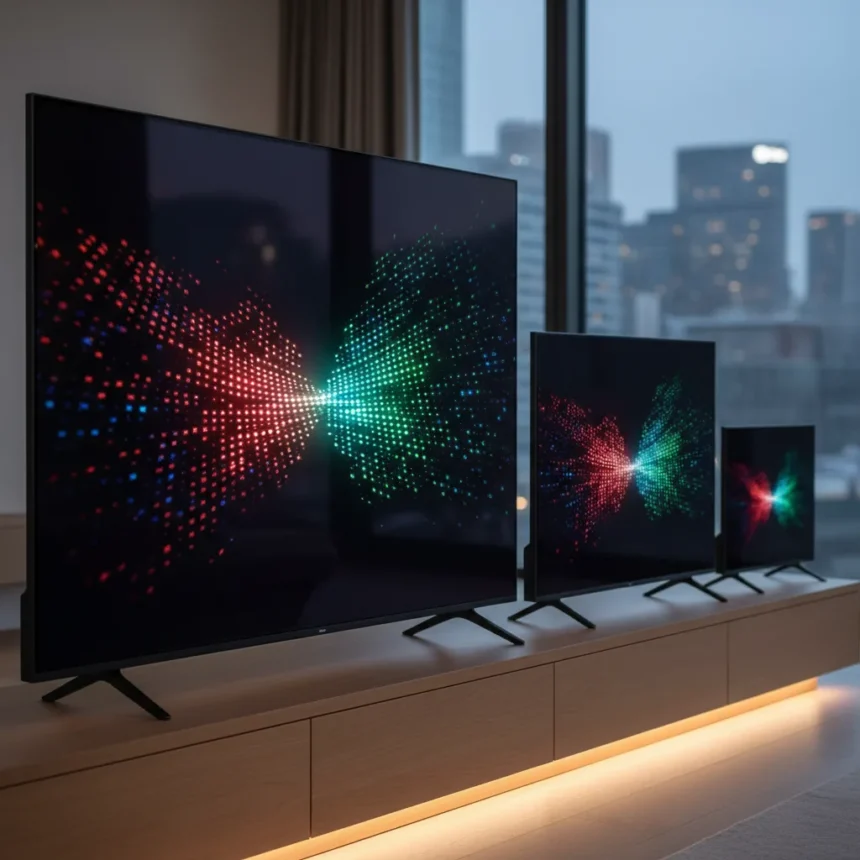
LG Micro RGB evo TV pricing has been officially announced, marking the company’s entry into the premium RGB LED television category with three large-screen options that promise to deliver high-end picture quality without the astronomical price tag many feared.
Key Takeaways
- LG introduces MRGB95 Micro RGB evo TV in 75-inch, 85-inch, and 100-inch sizes.
- Pricing announced as premium but more reasonable than comparable RGB LED competitors from Samsung, Hisense, and TCL.
- First Micro RGB evo TV from LG, entering a market dominated by high-cost RGB LED technology.
- RGB LED TVs typically launch at elevated price points due to manufacturing complexity.
- Hisense also preparing RGB Mini-LED evo competition in 116-inch size.
LG Micro RGB evo TV: What You’re Getting
The LG MRGB95 represents LG’s first venture into Micro RGB evo television technology, available in 75-inch, 85-inch, and 100-inch configurations. This marks a significant shift for LG, which has long dominated the premium TV market through OLED technology but is now competing in the emerging RGB LED space where pixel-level color control and brightness deliver distinct advantages. The three size options position LG squarely in the luxury television segment, targeting home theater enthusiasts and commercial installations where screen real estate matters.
RGB LED technology differs fundamentally from traditional LED and OLED approaches. Instead of relying on a backlight layer or organic pixels, RGB LEDs place individual red, green, and blue light sources at the pixel level, enabling precise color reproduction and exceptional brightness without the burn-in risks associated with OLED displays. LG’s entry into this category signals confidence that the technology will define premium television in 2026 and beyond.
Pricing That Defies Premium Expectations
LG’s announcement of MRGB95 pricing struck a careful balance between premium positioning and market accessibility. The company positioned the pricing as expensive but not prohibitively so—a calculated message designed to manage expectations for a first-generation RGB LED television from a major manufacturer. While exact pricing figures were not detailed in the announcement, the framing suggests LG deliberately undercut the potential sticker shock that typically accompanies debut RGB LED models, which carry elevated costs due to manufacturing complexity and yield challenges.



Competing RGB LED offerings from Samsung, Hisense, and TCL establish a pricing tier that LG’s MRGB95 targets, though specific rival model prices remain unconfirmed. Hisense’s RGB Mini-LED evo variant, available only in a massive 116-inch size, represents another competitive pressure point, though Hisense’s official pricing and release timeline remain pending. The market positioning suggests LG sees an opportunity to capture buyers willing to pay premium prices for technology that outperforms OLED in brightness and color volume while avoiding the burn-in concerns that plague long-term OLED ownership.
Why RGB LED Costs So Much (And Why LG’s Approach Matters)
RGB LED technology demands precision manufacturing at scales that traditional television production has never required. Each pixel requires three separate light sources—red, green, and blue—positioned with micron-level accuracy. The complexity of producing millions of these micro-LED arrays drives initial pricing substantially higher than OLED or Mini-LED alternatives. First-generation RGB LED TVs from any manufacturer inevitably launch at premium prices as manufacturers absorb development costs and optimize production efficiency.



LG’s decision to price the MRGB95 as expensive but reasonable suggests the company has achieved manufacturing efficiencies that rival early RGB LED entrants may not have matched. By offering three distinct sizes rather than a single flagship model, LG demonstrates confidence in its production capacity and willingness to serve a broader premium segment than competitors who have limited RGB LED availability to single ultra-large configurations. This strategy could accelerate market adoption and drive manufacturing scale economies that benefit the entire RGB LED category.
How LG Micro RGB evo TV Compares to Current Premium Options
The LG MRGB95 enters a premium television landscape already crowded with high-end OLED and Mini-LED options. Samsung’s flagship OLED models and LG’s own G5 OLED lineup represent mature technologies with established pricing and proven performance, though they lack the extreme brightness capabilities that RGB LED technology delivers. These OLED alternatives typically position at similar or slightly lower price points than what LG is asking for RGB LED, yet they sacrifice peak brightness and color volume—trade-offs that matter significantly for bright rooms and commercial applications.
The comparison also extends to Mini-LED competitors like Samsung’s high-end Mini-LED TVs and the forthcoming Hisense RGB Mini-LED evo, which occupies a different market segment entirely due to its 116-inch-only availability. LG’s strategy of offering 75-, 85-, and 100-inch sizes acknowledges that RGB LED buyers span a range of room sizes and budgets, not just the ultra-luxury segment willing to commit to 116-inch installations. This segmentation advantage could prove decisive in converting mainstream premium buyers to RGB LED technology.
What This Means for RGB LED’s Future
LG’s pricing announcement signals that RGB LED television is transitioning from exotic luxury to premium mainstream—a critical inflection point for the technology. If LG’s MRGB95 pricing resonates with buyers, it could accelerate industry adoption and drive competing manufacturers to expand their RGB LED portfolios beyond limited flagship models. The next 12 months will determine whether RGB LED becomes a sustained premium category or remains a niche offering reserved for the wealthiest enthusiasts.



The fact that LG positioned pricing as reasonable rather than shocking suggests internal market research indicates strong demand for RGB LED’s brightness and color advantages, even at premium price points. This confidence contrasts sharply with the cautious, limited-availability approach Samsung and Hisense have taken with their own RGB LED entries, implying LG believes it has cracked the manufacturing cost curve faster than rivals.
Is the LG Micro RGB evo TV worth the premium price?
That depends entirely on your viewing environment and priorities. If you watch in a bright room and demand maximum brightness and color volume, RGB LED’s advantages over OLED justify the premium. If you prioritize contrast and watch primarily in dark rooms, OLED remains the better choice. RGB LED’s lack of burn-in risk appeals to commercial users and those planning to keep a TV for a decade or more without risk of permanent image retention.
When will exact LG Micro RGB evo TV prices be available?
The research brief does not specify a date for detailed pricing disclosure. LG announced pricing recently, but exact figures for the 75-, 85-, and 100-inch models have not been publicly detailed. Contact LG directly or monitor major electronics retailers for confirmed pricing and availability information.
How does the LG Micro RGB evo TV compare to Hisense’s RGB Mini-LED evo?
Both represent RGB LED technology, but Hisense’s offering is available only in 116 inches, making it impractical for most home installations, while LG’s MRGB95 spans 75 to 100 inches. LG’s broader size selection and more reasonable pricing position it as the more accessible RGB LED option, though Hisense’s eventual pricing could shift this calculus once officially announced.
LG’s Micro RGB evo TV announcement arrives at a pivotal moment for premium television technology. The company is betting that reasonable pricing for RGB LED’s exceptional brightness and color performance will convince mainstream luxury buyers to abandon OLED despite its proven track record. Whether that gamble pays off depends on whether the price difference justifies the brightness gains—a calculation each buyer must make based on their own viewing habits and room conditions. What’s clear is that RGB LED is no longer a theoretical future technology; it’s here, it’s available, and LG is positioning it as the premium choice for buyers who refuse to compromise on brightness.
Edited by the All Things Geek team.
Source: Tom's Guide