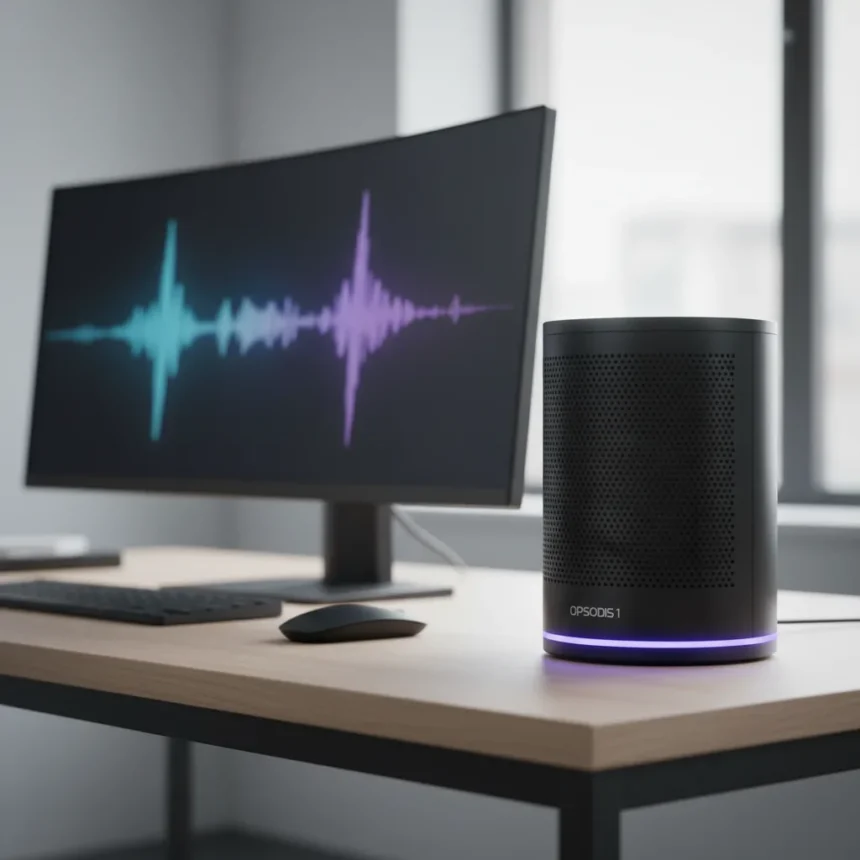
The Opsodis 1 desktop speaker is a single-unit active speaker from Japanese audio company OPSODIS that simulates immersive 3D surround sound using proprietary spatial audio technology. Launched in retail in January 2024 after a Kickstarter campaign in March 2023, the Opsodis 1 packs eight 1.2-inch drivers and a 4-inch subwoofer into a compact aluminum chassis measuring 200 x 140 x 180mm and weighing just 3.2kg. At $399 USD (£349 GBP, ¥59,800 JPY), it targets desktop users and compact spaces where traditional multichannel setups are impractical.
Key Takeaways
- Simulates up to 22.2-channel audio from a single compact desktop unit using proprietary OPSODIS® spatial technology
- Eight 1.2-inch drivers plus 4-inch subwoofer deliver 40Hz–20kHz frequency response with 100W peak power
- Supports USB-C (24-bit/96kHz), Bluetooth 5.0 (aptX HD), optical TOSLINK, and 3.5mm analog inputs
- OPSODIS app includes four EQ presets (Movie, Music, Game, Voice) plus room calibration via built-in microphone
- Requires 30W+ USB-C power delivery charger (not included); available worldwide via OPSODIS website and major retailers
What Makes the Opsodis 1 Desktop Speaker Stand Out
The Opsodis 1 desktop speaker doesn’t try to hide what it is: a desktop-first device engineered for immersive audio in tight spaces. Unlike soundbars or traditional stereo pairs, it uses an acoustic lens array and spatial processing to place sounds around and above you, creating the illusion of a far larger surround field than its footprint suggests. The company previously developed 8K/22.2-channel soundbar technology, and this is their first consumer desktop product applying that expertise.
The build quality reflects the price point. The aluminum chassis feels solid, and the eight full-range drivers are arranged to disperse sound in three dimensions rather than simply projecting it forward. The 4-inch subwoofer in a sealed enclosure handles low-end punch without bloat. Connectivity is comprehensive: USB-C for digital audio (supporting 24-bit/96kHz), Bluetooth 5.0 with aptX HD support, optical TOSLINK, 3.5mm analog, and a headphone output. That flexibility matters for desktops where you might switch between a gaming PC, a Mac, and a phone throughout the day.
Setup is straightforward. You plug in a USB-C power delivery charger (30W minimum; the speaker doesn’t ship with one), pair via Bluetooth by holding the button for five seconds, or plug into optical/analog ports. The OPSODIS app, available on iOS and Android, is where the Opsodis 1 desktop speaker reveals its intelligence. It offers four EQ presets—Movie (bass and surround boost), Music (flat with mid emphasis), Game (enhanced directional cues), and Voice (high-pass filter for podcasts)—plus a 10-band parametric EQ for deeper tweaking. The Room Tune calibration feature uses the built-in microphone to measure your room’s reflections over 30 seconds, then adjusts the spatial processing accordingly.



How the Opsodis 1 Desktop Speaker Compares to Rivals
Comparing the Opsodis 1 desktop speaker to alternatives reveals where it wins and where compromise is necessary. Against the Audioengine A5+, a desktop favorite for two decades, the Opsodis 1 superior in 3D imaging and spatial depth—Audioengine is a traditional stereo pair, after all—but the A5+ extends lower (50Hz vs. 40Hz), giving it more subwoofer-like punch. The Razer Nommo Pro costs $550 and requires a separate subwoofer satellite setup; the Opsodis 1 at $399 bundles everything into one unit with more accurate surround simulation. Against the Bose Smart Soundbar 300, the Opsodis 1 is more compact and integrates better with USB-first workflows, whereas the Bose is a better fit for living room TV duty. The SteelSeries Arena 9 attempts similar multichannel simulation but the Opsodis 1 proves more precise when processing stereo sources, which is what most people actually listen to on desktop.
That said, the Opsodis 1 desktop speaker doesn’t fully replicate 22.2-channel audio—it simulates it. A single unit cannot place sounds in 22 discrete channels the way a full theater can. What it does is convincingly create the impression of width, depth, and height using phase manipulation and frequency steering. If you are expecting true discrete surround channels, you will be disappointed. If you are hoping for a single compact device that makes movies and games feel immersive, it delivers.



Setup, Controls, and the OPSODIS App Experience
The Opsodis 1 desktop speaker’s top-mounted touch controls are intuitive: volume, input selection, and a 3D mode toggle. But the app is where the device earns its keep. Download it, connect via Bluetooth, and run Room Tune. The microphone measures reflections and ambient noise over 30 seconds, then the app adjusts EQ and spatial processing to suit your space. This is not a gimmick—rooms vary wildly, and a speaker that adapts to yours sounds better than one that doesn’t.
The four preset modes hit their marks. Movie mode boosts bass and surround, making action sequences feel expansive. Music mode flattens the response with a slight mid emphasis, letting vocals sit naturally. Game mode enhances directional cues and footsteps, useful for competitive shooters. Voice mode high-passes everything below speech frequencies, cleaning up podcast and call audio. If none of these suit you, the 10-band parametric EQ lets you dial in whatever curve you prefer. Multipoint Bluetooth support means you can pair two devices and switch between them without re-pairing—a small feature that makes a desktop speaker feel less clunky than it has any right to.
Power, Connectivity, and Real-World Limitations
The Opsodis 1 desktop speaker requires a USB-C power delivery charger rated for at least 30W (5V/3A or 9V/3A). OPSODIS does not include one, which is frustrating at this price point but not unusual for modern audio gear. You will likely have one lying around if you own a recent laptop or phone, but if not, budget an extra $20–30 for a decent PD charger.
Connectivity is strong across the board. USB-C audio input supports 24-bit/96kHz, which is more than adequate for desktop use. Bluetooth 5.0 with aptX HD means wireless audio from your phone or tablet sounds better than standard Bluetooth. Optical TOSLINK and 3.5mm analog cover older devices. The 3.5mm headphone output is a nice touch for late-night listening without disturbing others.



Real-world limitations exist. At 100W peak power, the Opsodis 1 desktop speaker is loud enough for a bedroom or small office but will not fill a large living room. The 40Hz lower frequency limit is respectable but not subwoofer-grade; if you crave earth-shaking bass, you will want something more. The spatial simulation is convincing for movies and games but less transformative for traditional stereo music—you are still listening to a single point source, just a smarter one.
Is the Opsodis 1 Desktop Speaker Worth $399?
The Opsodis 1 desktop speaker is a niche product for a specific use case: someone with limited space who wants immersive audio for gaming, movies, and streaming without installing a full surround system. At $399, it undercuts the Razer Nommo Pro and offers more compact integration than a soundbar. It is not a replacement for real surround sound, and it is not a high-fidelity stereo reference monitor. It is a smart, well-designed desktop speaker that makes what you listen to feel bigger than the device itself. If that appeals to you, it is worth the investment.
How do I set up the Opsodis 1 desktop speaker?
Connect a 30W+ USB-C power delivery charger, then pair via Bluetooth by holding the button for five seconds, or plug into optical/analog ports for wired input. Download the OPSODIS app and run Room Tune calibration to optimize sound for your space. The built-in microphone measures reflections over 30 seconds, then the app adjusts EQ and spatial processing automatically.
What EQ presets does the Opsodis 1 desktop speaker include?
The OPSODIS app offers four presets: Movie (bass and surround boost), Music (flat response with mid emphasis), Game (enhanced directional cues), and Voice (high-pass filter). A 10-band parametric EQ allows custom tuning if the presets do not suit your taste.
How does the Opsodis 1 desktop speaker compare to traditional stereo speakers?
The Opsodis 1 desktop speaker simulates 3D surround sound from a single unit, making movies and games feel immersive. Traditional stereo pairs like the Audioengine A5+ deliver purer two-channel fidelity and slightly deeper bass but offer no spatial simulation. Choose the Opsodis 1 for immersion and compactness; choose stereo speakers for audio purity and lower frequencies.
The Opsodis 1 desktop speaker is proof that spatial audio no longer requires a room full of speakers. For anyone working or gaming in a space where surround sound feels like a luxury, this Japanese company has found a clever solution. It is not perfect—the 22.2-channel simulation is promotional hyperbole, and you will need to source your own USB-C charger—but it is thoughtfully engineered and competitively priced. If immersive desktop audio matters to you, this is the device to audition.
Where to Buy
Edited by the All Things Geek team.
Source: T3