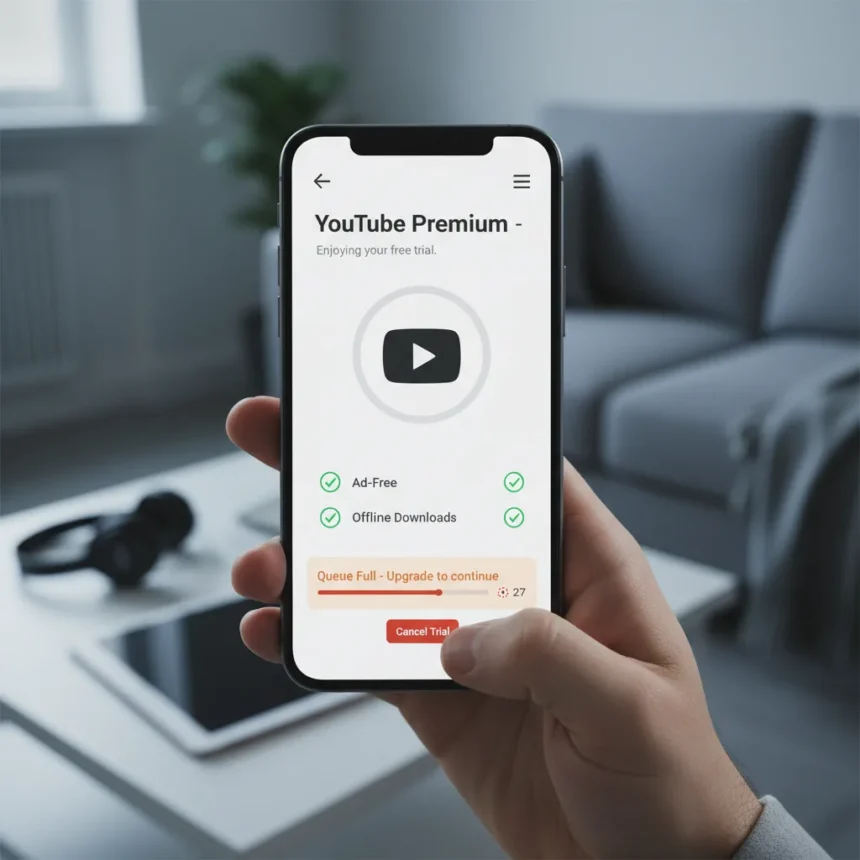
YouTube Premium free trial delivers enough polish to make you forget why you tolerated ads in the first place—until one frustrating limitation threatens to send you back to the free tier. New eligible users can sign up for a one-month free trial, though they must provide payment information during signup and will be automatically charged unless they cancel before the trial ends. After testing the service, the core features work brilliantly, but a specific queuing system setback undermines the entire value proposition for returning subscribers.
Key Takeaways
- YouTube Premium free trial removes ads across all videos and enables offline viewing on mobile devices
- New users must provide payment information to activate the trial and face automatic charges unless they cancel
- A queuing system limitation prevents returning subscribers from fully enjoying premium features
- The trial period lasts one month before automatic billing begins
- Ad-free viewing and background play work smoothly during the trial window
What YouTube Premium free trial actually delivers
The YouTube Premium free trial removes advertisements entirely—a feature that transforms the viewing experience immediately. Scrolling through your feed without banner ads, skipping pre-roll video interruptions, and watching without mid-roll breaks feels genuinely premium compared to the free tier. The offline viewing capability adds real utility: download videos on WiFi, then watch them later without an internet connection on mobile devices. Background play, which allows audio to continue when you switch apps or lock your phone, rounds out the feature set and justifies the trial signup alone for music listeners.
These core features work without friction. The interface remains identical to free YouTube, so there is no learning curve. Ad removal happens instantly—you will notice the absence of interruptions within your first session. For casual viewers, this is enough to justify staying subscribed after the trial ends. The question is whether the service maintains that momentum.
The queuing system setback that kills the deal
One critical limitation keeps YouTube Premium from becoming an obvious upgrade: the queuing system restriction for returning subscribers. Users who previously had YouTube Premium and let their subscription lapse face restrictions when they rejoin, preventing them from accessing the full feature set immediately. This creates friction precisely when the service should be cementing loyalty. A subscriber returning after a gap encounters barriers instead of a seamless re-entry, which contradicts the entire premise of a free trial—to demonstrate why staying is worth the monthly cost.



This setback is not a minor inconvenience. Returning subscribers represent high-value targets for retention, yet the queuing system punishes them rather than welcomes them back. The trial period should erase this friction, but it does not. For anyone who has previously subscribed and canceled, the YouTube Premium free trial becomes less compelling, not more.
YouTube Premium free trial vs. staying free
The decision to keep YouTube Premium after the trial expires hinges on whether ad-free viewing and offline access justify the recurring monthly charge. For heavy YouTube users—those watching multiple hours daily—the ad removal alone saves significant time and frustration. The offline viewing feature appeals to commuters and travelers who consume video content across different connectivity scenarios. Background play benefits music listeners who use YouTube as a streaming source.



For casual viewers who watch a few videos weekly, the free tier remains adequate. The queuing system setback compounds this calculus: if you are a returning subscriber already frustrated by restrictions, the trial becomes a reminder of what you lost rather than a pathway back to the service. YouTube should use the trial to rebuild trust with lapsed subscribers, but instead the queuing limitation signals that the company prioritizes new signups over retention.
Should you claim the YouTube Premium free trial?
New users should absolutely claim the one-month trial. The features work as advertised, and you lose nothing by testing the service before deciding whether to pay. Remember to cancel before the trial ends if you decide not to continue—automatic billing will charge your payment method otherwise. Returning subscribers should approach cautiously: the queuing system setback means your experience may feel restricted compared to your previous subscription, which defeats the purpose of a trial designed to lure you back.
Can I cancel the YouTube Premium free trial anytime?
Yes, you can cancel the YouTube Premium free trial at any point before the one-month period ends. Canceling before the trial expires prevents automatic billing to your payment method. After cancellation, your account reverts to free YouTube with ads. The exact cancellation process depends on your device and account settings, but YouTube support pages walk through the steps for both desktop and mobile users.
Does YouTube Premium free trial include YouTube Music?
YouTube Premium and YouTube Music are related but distinct services. The free trial focuses on YouTube video features—ad removal, offline viewing, and background play. YouTube Music is a separate subscription that provides music-specific features and ad-free listening across the music platform. Some bundle offers may combine both services, but the standard one-month trial primarily covers YouTube video functionality.



What happens after the YouTube Premium free trial ends?
After the one-month trial expires, your account automatically converts to a paid YouTube Premium subscription unless you cancel beforehand. You will be charged the monthly subscription rate using the payment method you provided during signup. If you do not cancel, you will continue to enjoy ad-free viewing, offline access, and background play. If you want to avoid charges, set a calendar reminder to cancel before the trial ends—do not rely on memory alone.
The YouTube Premium free trial proves that ad-free video streaming is genuinely valuable, but the queuing system setback for returning subscribers undermines the service’s retention strategy. New users will find the trial worthwhile and may convert to paid subscribers. Lapsed subscribers, however, should expect friction rather than a warm welcome back. Until YouTube removes the queuing restriction for trial users, the service remains an attractive option only for those signing up for the first time.
Edited by the All Things Geek team.
Source: TechRadar