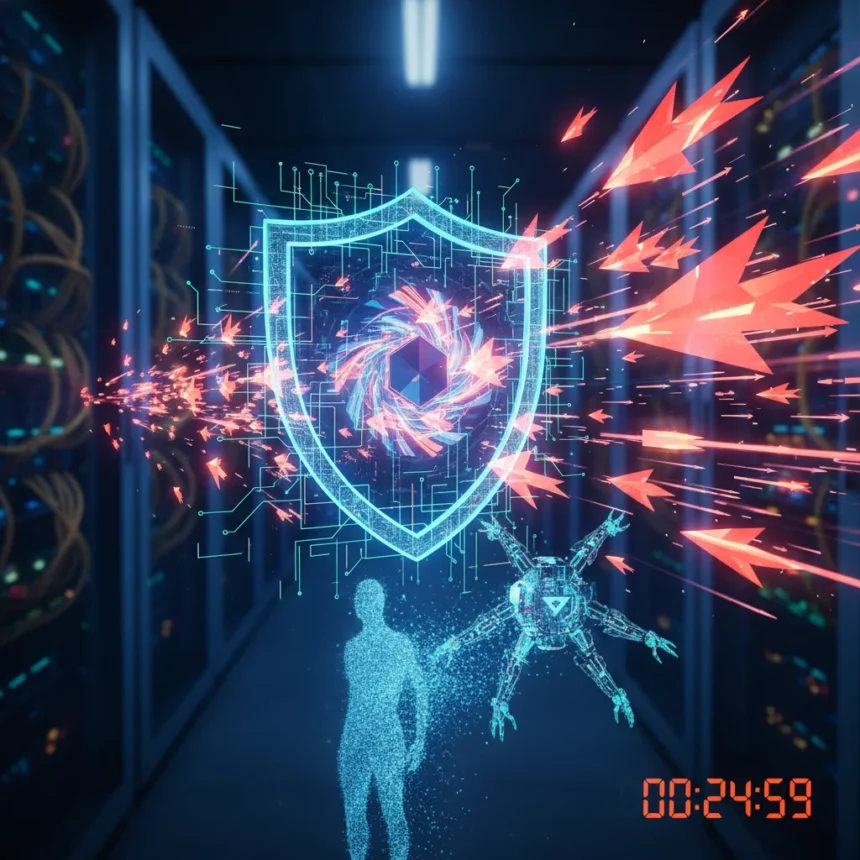
Agentic AI security represents the next frontier in enterprise defense—and most organizations are not ready for it. As AI agents move from lab experiments to production systems across enterprises, the security model that protected cloud infrastructure is already obsolete. The problem is not new; it is accelerating.
Key Takeaways
- Organizations failed at cloud security by securing after deployment, not before—a mistake now repeating with agentic AI.
- AI-supported attacks now unfold in 25 minutes, half the time from a year prior.
- Gartner predicts 40% of enterprises will run AI agents in production by end of 2026, up from less than 5% currently.
- 100% of 2,800 surveyed organizations reported a major cloud security incident in the past year.
- Agentic AI shifts security from dashboards to autonomous machine-speed defense across encrypted, autonomous operations.
Why cloud security failed—and why agentic AI will repeat the mistake
Most organizations did not fail at cloud security because they misunderstood the technology. They failed because they tried to secure it after deployment, not before. Cloud arrived with limitless scale, software shipping faster than ever, and environments reconfiguring in seconds. Security teams reacted. They deployed dashboards, wrote playbooks, and built copilots that accelerated retrieval but bottlenecked on human intervention. The model worked until it did not.
Today, 100% of 2,800 surveyed organizations have experienced a major cloud security incident in the past year. That is not a metric of failure—that is a metric of saturation. Every organization now operates in the cloud. Every organization has been breached. The question is no longer whether your infrastructure is vulnerable, but whether you can detect and respond faster than attackers can exploit.
Agentic AI amplifies this crisis. Unlike copilots that wait for human approval, AI agents operate autonomously across networks, connecting to more systems than any prior software and executing decisions at machine speed. The attack surface does not just expand—it multiplies. An AI agent integrating with your ticketing system, your cloud infrastructure, and your authentication layer creates three new attack vectors where one existed before. Traditional firewalls and perimeter-based security collapse under this model.

The 25-minute attack window and why speed now matters more than anything
AI turbocharges exploitation down to hours, according to security experts observing real-world threats. More precisely, AI-supported attacks now unfold in as little as 25 minutes—half the time from a year prior. This compression of the attack timeline is not incremental. It is existential.
Consider the mechanics: an attacker identifies a vulnerability, generates exploit code using AI, deploys it across your infrastructure, and exfiltrates data—all before your security team finishes gathering alert context. Thirty-eight percent of security teams spend a full day or more simply collecting the information needed to understand a single alert. By then, the attack is over. The attacker is gone. Your data is compromised.



This speed advantage forces a fundamental rethinking of defense architecture. Humans cannot compete at machine velocity. Dashboards and ticket systems, no matter how well designed, introduce latency that attackers now exploit as a feature, not a limitation. The only viable response is autonomous defense—AI agents that detect, investigate, and respond to threats without waiting for human authorization.
Agentic AI security: from dashboards to autonomous defense
Agentic AI shifts security from reactive monitoring to proactive autonomous operation. Rather than alerting humans to investigate a potential breach, an agentic security system detects anomalies, correlates signals across encrypted machine-to-machine operations, and executes countermeasures in real time. This is not artificial intelligence assisting humans. This is artificial intelligence replacing the bottleneck.
The stakes are enormous. Gartner predicts 40% of enterprises will run AI agents in production by the end of 2026, up from less than 5% currently. Each deployment expands the attack surface. Each agent introduces new integration points, new data flows, and new failure modes. Traditional security governance structures, which assume human oversight and identity-based access control, collapse under autonomous machine-to-machine operations. As one security leader noted, the lack of governance structures around agentic AI leaves enterprises vulnerable.
The irony is bitter: the same speed and autonomy that make AI agents valuable for business operations make them dangerous for security. An AI agent that can reconfigure your infrastructure in seconds without human approval is precisely the kind of system an attacker would want to compromise. One compromised agent could cascade failures across your entire infrastructure faster than humans could even detect the initial breach.



Why your current security tools are already obsolete
Cloud-native application protection platforms reached their limits years ago. Copilots accelerate alert retrieval but still bottleneck on human intervention. Playbook-driven automation fails the moment a threat deviates from predefined logic. These tools were designed for a world where humans made the final decision. In the agentic era, that assumption is dead.
The security industry is beginning to recognize this. Vendors are repositioning around autonomous defense, moving from dashboards and tickets to platforms that operate at machine speed. But recognition is not the same as readiness. Most organizations still staff security teams as if the attack timeline is hours, not minutes. Most still rely on human expertise to detect and respond to novel threats. Most still assume that encryption and firewalls provide meaningful protection against autonomous adversaries operating at scale.
The gap between where security is and where it needs to be is widening. AI-generated code will soon account for 95% of production code. That code ships faster, changes more frequently, and introduces more vulnerabilities than human-written software. Security teams face exponential threats but linear resource growth. The math does not work. It never will.
What happens when 40% of enterprises run undefended AI agents?
The timeline is aggressive. By the end of 2026, Gartner expects 40% of enterprises to run AI agents in production. Most of those deployments will lack the governance structures, monitoring capabilities, and autonomous defense mechanisms needed to operate safely. The attack surface will expand across every major organization simultaneously. Attackers will have years of data on how AI agents behave, how they fail, and how they can be manipulated.
This is not speculation. It is the pattern we have seen before. Cloud security failed because organizations adopted the technology before securing it. They moved fast, broke things, and paid the price. Agentic AI is following the same trajectory, but compressed into months instead of years. The window to build security into agentic systems before mass adoption is closing.
FAQ
What is the difference between agentic AI security and traditional cloud security?
Traditional cloud security relies on human oversight, identity-based access control, and reactive response to detected threats. Agentic AI security must operate autonomously at machine speed, detecting and responding to threats without human intervention. Traditional tools like dashboards and playbooks introduce latency that attackers now exploit. Autonomous defense eliminates that bottleneck.
How fast do AI-supported attacks actually unfold?
AI-supported attacks now unfold in as little as 25 minutes, down from approximately 50 minutes a year ago. This compression means security teams have no time for traditional investigation workflows. The only viable response is automated detection and response at machine speed.
Will my organization need to adopt agentic AI agents by 2026?
Not necessarily. However, 40% of enterprises are expected to run AI agents in production by the end of 2026, according to Gartner. Competitive pressure will likely drive adoption even among organizations that are not ready. The security question is not whether to adopt, but whether to do so safely.
The hard truth is this: organizations that secure agentic AI before deployment will have a massive advantage over those that try to retrofit security afterward. We have learned this lesson once with cloud. We are about to learn it again with AI agents, and the cost of the lesson is accelerating.
Edited by the All Things Geek team.
Source: TechRadar