





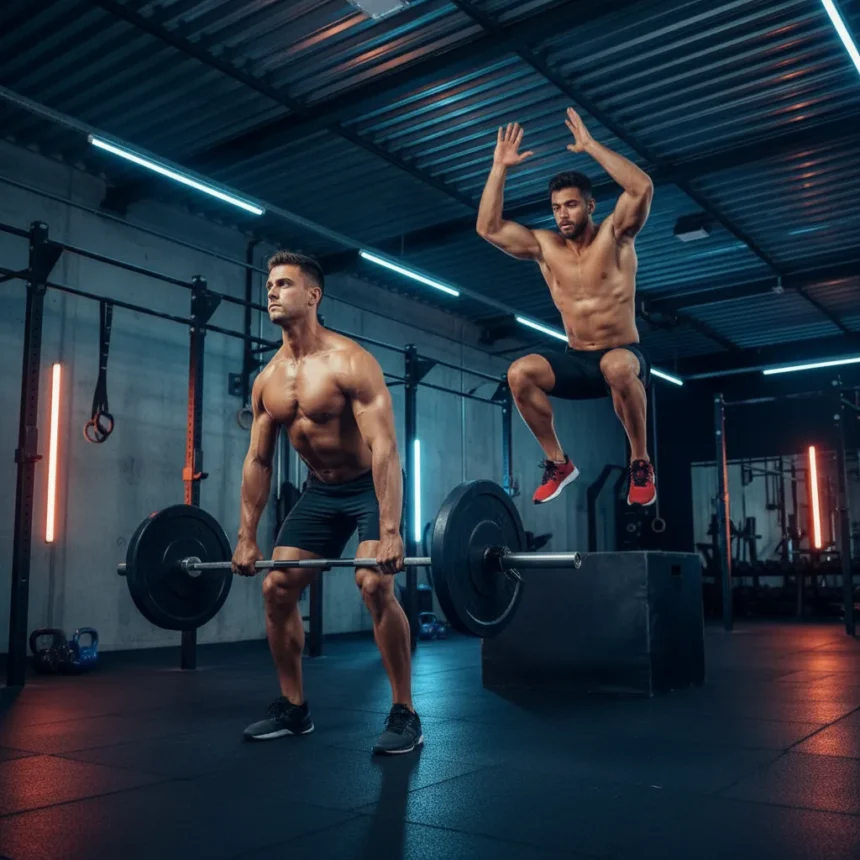
Contrast training pairs heavy resistance exercises with explosive power movements to build strength and power simultaneously, leveraging post-activation potentiation (PAP) to prime the nervous system for greater force output. The method recruits both fast-twitch and slow-twitch muscle fibers, enhancing neuromuscular coordination and rate of force development in a single session. For athletes and serious lifters seeking time-efficient gains, this approach challenges the traditional separation of strength and power work.
Key Takeaways
- Contrast training pairs heavy lifts (80-98% of 1RM) with explosive movements to exploit post-activation potentiation.
- Recruits both fast and slow-twitch muscle fibers, improving neuromuscular coordination and power output.
- Research shows 16% greater jump height gains and 30% more squat strength versus traditional training.
- Best suited for intermediate and advanced athletes with a solid strength foundation.
- Effective in 4-6 week blocks at 2-3 sessions per week for sprint speed, jump height, and upper body power.
How Contrast Training Works
The core mechanism is straightforward: perform a heavy strength exercise, then immediately follow it with an explosive power movement. A lifter might squat at 80-98% of their one-rep max for 3-5 reps, then perform jump squats or box jumps for 3-6 reps. The heavy load primes the nervous system, allowing greater force production during the explosive phase. Rest 2-3 minutes between pairs before repeating.
The heavy loading is critical. Research comparing loads shows that 80-98% of 1RM produces better lower body power gains than lighter 55-70% loads. According to NSCA trainers, most research supports loads between 60-84% of one rep max, but athletes using 80-98% of 1RM saw superior results. This is why contrast training demands a solid strength base—beginners lack the movement mechanics and structural resilience to handle these loads safely.
Upper body contrast pairs follow the same logic. A heavy bench press (3-5 reps) pairs with medicine ball throws or plyometric push-ups (6-8 reps). The principle remains: heavy load, then explosive output, in the same session.

Contrast Training vs. Traditional Strength and Plyometrics
Traditional training separates strength work from power work. Lifters spend one session building max strength, another developing explosiveness. Contrast training collapses this into one efficient approach, and the evidence suggests it works better. A 10-week study of junior basketball players found the contrast group improved sprint acceleration by 9%, max velocity by 6%, and jump height by over 5 inches, while their 1RM squat increased 30% more than the control group. An 8-week study showed countermovement jump height improved 16% more with contrast training than traditional methods.
Why does it outperform? Traditional plyometrics alone do not build maximal strength. Traditional strength training alone does not develop explosive power. Contrast training forces the body to do both, recruiting a broader spectrum of motor units and enhancing inter- and intra-muscular coordination. The nervous system adapts to express force explosively under heavy load, a skill that transfers to sports and athletics.



French Contrast: A Four-Movement Variation
The French Contrast model extends the basic pair into a four-exercise cluster. The sequence runs: heavy squat or deadlift (3-5 reps), weighted explosive squat (6-8 reps), bodyweight plyometric jump (8-10 reps), and sprint or agility drill (20-30 seconds). Complete 3-4 rounds with 3-5 minutes rest between rounds. This progression moves from maximal strength to explosive strength to reactive strength to speed, creating a comprehensive neural stimulus for rate of force development.
The four-movement structure is more demanding than basic pairs but targets a wider range of power qualities. Athletes in sports like basketball, football, soccer, and volleyball benefit from this comprehensive approach. The method requires more recovery time and should be used within structured 4-6 week training blocks to avoid overtraining.
Programming Contrast Training Into Your Week
Contrast training works best when structured deliberately. Run 4-6 week blocks at 2-3 sessions per week. A lifter might perform contrast training twice weekly—one lower body session, one upper body session—leaving other days for sport-specific work, conditioning, or recovery. The heavy loads and neural demand require adequate rest between sessions.
Beginners should not attempt contrast training. The method demands intermediate to advanced strength levels and solid movement mechanics. A lifter should be comfortable squatting at 80-98% of their max before pairing it with plyometrics. Poor form under heavy load followed by explosive movement is a recipe for injury.



Elite athletes and experienced lifters can push the loads higher. Research with elite rugby players aged 23-25 used 80-98% of 1RM safely and produced significant power gains. Scale the intensity to your experience level, but do not skip the heavy loading—lighter loads diminish the post-activation potentiation effect.
Is Contrast Training Right for You?
Contrast training is not a beginner method. If you lack a solid strength foundation or struggle with movement mechanics under load, spend 8-12 weeks building strength first. Once you can squat, deadlift, and bench press with confidence at 70% of your 1RM, contrast training becomes an option.
Athletes competing in power sports—basketball, American football, soccer, volleyball—see the most dramatic returns. The method directly improves jump height, sprint speed, and agility, all critical for performance. Strength athletes seeking lean muscle gain also benefit from the time efficiency and metabolic demand of paired movements.
The time investment is modest. Two 45-minute contrast sessions per week, structured within a 4-6 week block, can produce measurable strength and power gains. Compare this to traditional programming that separates strength and power work across different sessions or weeks.
Can beginners use contrast training safely?
No. Contrast training requires intermediate to advanced strength levels and solid movement mechanics. Heavy loads (80-98% of 1RM) paired with explosive movements demand technical proficiency and structural resilience. Beginners should build a strength base first before attempting contrast training.
How long does a contrast training block last?
Contrast training works best in structured 4-6 week blocks at 2-3 sessions per week. After 6 weeks, switch to a different training stimulus to allow recovery and prevent adaptation plateau.
What equipment do I need for contrast training?
Contrast training requires standard gym equipment: barbells for heavy lifts, boxes for jump variations, and medicine balls for upper body throws. Most commercial gyms have everything needed. Home setups require adjustable dumbbells, a pull-up bar, and a sturdy box or step for plyometrics.
Contrast training delivers measurable strength and power gains in efficient sessions, making it an attractive option for athletes and lifters who want both qualities without doubling their training frequency. The science backs it—studies consistently show better results than traditional separated training. The catch is simple: you need a solid strength foundation to start safely. Build that base first, then pair heavy lifts with explosiveness to unlock dual gains.
Edited by the All Things Geek team.
Source: T3




