





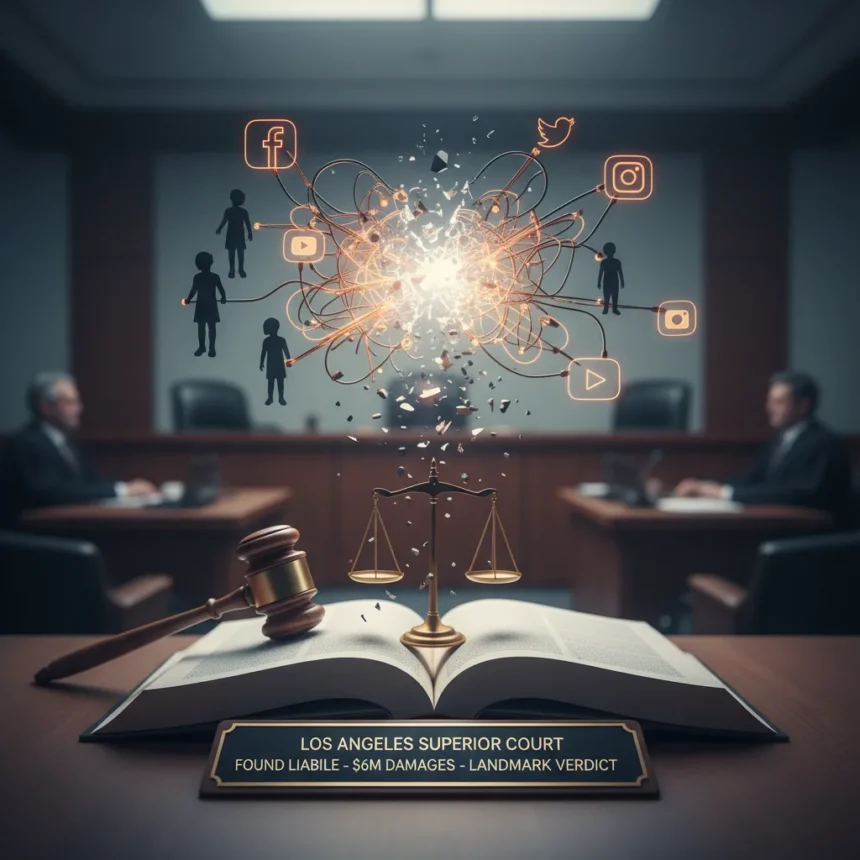
Social media addiction engineering has just entered the courtroom as a prosecutable offense. On March 25, 2026, a Los Angeles jury found Meta and Google liable for deliberately designing platforms to addict minors, awarding $6 million in compensatory damages after 43 hours of deliberation over a 9-day trial. The verdict is the first jury referendum on whether the world’s largest tech companies knowingly weaponized psychological manipulation against children for profit—and it says yes.
Key Takeaways
- Meta and Google found liable for social media addiction engineering targeting minors on March 25, 2026.
- Plaintiff K.G.M., a 20-year-old California woman, claimed platform addiction caused depression and suicidal thoughts as a minor.
- Meta ordered to pay $4.2 million total (70% share), Google $1.8 million total (30% share), including punitive damages.
- Snap and TikTok settled for undisclosed amounts before trial, avoiding a public liability finding.
- Google disputes YouTube’s categorization as social media, calling it a responsibly built streaming platform.
How Meta and Google Weaponized Design Against Children
The trial centered on a single, damning thesis: Meta and Google built features they knew would hook young users, then hid those design choices from the public while reaping billions. The plaintiff, identified as K.G.M. or Kaye, was a minor when she became dependent on Instagram and Facebook. Her lawyers argued that the companies profited from targeting children while concealing addictive mechanics—infinite scroll, algorithmic feeds designed to maximize engagement, notification systems engineered to pull users back—all of it deliberate, all of it hidden. The jury agreed. What makes this verdict explosive is not that these features exist; it is that the evidence proved they were designed with full knowledge of their addictive potential and deployed anyway.
The damages split reflects the jury’s assessment of culpability: Meta absorbed 70 percent liability, receiving $3 million in compensatory damages plus $2.1 million in punitive damages, totaling $4.2 million. Google paid 30 percent—$3 million compensatory plus $900,000 punitive, totaling $1.8 million. Punitive damages exist to punish corporate behavior so reckless or intentional that money alone is insufficient. The jury’s decision to impose them signals that they viewed this not as negligence but as deliberate harm.
Why Google’s Defense Failed—and What It Reveals
Google’s defense strategy was architecturally interesting: YouTube is not social media, the company argued through spokesperson José Castañeda, but a responsibly built streaming platform. The distinction matters legally because social media platforms face different regulatory scrutiny around addiction than video streaming services. But the jury rejected this framing. YouTube’s recommendation algorithm, notification system, and engagement metrics operate identically to Instagram’s—they are designed to maximize watch time, not to serve the user’s interests. Calling YouTube a streaming service rather than social media is technically true in the narrowest sense; it is also strategically dishonest in a way the jury saw through.

What the verdict exposes is that the industry’s entire defense against addiction claims rests on semantic games. Meta owns Instagram and Facebook. Google owns YouTube. All three platforms employ the same psychological levers: variable rewards (you never know what you will see when you scroll), social validation (likes, comments, shares), and infinite content (there is always one more video, one more post). Rebranding YouTube as non-social does not change the underlying mechanics. The jury’s verdict suggests that courts will no longer tolerate this kind of linguistic sleight of hand.
The Broader Reckoning: Snap and TikTok Already Settled
Meta and Google were not the only platforms in the dock. Snap and TikTok both settled before trial for undisclosed amounts, choosing to pay rather than face a jury verdict. That decision speaks volumes. If the companies believed they could win—that their design choices were defensible, that addiction was not their responsibility—they would have fought. Instead, they paid. The fact that Meta and Google chose to go to trial and lost suggests either overconfidence or a calculated decision that a jury verdict was preferable to a settlement amount that would have been even larger.



The broader pattern is unmistakable. In New Mexico, a separate jury ordered Meta to pay $375 million on March 24, 2026—one day before the Los Angeles verdict—for misleading users on safety and enabling child sexual exploitation. These are not isolated cases. They are the opening salvo in a global reckoning with social media’s business model. When platforms profit from engagement above all else, and engagement is maximized by addicting users, the incentive structure inevitably harms vulnerable populations—especially children whose prefrontal cortexes are still developing and whose dopamine systems are particularly susceptible to variable reward schedules.
What Happens Next: Appeals and Industry Uncertainty
Google has already stated it plans to appeal, which means this verdict is not final. Appeals can take years. Eric Goldman, a law professor at Santa Clara University, noted that while the verdict could force tech firms to rethink their defenses against safety claims, appeals will likely delay any concrete changes to platform design. That temporal gap is crucial: Meta and Google have time to lobby, to argue in appellate courts, to reshape the narrative around what constitutes responsible design. The industry will not capitulate overnight.
Yet the verdict has already changed the conversation. New Mexico’s Attorney General Raúl Torrez called it a step toward justice that puts big tech executives on notice. That framing is significant. Executives are now personally aware that juries will hold them accountable for design choices they made in pursuit of engagement metrics. That knowledge alone may shift internal conversations at Meta, Google, and other platforms. No executive wants to be the one who ignored warnings about addictive design and then sits in a courtroom watching a jury award millions to a young woman whose life was damaged by their product.
Can Tech Companies Redesign Without Destroying Their Business Model?
The uncomfortable truth is that Meta and Google’s entire revenue model depends on engagement. Advertisers pay for attention. Attention is maximized by addictive design. Removing addictive features means lower engagement, which means lower ad revenue, which means lower stock prices. The companies could redesign their platforms to be less addictive—chronological feeds instead of algorithmic ones, limited notifications, session time limits—but doing so would require them to accept lower profitability. That is not a technical problem; it is a business problem. The verdict does not force them to solve it. It only makes the cost of not solving it higher.



FAQ
What is social media addiction engineering?
Social media addiction engineering refers to the deliberate design of platform features—infinite scroll, algorithmic feeds, notification systems, variable rewards—intended to maximize user engagement and create psychological dependence, particularly in minors.
Why did Meta pay more damages than Google?
The jury assessed Meta as 70 percent liable and Google as 30 percent liable, reflecting their judgment that Meta’s platforms (Instagram and Facebook) were more directly designed to addict minors than YouTube. Meta’s total liability was $4.2 million compared to Google’s $1.8 million.
Will this verdict change how social media platforms operate?
Not immediately. Google plans to appeal, and appeals can take years. However, the verdict signals that juries will hold companies accountable for addictive design, which may influence internal policy discussions and future design decisions—though profit incentives remain a powerful counterforce.
The March 2026 verdicts in Los Angeles and New Mexico represent a watershed moment for the tech industry. For two decades, social media companies have operated under the assumption that engagement maximization was a neutral business goal, not a harmful one. Juries have now rejected that assumption. Whether the industry will respond by genuinely redesigning for user welfare rather than engagement, or whether it will simply become more skilled at hiding its addictive mechanics, remains to be seen. What is certain is that the era of unchallenged social media addiction engineering is over.
Edited by the All Things Geek team.
Source: TechRadar




