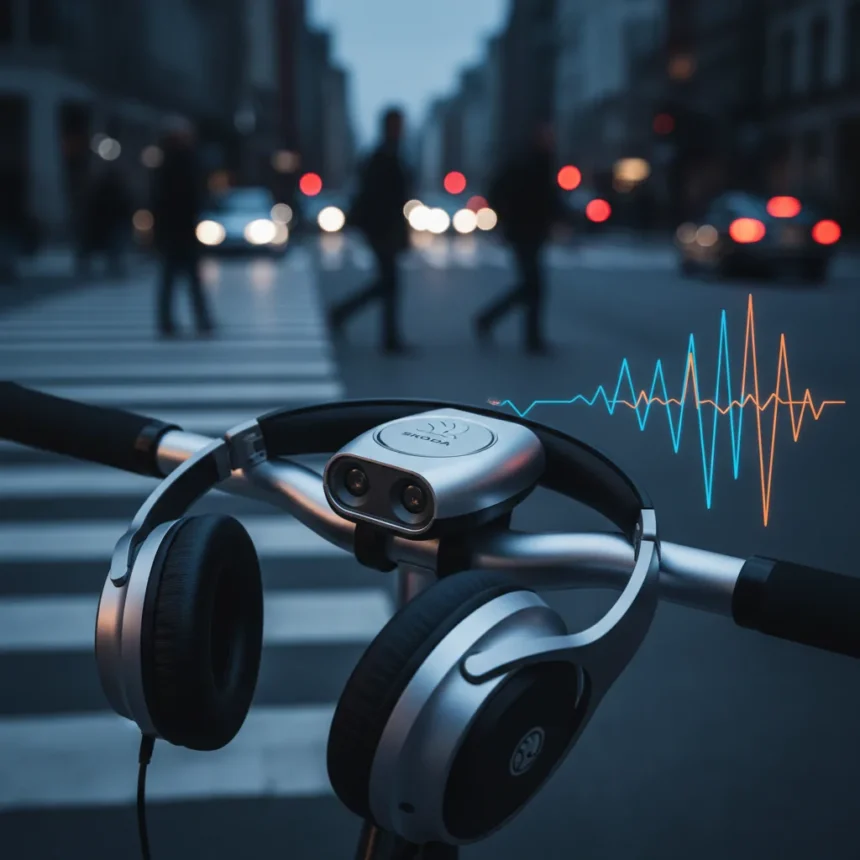
The Skoda DuoBell bicycle bell is a prototype device engineered to penetrate active noise-cancelling headphones by exploiting a frequency weakness that standard bells cannot exploit. Developed by Škoda Auto in cooperation with scientists and audiologists from the University of Salford, the DuoBell targets a narrow acoustic gap between 750 and 780 Hz where ANC algorithms fail to cancel sound. This is not louder engineering—it is smarter engineering.
Key Takeaways
- DuoBell targets a 750-780 Hz frequency gap where ANC headphones cannot suppress sound
- Uses dual frequencies and rapid irregular strikes to defeat digital signal processing algorithms
- Developed with University of Salford scientists and announced around April 2026
- Addresses rising cyclist-pedestrian collisions linked to ANC headphone adoption in high-commute cities
- Analogue solution that works without increasing volume
Why the DuoBell Bicycle Bell Matters Right Now
Urban cycling faces a genuine safety paradox. In cities with 1.5 million daily bike commutes, 54% of headphones sold now include active noise cancellation, yet cyclist-pedestrian collisions have risen 24%. Riders wearing ANC headphones cannot hear conventional bike bells—a problem that has persisted while the technology around cycling has evolved. The DuoBell addresses this specific gap where traditional safety design has failed.
Bicycle bells have remained mechanically unchanged for over a century, but the acoustic environment surrounding them has transformed entirely. ANC headphones use digital signal processing to generate inverted sound waves that cancel incoming noise, but this cancellation is not universal across all frequencies. Škoda’s research identified that most leading ANC headphones struggle to suppress signals in the 750-780 Hz range—a vulnerability no conventional bell was designed to exploit.
How the DuoBell Bicycle Bell Defeats ANC Algorithms
The DuoBell works by targeting two acoustic principles that defeat noise-cancelling algorithms. First, it generates a primary frequency tuned specifically to 750 Hz, which sits in the frequency band where ANC digital signal processing fails to generate effective inverted cancellation waves. Second, it adds a second higher frequency via an additional resonator, creating dual-frequency coverage that makes the signal more robust against different ANC implementations. The result is called DuoBell precisely because of this two-frequency design.


The bell’s hammer mechanism is equally critical. Instead of a single strike, it produces rapid and irregular strikes that generate sound waves faster than ANC algorithms can process and cancel. Most ANC systems are tuned to handle steady-state noise—engine hum, air conditioning, ambient traffic. The unpredictable, sharp strikes of the DuoBell hammer create transient signals that defeat the predictive models underlying noise cancellation.
Škoda’s testing process examined hundreds of acoustic signals across six leading ANC headphone brands to identify this weakness. The research team did not simply make the bell louder—a strategy that would defeat the purpose of headphone design and annoy riders who value audio privacy. Instead, they engineered the bell to be acoustically intelligent, exploiting the specific limitations of how ANC algorithms process narrow-band frequency signals.



DuoBell Bicycle Bell vs. Standard Bike Bells
Conventional bicycle bells, which have remained largely unchanged for over 100 years, produce broad-spectrum sound that ANC headphones can suppress effectively. When a standard bell rings, it generates sound across multiple frequencies simultaneously. ANC systems analyze this broad signal, generate an inverted version, and cancel most of the audible output. The rider in ANC headphones hears almost nothing.
The DuoBell abandons the broad-spectrum approach entirely. By concentrating acoustic energy in a narrow, specifically chosen frequency band where ANC cannot generate effective cancellation, it achieves audibility without volume escalation. This distinction matters for urban cycling culture: the DuoBell is not the loudest bell on city streets, but it is the only bell designed to reach riders who have actively chosen to block out ambient sound.
Škoda intends to publicly release research findings as a PDF to support expert discussion and urban traffic safety innovation, signaling that this is not merely a commercial product but a contribution to cycling safety science. The company originated as a bicycle manufacturer over a century ago, so returning to cycling safety with technological innovation carries historical weight.
Will the DuoBell Actually Work in Real Conditions?
The DuoBell was tested in a virtual reality scenario simulating a cyclist approaching a distracted pedestrian wearing ANC headphones. This controlled environment confirmed that the frequency-targeting approach defeats ANC algorithms in laboratory conditions. Real-world effectiveness remains uncertain, particularly in scenarios where riders are listening to music while wearing ANC headphones—a combination that adds additional masking beyond the ANC algorithm itself. User skepticism on community forums suggests that regular bells struggle to penetrate music playback, raising questions about whether frequency targeting alone solves the problem.



The prototype stage also means no commercial availability has been announced, and no pricing or retail timeline has been disclosed. Škoda has not confirmed whether the DuoBell will eventually ship as a consumer product or remain a research demonstration intended to drive broader industry discussion about ANC safety trade-offs.
Is the DuoBell bicycle bell the first of its kind?
The DuoBell appears to be the first bicycle bell specifically engineered to penetrate noise-cancelling headphones by targeting a known frequency weakness. While other bells may incidentally penetrate ANC in certain conditions, none were designed with this acoustic principle in mind. The collaboration between Škoda Auto and University of Salford researchers represents one of the first formal studies examining how ANC algorithms interact with bicycle safety signals.
Why can’t ANC headphones just cancel the DuoBell frequency?
ANC algorithms are trained on steady-state noise patterns—engines, air conditioning, ambient traffic hum. They struggle with transient, unpredictable signals like the rapid irregular strikes of the DuoBell hammer. Additionally, the 750-780 Hz gap exists because ANC systems must balance noise cancellation against audio quality; cancelling too aggressively across all frequencies would degrade music and voice playback. The DuoBell exploits this engineering trade-off.
Could riders just turn off ANC when cycling?
Theoretically yes, but this places the safety burden on individual user behavior rather than product design. The DuoBell instead shifts responsibility to infrastructure and bicycle design, making cycling safer without requiring riders to abandon the hearing protection or ambient noise reduction that ANC provides in urban environments.
The DuoBell bicycle bell represents a rare case where a century-old product class is being redesigned not for performance or aesthetics, but for acoustic compatibility with technology that did not exist when the original design was finalized. Whether it reaches production, and whether it solves the real-world safety problem it addresses, will determine whether Škoda’s research becomes a template for future cycling safety innovations or remains a clever engineering proof-of-concept that never shipped.
Edited by the All Things Geek team.
Source: Tom's Guide