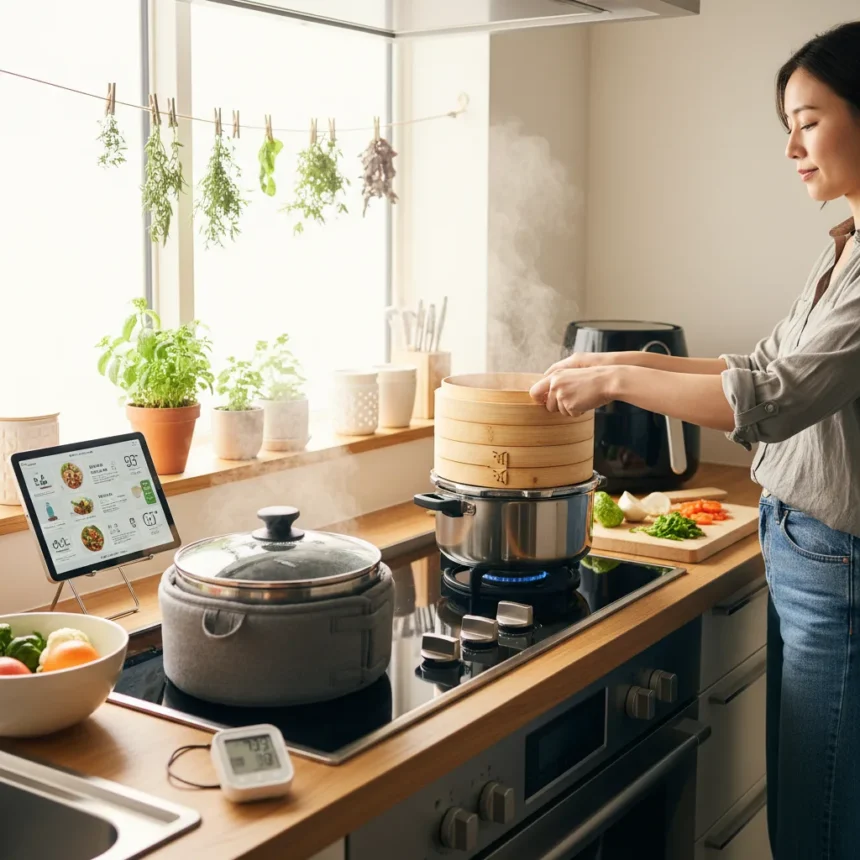
Cooking hacks energy bills is not just marketing speak—the kitchen is one of the highest-energy rooms in any home, and simple behavioral changes can meaningfully reduce what you pay each month. Most households treat cooking as a fixed cost: turn on the stove, use the oven, run the dishwasher, repeat. But the appliances and techniques you choose determine whether you are wasting money or spending strategically.
Key Takeaways
- Kitchen appliance use accounts for a significant portion of household energy consumption.
- Cooking hacks energy bills focuses on behavioral changes rather than buying new equipment.
- Lid placement, burner selection, and appliance timing directly impact gas and electricity use.
- Water heating and residual heat management are the biggest leverage points for savings.
- Small kitchen habit shifts compound into measurable monthly bill reductions.
Why Your Kitchen Wastes More Energy Than You Realize
The kitchen is deceptive. You might think heating or cooling dominates your energy bill, but cooking and food preparation consume far more electricity and gas than most people estimate. Every time you boil water without a lid, preheat an oven when you don’t need to, or use a burner larger than your pot, you are converting money into heat that escapes into the air instead of cooking your food. The inefficiency is invisible until you see it on your utility statement.
Compared to other rooms, the kitchen offers immediate, measurable savings because the energy waste is concentrated and controllable. You are not negotiating with a heating system or waiting for seasonal changes—you are making direct choices multiple times per day. Each choice is small, but they stack. A household that cooks dinner five nights a week can recoup hundreds of dollars annually by adjusting how they use their stove and oven, without eating differently or buying new appliances.
Cooking Hacks Energy Bills: Five Practical Techniques
The most effective cooking hacks energy bills involve matching the tool to the task and eliminating wasted heat. These are not secrets—they are habits that professional kitchens have used for decades because they work. The five core techniques are: using lids on pots and pans, selecting the right burner size, matching cookware to heat source, using residual heat after turning off the stove, and choosing the right appliance for the job (stovetop versus oven, for example).


Using a lid on a pot of boiling water can reduce cooking time by up to 25 percent because the trapped steam accelerates the cooking process and prevents heat loss. This single habit compounds across hundreds of meals per year. Matching burner size to pot diameter prevents energy from radiating around the sides of the pot—a small pot on a large burner wastes significant gas or electricity. Choosing a stovetop burner instead of the oven for small meals eliminates the energy cost of preheating a large appliance and heating the entire kitchen unnecessarily.
Residual heat is free energy you have already paid for. After boiling pasta or cooking rice, turn off the burner and let the pot sit on the hot surface for a few minutes—the food continues cooking. Similarly, turn off the oven a few minutes before your food is done and use the remaining heat to finish cooking. These micro-adjustments feel trivial but eliminate wasted fuel that serves no purpose once the cooking temperature is reached.



Appliance Selection and Timing Matter More Than You Think
Not all cooking methods are equal from an energy perspective. Boiling water on a stovetop uses less energy than using an electric kettle for many households, depending on your local electricity grid and gas prices. Slow cookers and pressure cookers are exceptionally efficient because they use lower, sustained heat rather than intense direct flame or electric heating elements. Microwaves are efficient for reheating and cooking small portions because they heat food directly rather than heating air around it.
Timing your cooking to off-peak hours, if your utility provider offers time-of-use rates, can reduce your per-unit energy cost even if you use the same total amount of energy. Batch cooking—preparing multiple meals in one session—reduces the total number of times you heat your kitchen and appliances. These are not behavioral tricks; they are straightforward applications of how energy pricing and physics work.
How Much Can You Actually Save?
The savings from cooking hacks energy bills are real but modest at the household level—typically 5 to 15 percent of kitchen energy use, depending on how many habits you change and how consistently you apply them. For a household spending $150 per month on energy, that translates to $7.50 to $22.50 in monthly savings, or $90 to $270 annually. It is not transformative, but it is also not negligible, and the changes require no capital investment and no sacrifice in meal quality.
The appeal of cooking hacks energy bills is that the effort-to-reward ratio is favorable. Putting a lid on a pot takes two seconds. Selecting the correct burner size takes no extra time. These are not lifestyle changes—they are minor adjustments to things you are already doing. The cumulative effect, across dozens of cooking sessions per month, is measurable on your utility bill without feeling like you have changed anything significant about how you eat.



Are Cooking Hacks Energy Bills Better Than Upgrading Appliances?
Behavioral changes are more cost-effective than buying new appliances for most households. A new Energy Star oven or cooktop might save 10 to 20 percent on cooking energy, but the upfront cost is $500 to $3,000. Implementing cooking hacks energy bills costs nothing and delivers results immediately. If you have an older appliance that is failing, replacing it with an efficient model makes sense. If your current appliances are functional, optimizing how you use them is the smarter financial move.
That said, some appliances are worth upgrading if you cook frequently. Pressure cookers and slow cookers are inexpensive ($30 to $100) and deliver genuine energy savings because they use sustained low heat instead of intense direct heat. An electric kettle is more efficient than boiling water on a gas stovetop in most cases. These are not major investments, and they serve dual purposes—they cook food and reduce energy use simultaneously.
FAQ
What is the single most effective cooking hack for reducing energy bills?
Using a lid on pots and pans is the highest-leverage single habit because it reduces cooking time by accelerating heat transfer, prevents water loss, and eliminates wasted steam. It costs nothing, takes two seconds, and applies to nearly every boiling or simmering task. If you change only one cooking behavior, this is the one that delivers the most reliable savings.
Do slow cookers really save energy compared to ovens?
Yes. Slow cookers use sustained low heat (typically 200–300 watts) over many hours, while ovens use intense heat (3,000–5,000 watts) for shorter periods. Even accounting for the longer cooking time, slow cookers consume less total energy. They are also more efficient than stovetop simmering because the heat is contained within an insulated vessel rather than radiating into the kitchen.
Can cooking hacks energy bills work if you rent and cannot upgrade appliances?
Absolutely. Behavioral changes are entirely within your control as a renter. Lids, burner selection, residual heat, and appliance choice are all habits that require no modifications to the rental property. These are the most accessible cooking hacks energy bills for anyone without the option to upgrade equipment.
Cooking hacks energy bills work because they address the source of kitchen energy waste: inefficient heat transfer, unnecessary preheating, and poor appliance-to-task matching. The savings are modest individually but compound across hundreds of cooking sessions per year. The best part is that none of these habits require sacrifice—you are not eating less, cooking less, or eating worse food. You are simply making your existing cooking process less wasteful. Start with lids and burner sizing, and the rest becomes habit.
Where to Buy
Le Creuset Enameled Cast Iron Signature Round Dutch Oven:
Edited by the All Things Geek team.
Source: Tom's Guide