





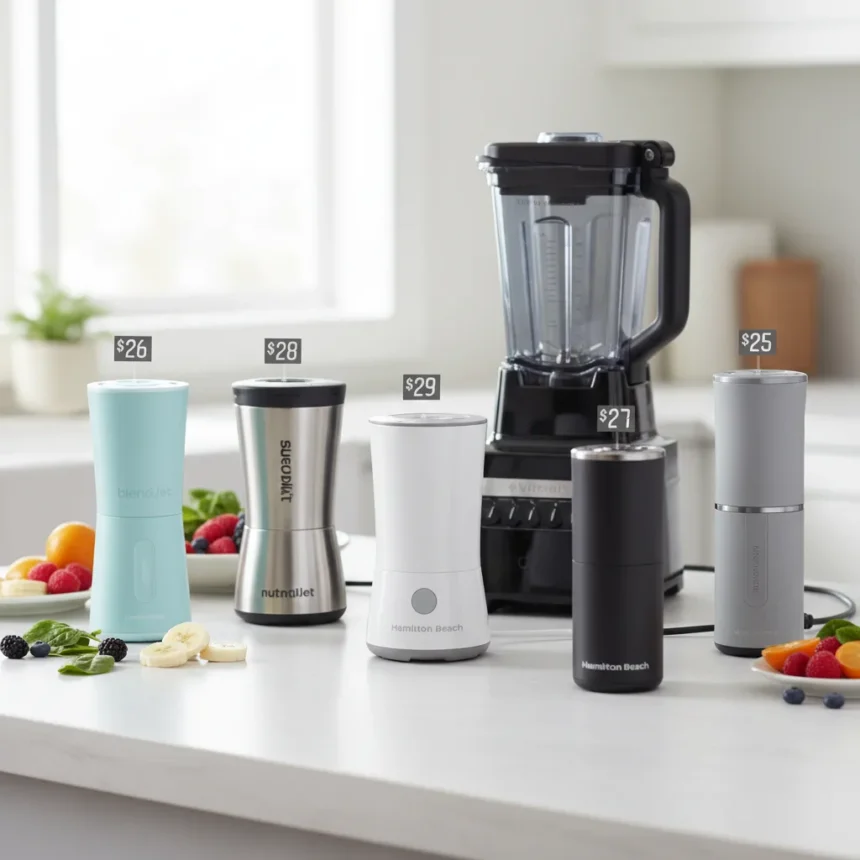
Personal blender deals under $30 challenge the assumption that you need a full-size Vitamix to blend smoothies, soups, and sauces effectively. If you’ve been storing a bulky countertop blender you rarely use, downsizing to a compact personal blender might be the smarter move—especially when quality options start at just $26.
Key Takeaways
- Personal blender deals begin at $26, a fraction of full-size Vitamix pricing
- Compact blenders occupy minimal counter and storage space
- Five quality options available across major retailers and price points
- Personal blenders handle daily smoothies, nut butters, and small-batch cooking
- Downsizing eliminates the guilt of owning unused kitchen equipment
Why Personal Blender Deals Matter Right Now
The kitchen appliance market has shifted. Full-size blenders like Vitamix models dominate retail shelves and kitchen islands, but they come with a space penalty and a price tag that often exceeds $300. Personal blender deals are reshaping how people think about blending. Instead of investing in a powerful machine you use twice a month, compact blenders deliver the same core functionality—crushing ice, pureeing fruit, emulsifying liquids—in a footprint small enough to tuck into a cabinet. For renters, apartment dwellers, and anyone with limited counter space, this shift matters.
The appeal is practical. A personal blender handles single-serve smoothies without requiring you to fill a massive pitcher. It blends faster for small quantities because the motor doesn’t waste energy processing empty space. And when your blender costs $26 instead of $400, you feel less guilty about occasional use. The trade-off is capacity—personal blenders typically hold 16 to 32 ounces compared to Vitamix’s 48 to 64 ounces—but for most households, that limitation is irrelevant.
Five Personal Blender Deals Worth Your Money
The personal blender deals on the shortlist span price points and feature sets, but all share one advantage: they cost less than a single Vitamix pitcher replacement. Each option solves a different blending problem without the bulk or expense of full-size competition.



Entry-level personal blenders start at the $26 mark and handle basic smoothie work. Mid-range options, typically $40 to $60, add features like preset buttons, better motor power, and durable construction. Premium personal blender deals, approaching $80 to $100, compete directly with entry-level full-size blenders on performance while maintaining the compact form factor. The five deals highlighted represent the sweet spots across these tiers—models that reviewers trust and retailers actively discount.
Each blender in this roundup prioritizes portability without sacrificing durability. They come with single-serve cups that double as drinking vessels, eliminating the need to transfer blended drinks into glasses. Motors range from 200 watts to 600 watts, with higher wattage handling tougher jobs like frozen fruit and nut butters. Blade quality varies, but even budget models use stainless steel rather than plastic, extending lifespan and preventing flavor transfer between uses.


Personal Blender Deals vs. Full-Size Vitamix: The Real Difference
A Vitamix blender excels at high-volume tasks: making soup for six, grinding whole grains into flour, or processing large batches of nut butter. It runs cooler, lasts longer, and handles abuse that would burn out a personal blender motor. But these strengths matter only if you actually use them. Most home cooks make single or double-serving smoothies, not catering-sized batches. For that use case, personal blender deals deliver better value.
The noise difference is real. Full-size blenders run louder because they process more volume at higher speeds. Personal blenders, by contrast, finish the job in seconds with a quieter motor—a meaningful advantage if you blend before dawn or in an open-plan apartment. Cleanup is faster too. A personal blender cup fits directly into most dishwashers, while Vitamix pitchers often require hand washing due to size. Storage is the most obvious win: a personal blender occupies shelf space equivalent to a coffee maker, not a toaster oven.
The durability question cuts both ways. Vitamix machines are engineered to last decades with proper care. Personal blenders typically have a 3- to 5-year lifespan before the motor degrades. But at $26 to $100, replacing a personal blender three times costs less than buying a single Vitamix once. The economics favor downsizing unless you’re blending daily for a family of four.
Where to Find Personal Blender Deals and What to Watch For
Personal blender deals appear regularly across Macy’s, Amazon, Target, and specialty retailers. Prices fluctuate based on season—expect deeper discounts in January (New Year’s resolutions) and September (back-to-school promotions). Retailers like Macy’s maintain dedicated blender sections where you can compare hand blenders, immersion blenders, and personal blenders side by side.


When evaluating personal blender deals, prioritize motor wattage, blade material, and warranty length. A 300-watt motor handles most daily tasks; 500-watt motors tackle frozen ingredients faster. Stainless steel blades outperform plastic and resist corrosion. A one-year warranty signals the manufacturer’s confidence; anything less suggests a disposable product. Check whether the deal includes a travel lid—some personal blender deals bundle this accessory, adding value without inflating the price.
Read user reviews before committing, but weight recent feedback more heavily than older posts. A blender that worked well two years ago may have been redesigned or discontinued. Look for comments about motor longevity, seal durability, and whether the blender truly fits in standard cup holders (a key portability feature). Avoid deals that seem too good to be true—heavily discounted blenders from unfamiliar brands often cut corners on motor quality or blade sharpness.
Is a personal blender worth replacing your Vitamix?
A personal blender is worth the switch if you rarely use your full-size model and value counter space. If you make multiple smoothies daily or cook for more than two people, a full-size blender remains the better choice. Honestly assess your actual blending frequency—not your aspirational frequency. If you’ve owned a Vitamix for two years and used it fewer than ten times, a personal blender deal is the smarter purchase.
Can personal blenders handle frozen fruit and ice?
Most personal blenders with 300+ watt motors handle frozen fruit and ice, though processing takes longer than a full-size Vitamix. Higher-wattage personal blender deals (500+ watts) perform comparably to entry-level full-size models. Let frozen ingredients thaw slightly and add liquid to help the blade move freely, and you’ll get smooth results without burning out the motor.
What size personal blender should I buy?
A 16-ounce personal blender suits single-serve smoothies; 24-ounce models work for couples or larger drinks. Anything larger than 32 ounces blurs the line with full-size blenders and loses the portability advantage. Most personal blender deals cluster around 20 to 24 ounces, the sweet spot for flexibility without bulk.
The decision to downsize from a Vitamix to a personal blender is ultimately about honesty. If your full-size blender has become kitchen furniture rather than a tool, personal blender deals offer a practical escape. You’ll reclaim counter space, reduce guilt about unused equipment, and spend less than you’d recover selling a used Vitamix. For anyone blending solo or in pairs, the math is clear: go small, save money, and blend smarter.
Where to Buy
was $34 now $26 @ Amazon | was $49 now $34 @ Amazon | was $99 now $69 @ Amazon | was $99 now $79 @ Amazon | Hamilton Beach Go Sport:
This article was written with AI assistance and editorially reviewed.
Source: Tom's Guide


