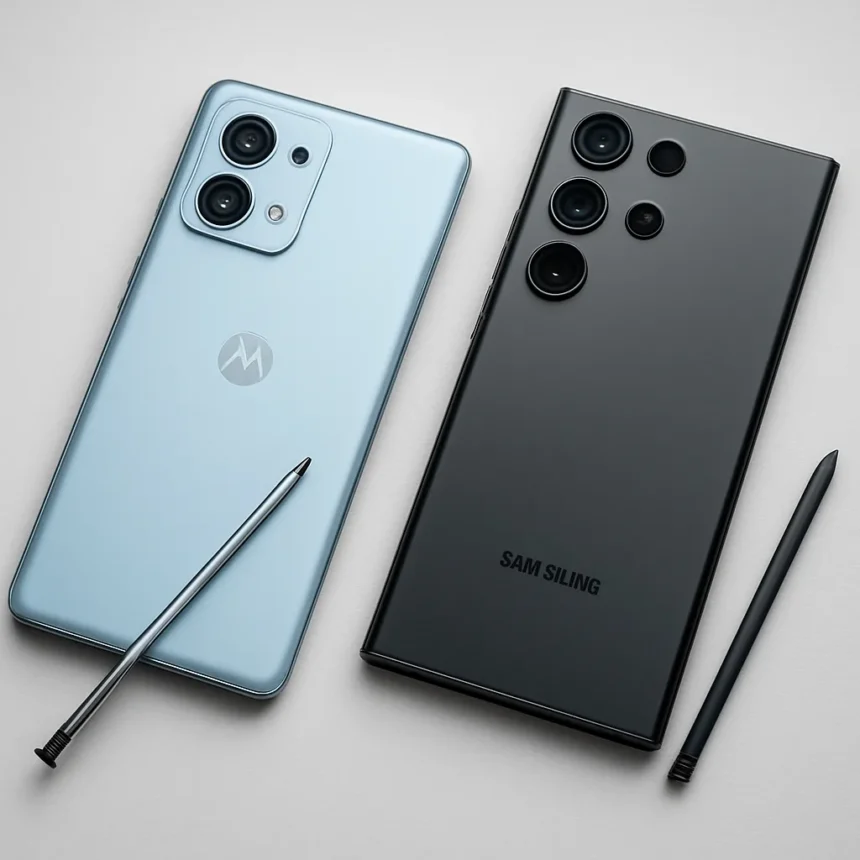
The Moto G Stylus 2026 vs Galaxy S26 Ultra comparison exposes a widening divide in the stylus phone market. Samsung’s flagship, released March 11, 2026, commands premium pricing for quad-camera photography and aggressive processing power. Motorola’s answer, announced April 8, 2026, strips away the luxury and delivers a stylus at a fraction of the cost. Both phones include built-in styluses, but the gap between them defines two entirely different buying philosophies.
Key Takeaways
- Moto G Stylus 2026 costs roughly one-third of the Galaxy S26 Ultra
- Galaxy S26 Ultra features quad rear cameras (200MP + 50MP + 50MP + 10MP) versus Moto’s dual setup (50MP + 13MP)
- Moto G Stylus has larger 5200mAh battery and faster 68W charging than Galaxy S26 Ultra’s 5000mAh and 60W
- Display sizes differ slightly: 6.78-inch Moto versus 6.90-inch Samsung
- Both phones launched within weeks of each other in early 2026
Camera: Where the Galaxy S26 Ultra Dominates
The camera gap between these two phones is the largest differentiator. Samsung’s Galaxy S26 Ultra packs a quad rear camera setup with a 200-megapixel primary sensor, flanked by 50MP, 50MP, and 10MP lenses. The Moto G Stylus 2026 uses a simpler dual-camera system with 50MP and 13MP sensors. For photographers, this is not a minor distinction—the Galaxy S26 Ultra’s multi-lens architecture gives it flexibility across zoom ranges and low-light scenarios that the Moto simply cannot match.
That said, the Moto G Stylus 2026 is not a camera phone designed for professionals. It is built for people who want a stylus and decent everyday shots without spending flagship money. The 50-megapixel main sensor is respectable for social media and casual snapshots. The real question is whether the Galaxy S26 Ultra’s camera prowess justifies its price premium, or whether the average user is paying for capability they will never use.
Battery and Charging: Moto Surprises
Here is where the Moto G Stylus 2026 flips the script. Despite being the cheaper phone, it ships with a larger 5200mAh battery compared to the Galaxy S26 Ultra’s 5000mAh. More surprising is the charging speed: Motorola offers 68W Turbo Charge, while Samsung tops out at 60W. This is a rare instance where the budget option outpaces the premium rival in raw specifications.


For daily users, this matters. A larger battery means longer time between charges, and faster charging means less time tethered to a wall outlet. The Moto G Stylus 2026 wins this round decisively, making it a smarter choice for anyone prioritizing endurance over camera prowess.
Stylus Experience and Design Philosophy
Both the Moto G Stylus 2026 and Galaxy S26 Ultra include built-in styluses, but the phones approach this feature from different angles. Samsung’s stylus is part of a premium ecosystem—the S Pen integrates deeply with Samsung’s software and is marketed as a productivity tool. Motorola’s stylus is more straightforward: it is there, it works, and it does not demand a learning curve.



The choice between them depends on your stylus expectations. Power users who sketch, take notes extensively, or demand pressure sensitivity across professional apps will prefer Samsung’s ecosystem. Casual stylus users who occasionally jot down reminders or sign documents will find the Moto G Stylus 2026 perfectly adequate—and they will keep hundreds of dollars in their pocket.
Display Specifications
The Galaxy S26 Ultra has a slight edge in screen real estate with a 6.90-inch display versus the Moto G Stylus 2026’s 6.78-inch panel. Both are large phones, and the difference is marginal—less than half an inch. For most users, the practical experience will feel nearly identical. The real question is refresh rate and brightness, which the research brief does not specify for either device.
Price: The Decisive Factor
The Moto G Stylus 2026 is described as significantly less expensive than the Galaxy S26 Ultra, potentially costing one-third as much. This is not a modest discount; it is a fundamental repositioning. At that price gap, the Galaxy S26 Ultra needs to deliver three times the value—and for most users, it simply does not.
If you are a casual user who wants a stylus without premium pricing, the Moto G Stylus 2026 is the obvious choice. If you are a power user who demands flagship cameras, premium materials, and deep software integration, the Galaxy S26 Ultra justifies its cost. Most people, though, fall somewhere in the middle—and they should choose the Moto.



Which Phone Should You Buy?
The Moto G Stylus 2026 is the smarter buy for budget-conscious buyers who want a stylus and solid everyday performance. You get a larger battery, faster charging, and a functional stylus without paying for features you will not use. The Galaxy S26 Ultra is the right choice if photography is a priority, if you want the most advanced stylus integration available, or if you simply demand the best regardless of cost.
Does the Moto G Stylus 2026 have a better battery than the Galaxy S26 Ultra?
Yes. The Moto G Stylus 2026 includes a 5200mAh battery with 68W Turbo Charge, while the Galaxy S26 Ultra has a 5000mAh battery with 60W charging. The Moto wins on both capacity and charging speed.
Is the Galaxy S26 Ultra worth three times the price of the Moto G Stylus 2026?
That depends on your priorities. The Galaxy S26 Ultra’s quad-camera system and premium stylus integration justify the premium for photographers and productivity-focused users. For casual users, the answer is no—the Moto G Stylus 2026 delivers excellent value at a third of the cost.
When did these phones launch?
The Samsung Galaxy S26 Ultra released on March 11, 2026, while the Moto G Stylus 2026 was announced on April 8, 2026. Both arrived within weeks of each other in early 2026.
The Moto G Stylus 2026 vs Galaxy S26 Ultra matchup is less a question of which is better and more a question of what you are willing to spend. Samsung built a flagship with premium cameras and deep stylus integration. Motorola built a practical alternative that costs a fraction as much and, in some areas like battery, outperforms its rival. For most people, the Moto makes more sense.
Where to Buy
$499.99 at Amazon | $1,125 at Amazon
Edited by the All Things Geek team.
Source: Android Central