



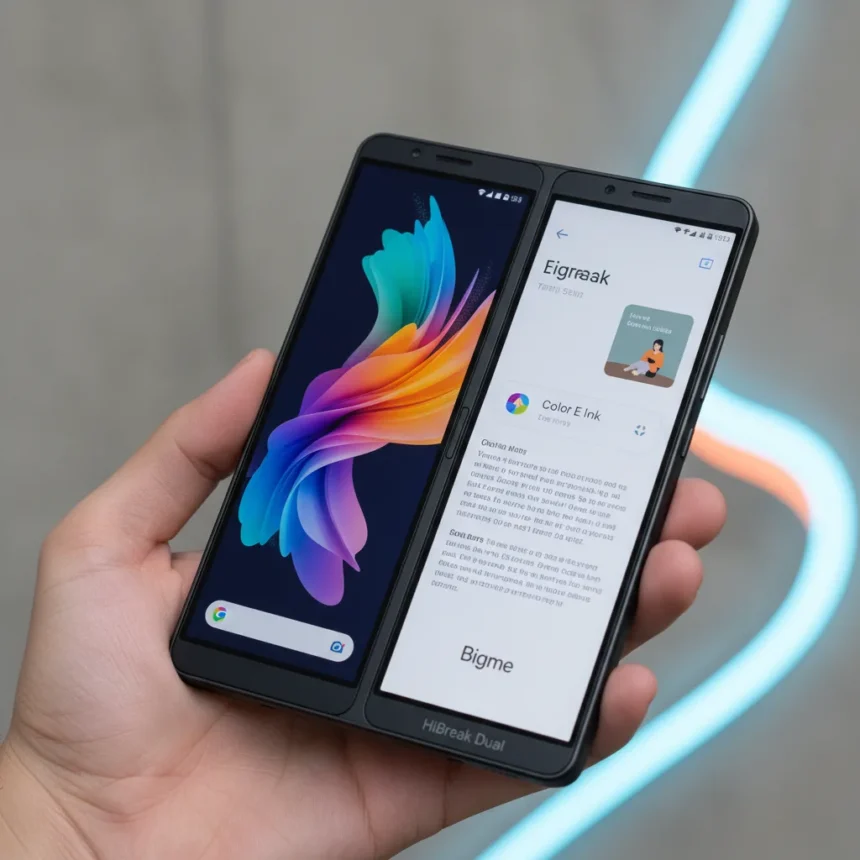
The Bigme HiBreak Dual is a dual-screen smartphone featuring a color E Ink Kaleido 3 display paired with an OLED panel, designed as a non-folding device running full Android. This is not a book-style foldable like Samsung’s Galaxy Z Fold—it’s a fundamentally different approach to giving users two genuinely useful screens on one device. For years, dual-screen phones have been gimmicks. The Bigme HiBreak Dual might finally change that.
Key Takeaways
- Bigme HiBreak Dual pairs a color E Ink Kaleido 3 main screen with an OLED/LCD back panel for dual functionality
- Non-folding dual-screen design differs from foldable competitors and past dual-screen attempts
- Fully Android-powered across both screens, unlike older competitors with fragmented software
- First color E Ink dual-screen smartphone, according to Bigme’s official store
- No confirmed release date or pricing yet; teased as coming soon
Why the Bigme HiBreak Dual matters now
Dual-screen phones have existed before—the Yotaphone and Hisense models proved the concept—but they suffered from crippling software fragmentation and design compromises. Each screen ran different software, or one side was essentially a dead weight. The Bigme HiBreak Dual sidesteps this by running Android across both panels, making the OLED side a genuine second display, not a secondary feature. This architectural choice transforms the device from novelty into tool. E Ink excels at reading, email, and long-form content without draining battery; OLED handles video, gaming, and vibrant media. Switching between them isn’t a workaround—it’s the entire point.
The timing matters. E Ink technology has matured. Bigme’s own HiBreak Pro Color already ships with a Dimensity 1080 chipset and 5G connectivity, proving that color E Ink phones can handle modern performance demands. Adding a second screen to that foundation feels inevitable in hindsight. Yet no other manufacturer has done it—not Hisense, not any Chinese startup, not even Samsung or Google. That gap is about to close.
What we know about the Bigme HiBreak Dual’s specs
Details remain sparse because Bigme is still teasing the device. However, we can infer likely specs from the HiBreak Pro Color, which features the same Kaleido 3 E Ink panel. That model includes a 6.1-inch color E Ink display, a Dimensity 1080 processor, 5G support, and Google Play access. The Dual will almost certainly match or exceed these foundations, though the company has not confirmed RAM, storage, battery capacity, or final processor choice for the new model.

The critical unknown is the OLED/LCD panel’s specifications. Screen size, resolution, refresh rate, and brightness remain unannounced. Bigme could opt for a smaller 4-inch display on the back, or match the E Ink side at 6 inches. The choice will determine whether this feels like two full phones or a phone with a secondary display. Without official specs, speculation is premature—but the architectural decision to use non-folding dual panels instead of a foldable hinge is already bold enough.
How does the Bigme HiBreak Dual compare to existing alternatives?
The Yotaphone 2, released over a decade ago, featured an LCD front and E Ink back but treated the E Ink side as a notification screen, not a full operating system. The Hisense dual-screen phones offered more functionality but struggled with inconsistent software between panels. Both devices felt like experiments rather than products designed for actual use.


Bigme’s existing single-screen HiBreak Color proves the company understands E Ink smartphone design. At $255.99, the HiBreak Color delivers a 5.84-inch HD color E Ink display, 6GB RAM, 128GB storage, a 36-level front light for reading in darkness, and Android 11 with Google Play. The HiBreak Pro Color steps up to $399–$425, adding a larger 6.1-inch Kaleido 3 panel, 5G, and Android 14. These phones are niche products, not mainstream competitors to iPhone or Samsung. But they prove there’s a market for devices that prioritize battery life and eye comfort over raw processing power.
The Bigme HiBreak Dual enters a category with almost no direct competition. It is not a foldable, so it does not compete with the Galaxy Z Fold or Oppo Find N. It is not a standard smartphone, so it does not compete with the iPhone 16 or Pixel 9. It occupies its own space—and that space was empty until now.
What could go wrong with the Bigme HiBreak Dual?
Bigme claims the HiBreak Dual is the world’s first color E Ink dual-screen smartphone, but this is a marketing statement, not an independently verified fact. The company has not released full specifications, performance benchmarks, or hands-on reviews. Until the device launches and independent reviewers test it, claims about durability, software stability, and real-world battery life remain unproven.
Pricing is another unknown. The HiBreak Pro Color costs $399–$425. Adding a second OLED screen, more RAM, and updated processors could push the Bigme HiBreak Dual to $600 or beyond. At that price, it competes directly with flagship single-screen phones that offer more app ecosystem maturity and brand recognition. Bigme would need to convince buyers that dual screens justify the premium—a difficult sell in markets where most users have never heard of the company.



There is also the question of software maturity. Bigme’s existing phones run Android 11 or 14, but the company has not detailed how Android will behave on a dual-screen setup. Will both screens be active simultaneously? Can users run separate apps on each? Does the system intelligently switch between them based on content type? These are not trivial questions, and Bigme’s silence suggests the software story is still being finalized.
When will the Bigme HiBreak Dual launch?
Bigme has not announced a release date or confirmed pricing for the HiBreak Dual. The device is currently in the teaser phase, with no preorders or availability windows announced. Based on past Bigme product cycles, a launch within the next 6–12 months is plausible, but this is speculation. The company typically reveals full specs weeks before launch, so expect a detailed announcement before the device ships.
Should you wait for the Bigme HiBreak Dual or buy a HiBreak Color now?
If you want an E Ink smartphone today, the HiBreak Color ($255.99) or HiBreak Pro Color ($399–$425) are available now. Both deliver excellent battery life and eye-friendly displays. The HiBreak Dual is a future product with unconfirmed specs and pricing. Wait for the Dual only if dual screens are essential to your use case—if you genuinely want E Ink for reading and OLED for media on the same device. Otherwise, a current HiBreak model offers proven performance at a known price.
Is the Bigme HiBreak Dual really the world’s first dual-screen E Ink phone?
Bigme claims this title on its official store, and no other manufacturer has announced a competing device. However, this is a marketing claim, not a third-party verified fact. The Yotaphone had dual screens but not dual color E Ink; Hisense offered dual screens but with inconsistent software. The Bigme HiBreak Dual would be the first to combine color E Ink with a second full display running the same operating system across both sides. That is a genuine innovation—but wait for launch confirmation before treating it as guaranteed.
The Bigme HiBreak Dual represents a rare moment in smartphone design: a company betting on a genuinely different form factor instead of iterating on the same glass slab. Whether that bet pays off depends on execution—software stability, real-world battery life, pricing, and whether users actually want two screens. Bigme has proven it can make solid single-screen E Ink phones. Now it needs to prove that two screens are better than one. The teaser has done its job: we’re waiting.
Where to Buy
This article was written with AI assistance and editorially reviewed.
Source: Android Central