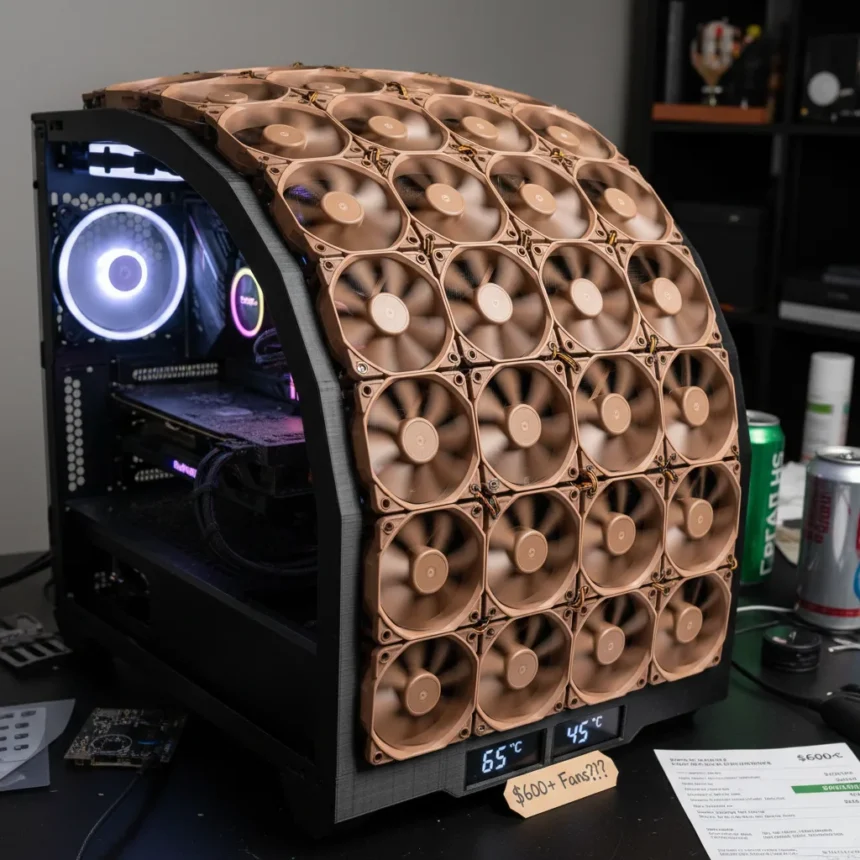
The Superdome—a bulbous 3D-printed PC case side panel housing 15 Noctua fans—demonstrates that PC case cooling fan arrays can deliver stunning thermal results. This custom mod achieves a 20-degree temperature reduction compared to standard cooling setups, pushing the boundaries of what air cooling can accomplish in enthusiast builds.
Key Takeaways
- Superdome features 15 Noctua fans in a 3D-printed bulbous structure attached to a PC case side panel.
- Total fan cost: $600 USD, with 20-degree temperature drop in testing.
- Design functions as a direct intake mod, channeling cool air into the case more efficiently.
- Part of ongoing Fan Showdown series exploring extreme cooling experiments.
- Raises practical questions about cost-benefit versus simpler cooling alternatives.
What Makes This PC Case Cooling Fan Array Different
The Superdome stands apart because it abandons conventional case design. Rather than relying on a standard side panel, this mod replaces it entirely with a 3D-printed bulbous intake structure packed with 15 Noctua fans arranged in a dense array. The design prioritizes airflow channeling directly into the case, creating a dedicated intake tunnel that feeds cool air straight to components. This is not a simple fan upgrade—it is a fundamental reimagining of how air enters a PC.
Most PC case cooling fan arrays follow traditional layouts: two or three intake fans, maybe a radiator mount. The Superdome abandons restraint entirely. The bulbous geometry maximizes surface area for fan mounting while maintaining structural integrity through 3D printing. Each Noctua fan contributes to a cumulative airflow effect, overwhelming standard case ventilation by sheer volume. The result is measurable: a 20-degree temperature drop across components.
How This Compares to Other Cooling Experiments
To understand the Superdome’s significance, context matters. Fan stacking—adding multiple fans to a single cooler—reduces temperatures by 8-30 degrees depending on configuration, with diminishing returns as more fans are added. Open side panel tests show roughly 22-degree GPU temperature drops in extreme scenarios, but sacrifice case protection and create dust management nightmares. Simpler venting modifications drop CPU temperatures by around 8 degrees while reducing fan noise.


The Superdome’s 20-degree gain positions it as a middle ground: more dramatic than passive venting, comparable to aggressive fan stacking, but requiring significant financial and physical investment. Other extreme cooling setups exist—the HAVN BF 360/360 Flow uses four 180x40mm fans for what designers call “insane airflow,” while a cross-flow fan concept set new cooling benchmarks. Yet none integrate into a case as smoothly as this bulbous side panel design, which maintains structural integrity while maximizing intake efficiency.
The $600 Question: Is It Worth It?
Here is where the Superdome reveals its weakness. Fifteen Noctua fans cost $600 USD—a price that demands scrutiny. For comparison, a high-end CPU cooler costs $100-150, and a complete case replacement runs $150-300. The Superdome’s fan investment alone exceeds most enthusiasts’ entire cooling budgets. The 20-degree temperature drop is undeniably impressive, but it assumes you need that much cooling capacity and can justify the cost against simpler alternatives.



A user facing thermal throttling might achieve 80% of the Superdome’s cooling gains by simply removing the case side panel (roughly 22 degrees) or adding two quality intake fans ($100-150) rather than fifteen. The Superdome targets a different audience: extreme overclockers, content creators who need stable thermals under sustained load, and cooling enthusiasts who view experimentation as entertainment rather than pure optimization. For those users, $600 becomes a reasonable cost for a conversation piece that actually delivers measurable results.
Why PC Case Cooling Fan Arrays Matter for Enthusiasts
The Superdome matters because it proves a point: case design, not just component selection, shapes thermal performance. Most PC builders focus on CPU coolers and GPU fans while treating the case as a container. This mod inverts that thinking. By redesigning the intake path and saturating it with fans, a case side panel becomes the primary cooling tool. That shift in perspective influences how enthusiasts think about thermal management.
The Fan Showdown series, which features the Superdome, documents this philosophy. Each episode tests cooling modifications methodically, isolating variables and measuring results. The series demonstrates that extreme cooling does not require exotic liquid loops or exotic components—it requires rethinking airflow architecture. For builders without access to water cooling or those seeking air-based solutions, PC case cooling fan arrays like the Superdome prove that density and geometry trump complexity.
Can You Build Your Own Superdome?
The Superdome is a one-off custom build, not a commercial product. Replicating it requires 3D printing expertise, CAD design skills, and access to a capable printer. The bulbous geometry is not trivial to model—it must balance structural strength with maximum surface area for fan mounting. Most enthusiasts lack the technical foundation to recreate this exact design, though the concept is clear: maximize intake fans through custom geometry and channel airflow efficiently into the case.



Builders interested in extreme PC case cooling fan arrays have alternatives. Purchasing a case with excellent intake design (cases from Corsair, Lian Li, or Phanteks offer multiple 120mm or 140mm fan mounts) costs far less and requires no fabrication. Adding aftermarket fans to existing mounts achieves meaningful cooling gains without the $600 investment. The Superdome remains a proof-of-concept rather than a reproducible solution for most users.
Should You Pursue Extreme PC Case Cooling Fan Arrays?
If you are a casual gamer or content creator, no. Standard case cooling with one or two quality intake fans handles most workloads without noise or cost penalties. If you are an overclocker pushing silicon to its limits or a professional running sustained heavy compute loads, the Superdome’s 20-degree gains become meaningful—potentially unlocking higher clock speeds or lower fan noise at the same thermal target. For enthusiasts who enjoy cooling experiments as a hobby, the Superdome is essential viewing and a benchmark for what is possible.
The real lesson is not that you need fifteen fans. It is that case design, intake geometry, and airflow channeling matter as much as component selection. A $150 investment in a better case with optimized intake design might deliver 60% of the Superdome’s cooling gains at one-quarter the cost. But for those chasing the absolute thermal ceiling, the Superdome proves that PC case cooling fan arrays, when engineered thoughtfully, can deliver results that rival much more expensive cooling solutions.
What temperature drop can you realistically expect from adding multiple intake fans?
Most users see 5-15 degree temperature drops by adding two to four quality intake fans, depending on case design and ambient temperature. The Superdome’s 20-degree result is exceptional because it combines fifteen fans with optimized intake geometry—a level of investment most builders never attempt.
Is the Superdome commercially available for purchase?
No, the Superdome is a custom one-off build created for the Fan Showdown series. It is not a commercial product and cannot be bought as a finished unit. Replication requires 3D printing and custom fabrication skills.
How does the Superdome compare to liquid cooling in terms of temperature performance?
The research does not provide direct thermal comparisons between the Superdome and liquid cooling systems. However, the Superdome demonstrates that air cooling, when engineered with extreme intake density and geometry optimization, can achieve results competitive with many all-in-one liquid coolers at a fraction of the complexity—though at higher cost than standard air cooling.
The Superdome is a fascinating experiment that proves PC case cooling fan arrays can achieve dramatic thermal improvements through thoughtful design and generous component investment. For most builders, it remains an inspiration rather than a blueprint—a reminder that case airflow deserves as much attention as the coolers mounted inside. But for extreme enthusiasts willing to spend $600 on fans and the time to integrate them, the 20-degree cooling gain is real and reproducible.
Edited by the All Things Geek team.
Source: Tom's Hardware