






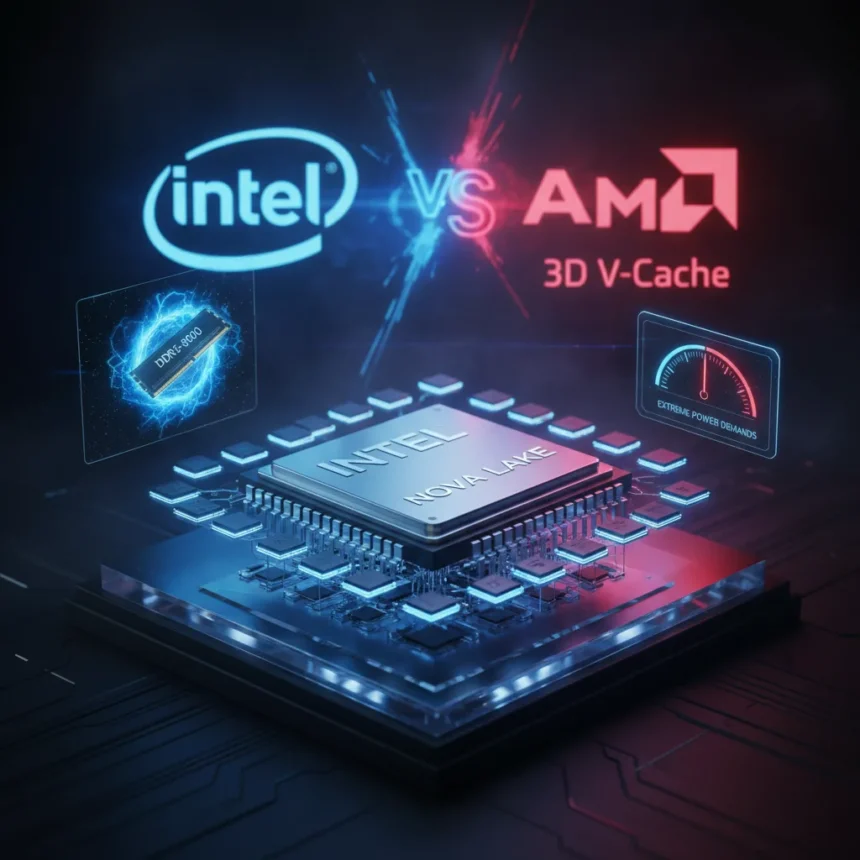
Intel Nova Lake CPUs are shaping up to be the company’s most ambitious desktop processor lineup in years, according to early leaks from VideoCardz. The upcoming Core Ultra 400S series promises up to 52 cores, DDR5-8000 support, and a direct challenge to AMD’s long-standing gaming performance advantage.
Key Takeaways
- Nova Lake-S flagship features 52 cores (16P + 32E + 4LP-E) with 175W TDP and 320MB total cache
- Memory support jumps to DDR5-8000 MT/s, a significant leap from Arrow Lake’s 6400-7200 MT/s
- 36 PCIe 5.0 lanes enable 1 GPU plus 3 NVMe SSDs at full bandwidth simultaneously
- Requires premium 900-series motherboards; entry-level boards will throttle performance
- Launches 2H 2026, positioning Intel against AMD’s next-generation Zen 6 processors
Core Count and Architecture: The 52-Core Gambit
The flagship Core Ultra 9 configuration packs 16 performance cores and 32 efficiency cores across dual compute tiles, plus 4 low-power efficiency cores on a separate SoC tile. This dual-tile approach differs fundamentally from AMD’s monolithic design, distributing workloads across specialized silicon. The P-cores use Intel’s new Coyote architecture, while E-cores adopt the Arctic design. This heterogeneous setup targets both gaming (P-core heavy) and productivity (E-core scaling) simultaneously.
Lower-tier SKUs scale down predictably. The Core Ultra 7 drops to 14P + 24E cores (42 total), while Core Ultra 5 and 3 variants range from 28 cores down to 12 cores, with TDPs from 125W to 65W. This tiering strategy mirrors AMD’s approach but with significantly higher core density at the flagship level.
Cache and Memory: Where Intel Targets AMD’s Weakness
Intel Nova Lake CPUs deliver 160MB to 320MB of total cache depending on configuration, with up to 144MB per single tile or 288MB across dual tiles. This dwarfs Arrow Lake’s 76MB cache and directly addresses one of AMD’s Ryzen 9000 series’ core advantages: massive L3 caches that boost gaming frame rates. The cache-to-core ratio here is aggressive—more cache per core than any current mainstream desktop CPU.



DDR5-8000 MT/s support represents another salvo at AMD. While Arrow Lake maxes out at 6400-7200 MT/s, Nova Lake’s official default speed of 8000 MT/s suggests Intel expects boards to ship with faster memory out of the box. This memory bandwidth advantage could translate to tangible gaming performance gains, particularly in CPU-bound scenarios where memory latency matters.
Power Demands and Platform Requirements: The Catch
Here is where Nova Lake gets aggressive. The flagship Core Ultra 9 carries a 175W TDP (PL1), but leaks suggest peak power consumption could reach approximately 700W under PL4 conditions with both tiles fully loaded. That is nearly double the power envelope of Arrow Lake’s flagship, which maxes out around 350W. For comparison, Raptor Lake’s Core i9-14900KS runs 150W/253W (PL1/PL2), so Nova Lake’s dual-tile design is in a completely different power class.



This extreme power demand creates a hard platform requirement. Only high-end 900-series motherboards with robust power delivery will unlock the full 52-core performance. Other boards will artificially limit the CPU’s power and frequency, crippling the investment. This gatekeeping means Nova Lake is not a drop-in upgrade for existing systems—it demands a platform refresh.
PCIe and Connectivity: Future-Proofing at Scale
Nova Lake CPUs offer 36 PCIe 5.0 lanes total: 24 from the CPU, 4 DMI lanes for chipset backhaul, and 8 from the Z990 chipset. This enables simultaneous 1x PCIe 5.0 GPU plus 3x PCIe 5.0 NVMe SSDs without bottlenecking, a luxury most gamers will not need but enterprise workloads will appreciate. Arrow Lake, by contrast, offers only 24 PCIe 5.0 lanes, making Nova Lake substantially more flexible for high-bandwidth I/O.
Gaming Performance and AMD Comparison
The headline claim—seizing AMD’s 3D V-Cache gaming throne—rests on three pillars: massive cache, fast memory, and P-core architecture optimized for gaming workloads. AMD’s Ryzen 9000 series (Zen 5) dominates gaming benchmarks largely due to 3D V-Cache, which stacks an extra 96MB of low-latency cache on top of standard L3. Intel’s approach is different: instead of stacking cache, it is increasing baseline cache density and memory bandwidth. Whether this proves equally effective remains unknown until independent benchmarks arrive.
AMD will respond. Zen 6, expected around the same 2H 2026 timeframe, will likely push core counts even higher and refine 3D V-Cache further. This sets up a genuine CPU arms race for the first time since Ryzen’s 2017 launch. The gaming performance crown is not guaranteed to Intel just because core counts are high—architecture efficiency matters as much as raw specs.



Socket and Compatibility: LGA 1954 Is a New Standard
Nova Lake requires a new socket: LGA 1954, replacing Arrow Lake’s LGA 1851. This is a hard break from the previous generation, meaning zero backward compatibility. Existing 900-series boards designed for Arrow Lake will not physically accept Nova Lake chips. Intel is essentially forcing a full platform upgrade, which is aggressive but not unusual for major architectural transitions.
Launch Timeline and Market Positioning
Intel Nova Lake CPUs are targeted for 2H 2026, roughly six months after Arrow Lake’s 1H 2026 launch. This staggered release allows Intel to milk Arrow Lake sales before introducing the flagship refresh. However, it also gives AMD time to respond with Zen 6, potentially negating Intel’s early advantage. Leaks are preliminary and official specs may shift before launch, so treating these numbers as final is premature.
Should you wait for Intel Nova Lake CPUs instead of buying now?
If you are shopping for a high-end desktop CPU in early 2025, Nova Lake is too far away to justify waiting. Arrow Lake and AMD Ryzen 9000 are available today and deliver strong gaming and productivity performance. However, if you are planning a build for late 2026 or beyond, Nova Lake deserves attention—assuming the leaks hold and power delivery challenges do not derail the launch.
How does Nova Lake’s cache compare to AMD Ryzen 9000?
Intel Nova Lake CPUs offer 160-320MB total cache versus Ryzen 9000’s 96MB of standard L3 plus 3D V-Cache stacking. Intel’s approach spreads cache across tiles, while AMD concentrates it. Neither is objectively better—it depends on workload. Gaming may favor AMD’s 3D V-Cache, while heavily threaded tasks might prefer Intel’s distributed cache.
What is the power draw difference between Nova Lake and Arrow Lake?
Arrow Lake’s flagship maxes out around 125W TDP and 350W peak power, while Nova Lake’s Core Ultra 9 runs 175W TDP with potential 700W peak power under full load. This roughly 2x difference reflects the dual-tile architecture and higher core count, but it also means Nova Lake demands significantly better cooling and power delivery infrastructure.
Intel Nova Lake CPUs represent a bold bet: massive core counts, generous cache, and fast memory to reclaim gaming supremacy from AMD. The leaks suggest real engineering ambition, but the 700W power envelope and hard platform requirements are genuine compromises. Whether the performance gain justifies the cost and complexity will depend entirely on how the chips perform in real gaming and productivity workloads—something only time and independent testing will reveal. For now, the specs are impressive on paper, but paper does not game.
Edited by the All Things Geek team.
Source: Tom's Hardware