






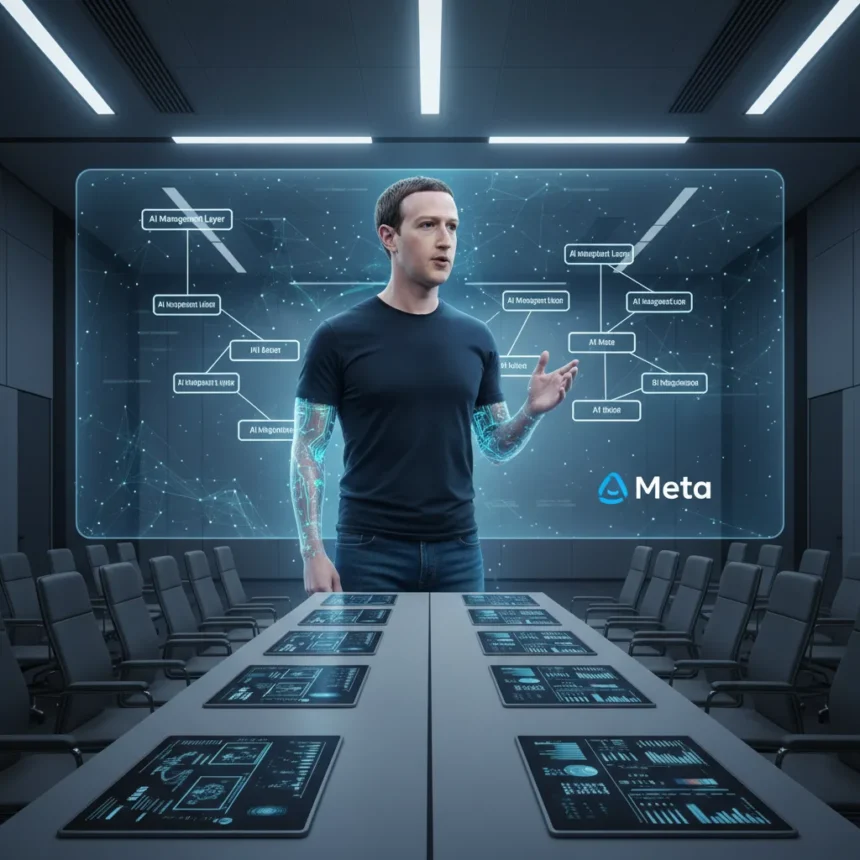
An AI clone of Mark Zuckerberg is being developed at Meta to handle employee interactions on his behalf, according to insiders cited in recent reporting. The project reveals something far larger than a time-saving gimmick: Meta is betting that AI agents can fundamentally reshape how companies operate, replacing traditional management structures with software that learns from human behavior and decision-making.
Key Takeaways
- Meta is building a 3D photoreal AI avatar of Zuckerberg trained on his emails, notes, and public statements
- The AI clone will engage with employees in real-time to save Zuckerberg time and flatten organizational layers
- Meta has 78,000 employees encouraged to build personal AI tools, including internal projects like Second Brain and My Claw
- Employees are already using AI agents to communicate with each other on internal messaging boards
- The broader strategy positions Meta as an AI-native company pursuing superintelligence
How Meta is building the Zuckerberg AI clone
The AI clone of Mark Zuckerberg is constructed from a comprehensive dataset of his communication patterns, strategic thinking, and personality traits. Meta trained the system using Zuckerberg’s personal emails, internal notes, company strategy documents, and public statements—essentially digitizing the way he thinks and speaks. The result is described as a hyperrealistic 3D avatar, animated like a video game character, capable of real-time conversations with Meta employees.
This is not merely a chatbot that responds to preset questions. The system is designed to replicate Zuckerberg’s mannerisms, conversation style, voice, intonations, language tics, and logic patterns. An internal employee project took this concept further, creating a chatbot replica specifically for practicing presentations—addressing the stress employees felt about presenting directly to Zuckerberg. The AI clone removes friction from routine interactions, allowing Zuckerberg to delegate lower-level engagement while maintaining his strategic input.
The AI clone of Mark Zuckerberg fits Meta’s larger organizational experiment
Meta is not stopping at Zuckerberg. The company is pushing to become an AI-native organization where every employee builds personal AI tools. This represents a fundamental shift in how work gets distributed and decisions get made. Rather than climbing a chain of command, employees interact with AI agents trained on their managers’ decision-making patterns.



Internal tools already in use include Second Brain, built on Anthropic’s Claude model, and experiments with a system called My Claw. Employees are encouraged to have their AI agents communicate with each other on internal messaging boards, flattening the traditional hierarchy. A manager no longer needs to attend every meeting or review every proposal—their AI agent can handle preliminary interactions, gather data, and flag critical decisions for human review. This approach theoretically accelerates decision-making by removing management bottlenecks.
The scale of this experiment is striking. With 78,000 employees, Meta is essentially running a large-scale test of AI-augmented organizational structure. If successful, the model could reshape corporate management across the tech industry. If it fails—if AI agents misrepresent their human counterparts or make poor decisions—the consequences for employee morale and decision quality could be severe.


What the Zuckerberg AI clone reveals about Meta’s superintelligence pursuit
The AI clone of Mark Zuckerberg is not an isolated vanity project. It reflects Meta’s broader pursuit of superintelligence and its commitment to becoming an AI-first company. Beyond internal tools, Meta is investing heavily in AI clones for external audiences: Instagram creators can build AI versions of themselves to respond to fan messages through AI Studio; celebrity AI chatbots simulate conversations with famous figures; and AI bot profiles on Facebook and Instagram generate content and engage followers.
These experiments serve a dual purpose. First, they position Meta’s AI infrastructure as essential to creators and celebrities, embedding the company deeper into content creation workflows. Second, they function as training grounds for more sophisticated AI systems. Each interaction, each conversation, each decision made by these AI agents feeds back into Meta’s models, improving their ability to replicate human reasoning and behavior. Zuckerberg’s clone is simultaneously a productivity tool and a research project in human-like AI behavior.
Is the AI clone of Mark Zuckerberg actually practical?
The promise is clear: Zuckerberg gets more hours in the day, employees get faster responses, decisions accelerate. The reality is murkier. An AI agent trained on emails and documents might capture decision patterns, but it cannot capture intuition, judgment in novel situations, or the kind of strategic insight that emerges from experience outside the training data. Employees interacting with the AI clone might feel they are getting Zuckerberg’s thinking, when they are actually getting a probabilistic reconstruction of his past behavior.
There is also a trust problem. Will employees take decisions made by the AI clone seriously, or will they feel they are being managed by software? Will the system inadvertently reveal Zuckerberg’s biases, communication quirks, or decision-making blind spots at scale? Meta has not publicly addressed these concerns, and the project remains shrouded in internal secrecy.



FAQ
What data is the AI clone of Mark Zuckerberg trained on?
The system is trained on Zuckerberg’s emails, personal notes, strategic company documents, and public statements. This dataset allows the AI to replicate his communication style, decision-making logic, and personality traits for employee interactions.
Can employees actually talk to the Zuckerberg AI clone?
Yes. The AI clone is designed as a 3D photoreal avatar capable of real-time conversations with Meta employees. It functions as a substitute for direct access to Zuckerberg, handling routine inquiries and interactions that would otherwise consume his time.
Is Meta the only company building AI versions of executives?
Meta is the most public about this strategy, but the broader trend of AI agents replacing management functions is spreading across tech. What distinguishes Meta is the scale—78,000 employees are encouraged to build personal AI tools—and the ambition to flatten organizational hierarchy through agent-to-agent communication.
The AI clone of Mark Zuckerberg is a window into Meta’s future vision: a company where AI agents handle routine work, employees interact with digital versions of leaders, and organizational structure flattens into networks of autonomous software. Whether this vision is practical or dystopian remains an open question. What is certain is that Meta is betting billions on the answer.
This article was written with AI assistance and editorially reviewed.
Source: Tom's Hardware