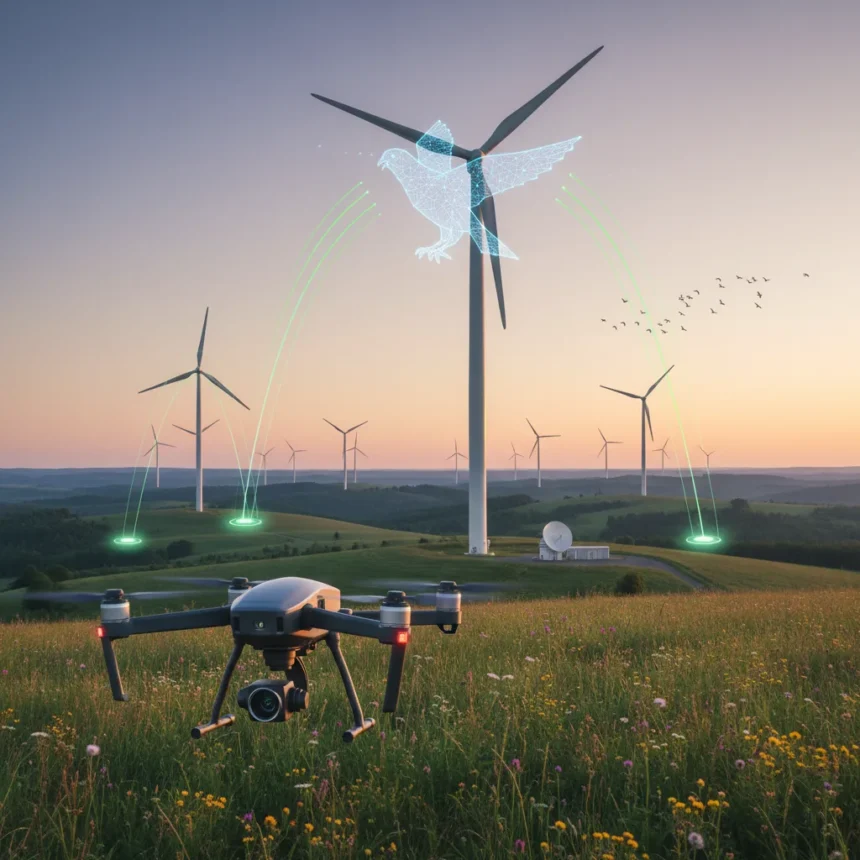
AI bird monitoring is transforming how wind farms measure actual wildlife risk, revealing that collision prediction models overestimate bird deaths by orders of magnitude. Two major studies using computer vision and radar technology show that migratory birds avoid turbines at rates exceeding 99.8%, fundamentally challenging decades of conservative safety assumptions that have slowed offshore wind expansion.
Key Takeaways
- AI stereo cameras and radar tracked >137,000 birds at Aberdeen Bay; zero collisions confirmed over 19 months
- Pre-construction models predicted 13.5 collisions; actual data showed 0.002 expected collisions—a 7,000-fold overestimate
- Separate study analyzed >4 million bird movements; 99.87% nocturnal and 99.86% diurnal avoidance rates observed
- Seabirds adjust flight paths 100–200 meters from turbines, showing macro-avoidance behavior
- On-site carcass searches validated low collision predictions, eliminating a major source of model uncertainty
How AI Bird Monitoring Works at Wind Farms
AI bird monitoring combines three detection layers: AI-controlled stereo cameras detect flight activity directly in the rotor plane, specialized bird radar records migration patterns, and on-site carcass searches provide ground truth. This layered approach replaces guesswork with observation. Ask Helseth, CEO of Spoor, the company behind the monitoring technology, stated: By combining AI-powered detection and detailed expert analysis, we can replace assumptions with concrete observations and measure actual behaviour in the immediate vicinity of wind turbines.
The Aberdeen Bay offshore wind farm study, conducted over 19 months from June 2023 to December 2024, deployed this methodology on a single operating turbine. AI systems tracked more than 137,000 birds in the vicinity. Of 2,007 flight paths flagged as potentially risky, expert ornithologists reviewed just five as possible collision candidates—and all five were ruled out upon closer inspection, with birds either clearing the structure or executing natural diving behaviors.
The Collision Risk Reality vs. Predictions
Traditional pre-construction collision risk models rely on flight height distributions and avoidance assumptions derived from limited field observations. These models predicted approximately 13.5 collisions over 19 months at the Aberdeen Bay turbine. The actual data told a starkly different story: 0.002 expected collisions, representing a 7,000-fold overestimate. This gap exposes a critical flaw in legacy modeling approaches that assume birds behave uniformly near turbines, when real-world behavior shows active, intelligent avoidance.



A separate study by the German wind industry association BWO examined over 4 million bird movements across 1.5 years. Nocturnal migratory birds showed 99.87% avoidance rates; diurnal migrants achieved 99.86%. Collision risk percentages dropped to 0.0016% for night fliers and 0.0020% for day fliers—numbers so low they suggest offshore wind expansion poses negligible threat to migration corridors. Critically, researchers found no correlation between migration intensity and actual collisions; even nights with high nocturnal activity saw few birds penetrating the rotor area.
Why Traditional Models Failed So Badly
Legacy collision risk models were built on conservative assumptions because direct observation was impossible. Engineers modeled flight height probabilities, assumed fixed avoidance rates, and applied safety margins. The result: predictions that treated every bird near a turbine as equally vulnerable. Real-world AI bird monitoring reveals seabirds adjust paths 100–200 meters away from turbines—macro-avoidance behavior that traditional models underestimated or missed entirely.



Dr. Jorg Welcker of Bio-Consult SH, who led the research methodology, explained the shift: We used state-of-the-art methods. AI-controlled stereo cameras determined flight activity in the rotor area, while a specialised bird radar recorded migration patterns. By comparing both datasets, we were able to precisely calculate avoidance rates. In addition, we specifically searched for collision victims. This resulted in a comprehensive picture of the actual collision risk of migratory birds at wind turbines.
Industry Response and Policy Implications
The findings carry immediate policy weight. Vattenfall’s Dr. Eva Julius-Philipp stated that modern offshore wind farms can be operated with low risk to wildlife, signaling confidence among major operators to expand projects previously stalled by environmental concerns. Stefan Thimm of the BWO emphasized the depoliticization angle: The new study shows that migratory birds avoid wind turbines. This confirms that the environmentally-sound expansion of offshore wind energy works in harmony with these birds and not against them. With this research, we want to depoliticise the discussion, improve the data basis, and make decisions based on facts.
This represents a significant shift from earlier mitigation strategies. Some wind farms have deployed radar systems to shut down turbines when birds approach, while others have tested blade painting—red bands at South Africa’s Hopefield wind farm reduced bird deaths by over 80%, cutting birds of prey fatalities from seven to one. AI bird monitoring suggests such interventions may prove unnecessary at many sites, freeing resources for conservation efforts elsewhere.
What AI Bird Monitoring Means for Wind Farm Expansion
The collision risk data removes a major psychological barrier to offshore wind development. Environmental groups and coastal communities have cited bird mortality as a primary concern, often citing worst-case model predictions. AI bird monitoring grounds the debate in observed behavior rather than theoretical worst-case scenarios. This does not eliminate environmental review—site-specific factors matter—but it shifts the burden of proof from defending wind expansion to demonstrating why a particular location differs from the >99.8% avoidance baseline.


The technology also enables continuous monitoring post-construction, creating feedback loops that refine safety protocols. Unlike pre-construction models that lock in assumptions for decades, AI bird monitoring adapts as wind farms operate, detecting any unexpected behavioral changes or collision patterns in real time.
Can AI bird monitoring be deployed at every wind farm?
AI bird monitoring requires stereo cameras, radar systems, and expert ornithological review—infrastructure that adds cost and complexity. Smaller onshore wind projects may not justify the investment, while offshore farms with high migratory traffic benefit most. Deployment depends on regulatory requirements and developer risk tolerance, but the technology is rapidly scaling across major European and offshore projects.
Do these studies prove wind farms never kill birds?
The studies demonstrate observed collision rates at specific sites, not absolute zero risk. Aberdeen Bay recorded zero confirmed collisions over 19 months, but this represents one turbine in one location under particular migration patterns. Broader conclusions hold: avoidance rates exceed 99.8% and collision risks are orders of magnitude lower than predictions. Site-specific factors—geography, species composition, seasonal timing—still matter.
How does AI bird monitoring compare to traditional methods?
Traditional approaches relied on flight height modeling and generic avoidance assumptions, producing predictions that overestimated collisions by thousands of times. AI bird monitoring observes actual behavior through stereo vision and radar, eliminating the gap between theory and reality. This is not incremental improvement—it is a fundamental shift from modeling to measurement.
AI bird monitoring has reframed the wind-versus-wildlife debate from theoretical risk to observed behavior. With >99.8% avoidance rates and zero confirmed collisions in major studies, the data now supports rapid offshore wind expansion without compromising bird populations. The next phase is deploying this technology widely enough to establish site-specific baselines, moving environmental policy from precaution to evidence.
Edited by the All Things Geek team.
Source: TechRadar