





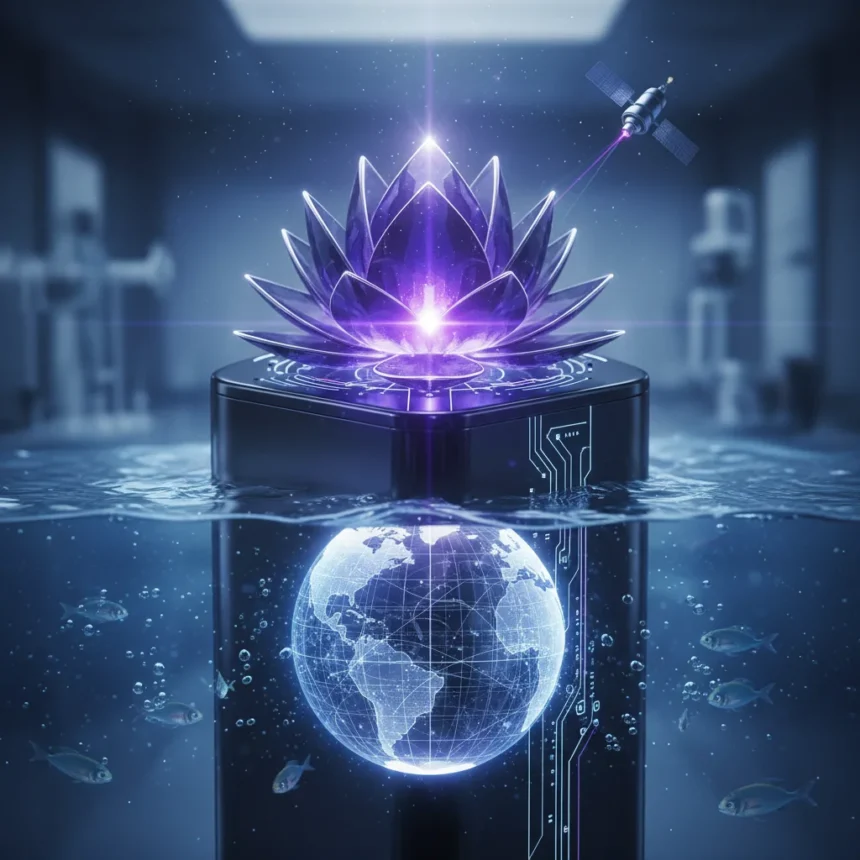
An ultraviolet crystal breakthrough in China could fundamentally reshape how we navigate when GPS fails, enabling nuclear clocks with timing precision far beyond current atomic systems. The breakthrough involves a novel crystal that produces laser pulses in one billionth of a second—1 picosecond—creating structures 1,000 times stronger and 1,000 times faster than conventional approaches. This is not about internet speed or consumer gadgets. It is about rewriting the rules for precision timing in environments where GPS signals vanish: deep space, underwater, and anywhere signals cannot penetrate.
Key Takeaways
- Ultraviolet crystal enables picosecond laser pulses for advanced nuclear clock research and development.
- Nuclear clocks achieve timing stability at 10^-18 level, vastly superior to GPS atomic clocks at 10^-14.
- Applications include autonomous navigation in GPS-denied environments like submarines and deep space probes.
- Breakthrough ties to broader Chinese advances in photonic computing and quantum materials.
- Deployment remains years away; nuclear clock technology is still in research phase, not production.
How the ultraviolet crystal breakthrough works
The ultraviolet crystal breakthrough enables laser precision previously impossible with conventional materials. By generating pulses measured in picoseconds, the crystal allows researchers to create nanostructures with extreme accuracy. This precision directly supports nuclear clock development, which requires controlling matter at scales where even tiny errors compound into timing failures.
The technology connects to a broader shift in Chinese photonics and quantum materials research. Alongside this crystal work, Chinese researchers have developed methods to grow 2D semiconductors 1,000 times faster than conventional chemical vapor deposition, expanding single-crystal domains to sub-millimeter sizes. These advances suggest China is building an ecosystem of precision manufacturing techniques that could reshape semiconductor and optical device production globally.
Why GPS replacement matters more than the hype suggests
The headline promise of making GPS obsolete overnight is sensational and misleading. Nuclear clocks remain in research and development, requiring years before practical deployment. But the underlying opportunity is genuine: GPS fails in environments where humanity increasingly operates. Submarines cannot receive satellite signals underwater. Deep space probes travel beyond GPS range. Military operations in GPS-denied zones face navigation challenges. A practical alternative—even one requiring years to mature—addresses a real strategic gap.

Nuclear clocks achieve timing stability at the 10^-18 level, compared to GPS atomic clocks at 10^-14. That difference sounds abstract until you consider its implications: nuclear clocks could enable autonomous navigation systems so precise they drift only seconds over millions of years. For submarines, space missions, and any application requiring dead reckoning in signal-denied environments, that represents a fundamental advantage over current alternatives.
This capability matters most in geopolitical contexts. As space exploration accelerates and underwater operations grow more sophisticated, nations with independent navigation systems reduce reliance on GPS infrastructure—whether their own or others’. The ultraviolet crystal breakthrough positions China as a leader in the optical and quantum technologies that make such systems possible.



The broader photonics race and what it means
The crystal breakthrough does not exist in isolation. Related Chinese research includes a quantum photonic chip claiming 1,000x speed advantages over Nvidia GPUs for specific AI workloads in aerospace, biomedicine, and finance. Separately, researchers have demonstrated quantum materials like 1T-TaS₂ that enable terahertz switching near room temperature, potentially challenging silicon’s dominance in conventional computing. These advances collectively suggest China is pursuing a photonics-first strategy rather than following Western silicon-centric paths.
The comparison to Nvidia is instructive but requires nuance. The quantum photonic chip’s claimed 1,000x speedup applies to specific workloads, not general computing. Nvidia GPUs excel at different tasks. Neither technology makes the other instantly obsolete. But the divergence matters: if Chinese photonic systems prove practical at scale, they could capture markets where optical approaches outperform electronic ones, fragmenting the global chip hierarchy that Nvidia currently dominates.
Defect engineering in materials like strontium ruthenate (SrRuO3) has yielded 3x improvements in switching energy efficiency through unconventional orbital relaxation mechanisms. These laboratory advances, while specialized, demonstrate that Chinese researchers are exploring material science avenues Western teams may have overlooked, potentially unlocking efficiencies that conventional approaches cannot match.
When will ultraviolet crystal technology actually matter?
The ultraviolet crystal breakthrough represents genuine progress, but expectations must be calibrated. The technology enables nuclear clock research, not nuclear clocks themselves. Development timelines for such systems typically span years or decades. Deployment in submarines, spacecraft, or military applications will follow only after extensive testing and validation. Expect laboratory demonstrations within the next few years, but practical navigation systems powered by nuclear clocks remain a longer-term prospect.



The sensational framing—1,000x faster internet, GPS obsolete overnight—misses the actual story. The real news is that China is systematically advancing photonic, quantum, and precision materials research across multiple fronts, building capabilities that could reshape how navigation, computing, and sensing systems work globally. That shift matters more than any single breakthrough.
Could ultraviolet crystal technology replace GPS in your phone?
No. Nuclear clocks are impractical for consumer devices. They require extreme precision and controlled environments incompatible with smartphones. The ultraviolet crystal breakthrough targets specialized applications: military navigation, deep space probes, submarines, and other GPS-denied environments where extreme timing accuracy justifies the complexity and cost.
What makes the ultraviolet crystal breakthrough different from previous laser research?
The picosecond pulses produced by the new crystal enable nanostructure creation and control at scales previously difficult to achieve. This precision directly supports nuclear clock development by allowing researchers to manipulate matter with unprecedented accuracy. Earlier laser systems could not match this capability, limiting progress in fields requiring extreme timing stability.
Is China really ahead of the West in photonics and quantum materials?
The research brief suggests China is advancing rapidly in these areas, with deployments of quantum photonic chips in real data centers. However, claiming definitive leadership requires comparing full research pipelines, manufacturing capabilities, and commercialization timelines across both regions—data not available in current sources. What is clear: China is investing heavily and producing results that Western researchers cannot dismiss.
The ultraviolet crystal breakthrough is real, but it solves a specific problem for specific applications. Do not expect your phone to navigate by nuclear clock. Do expect that over the next decade, military systems, space agencies, and underwater operations will increasingly rely on independent timing systems that GPS cannot provide. China’s advances in photonics and quantum materials suggest it will play a central role in that shift. That alone makes this breakthrough worth watching, even if the sensational headlines overstate the immediate impact.
Edited by the All Things Geek team.
Source: TechRadar




