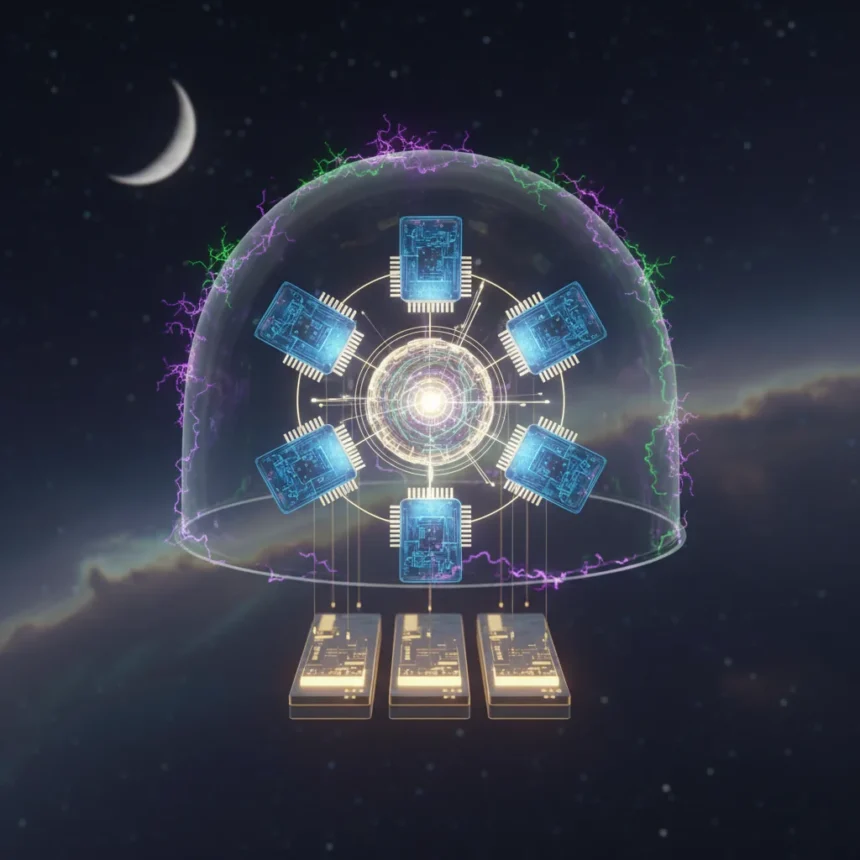
Artemis II’s fault-tolerant computing system is built on paranoia. The spacecraft carries four astronauts around the Moon for the first crewed lunar mission in over 50 years, traveling through an environment where a single cosmic ray can flip a bit in memory and kill the mission. NASA’s solution: eight processors that constantly check each other’s work, organized in four Flight Control Modules that vote on every command before it fires a thruster or adjusts life support.
Key Takeaways
- Orion’s computing system contains four Flight Control Modules, each with two processors running identical software in lockstep.
- Processors in each module form self-checking pairs; outputs must match perfectly before any command is sent.
- Triple Modular Redundant memory stores data in triplicate and votes “best-of-three” on every read to correct radiation-induced bit flips.
- The network uses three separate redundant planes with self-checking switches to prevent corrupted commands from propagating.
- If a module detects a discrepancy, it fails silent—stops transmitting and goes offline rather than sending wrong instructions.
How Artemis II Fault-Tolerant Computing Prevents Catastrophe
Artemis II fault-tolerant computing relies on a deceptively simple principle: agreement before action. Two processors inside each Flight Control Module run identical software in perfect synchronization. Before any command reaches the spacecraft’s thrusters, engines, or life support systems, their outputs are compared. If they match, the command proceeds. If they diverge—even by a single bit—the entire module shuts down. “A faulty computer will fail silent, rather than transmit the ‘wrong answer,'” explained NASA engineer Uitenbroek. This is not a passive failure mode. A silenced module can potentially recover and rejoin the voting pool, but only if it stops transmitting corrupted data first.
The system is built for deep-space radiation risks that Earth-orbit hardware never faces. High-energy particles constantly bombard the Orion spacecraft, flipping bits in memory with no atmosphere to shield against them. A single-bit flip in Apollo’s guidance computer might have gone unnoticed. In Artemis II, it triggers an immediate fail-safe response.
Memory and Network Redundancy: Catching Errors Before Software Sees Them
Hardware-level redundancy catches errors before they propagate to software. Artemis II fault-tolerant computing uses Triple Modular Redundant memory, storing every data value three times. When software reads a byte, the hardware performs a “best-of-three” vote, automatically correcting any single-bit error on the fly. This happens invisibly—the processor sees correct data even if one copy was corrupted by radiation.


The network layer adds another defensive layer. Three separate redundant planes carry commands and telemetry. Within each plane, network interface cards continuously compare two lanes of traffic. If they diverge, the interface card fails silent, preventing corrupted commands from reaching actuators or thrusters. All switches employ self-checking strategies, ensuring no corrupted instruction can propagate through the system.
Fault Tolerance in Action: Four Modules, Priority-Based Voting
Artemis II carries four Flight Control Modules, not three. This architecture sidesteps the complexity of triplex voting (where three systems vote 2-of-3 on every decision). Instead, the system uses priority-ordered source selection: it picks the output from the first healthy module in a ranked list and skips any that have silenced themselves. If the primary module fails silent, the system advances to the second. If the second fails, it moves to the third. The system can lose three modules in 22 seconds and still ride through safely on the last one.



This is not redundancy for comfort—it is redundancy scaled specifically for deep space. Unlike Apollo’s guidance computer, which handled only navigation, Artemis II’s computing system manages all safety-critical functions: life support, engine burns, communication routing, and navigation. The complexity and scope demand a system that tolerates not just single failures but cascading failures across minutes.
Comparison to Apollo: From Simple Redundancy to Fail-Silent Architecture
Apollo’s guidance computer included basic redundancy but operated under fundamentally different assumptions. It managed specific navigation tasks within a simpler mission architecture. Artemis II’s computing system inherits the goal but operates at a scale that would baffle Apollo engineers. The Orion spacecraft runs the Integrity-178 operating system and coordinates eight processors across four modules, each with fail-silent capability and hardware-level error correction.
The architectural leap from Apollo to Artemis II reflects 50+ years of understanding about how systems fail in space. Radiation, not mechanical wear, is the enemy. Bit flips, not component burnout, demand the engineering response. Fail-silent design—stopping transmission rather than guessing—prevents a single corrupted command from cascading into catastrophe.
Can Artemis II’s Computing System Actually Fail?
The system is designed to tolerate faults, not to be infallible. Losing three of four modules is survivable. Losing all four is not. A common-mode error—where both processors in a pair fail identically due to the same radiation event—could theoretically bypass the self-checking pair without triggering fail-silent. But such scenarios are rare enough that the architecture prioritizes the faults most likely to occur: single-bit flips, partial module failures, and isolated processor errors.



What makes Artemis II fault-tolerant computing remarkable is not invulnerability. It is the deliberate engineering choice to fail safely. Every redundancy layer—processor pairs, memory voting, network comparison, module prioritization—forces the system to stop and declare itself unhealthy rather than guess. In deep space, where repair is impossible, stopping is the safest choice.
Why This Matters for Artemis II’s Lunar Mission
Artemis II carries four astronauts farther from Earth than any human has traveled since 1972. The computing system protecting them operates in an environment where a single hardware failure cannot be walked back, where redundancy is not a luxury but the only acceptable design philosophy. The eight-CPU architecture, the fail-silent modules, the triple-redundant memory and network—these are not over-engineering. They are the minimum necessary to make a crewed deep-space mission survivable.
How does Artemis II’s computing system handle radiation differently than Earth-orbit spacecraft?
Artemis II fault-tolerant computing is explicitly designed for deep-space radiation risks. High-energy particles flip bits constantly in the lunar environment, where Earth’s magnetic field offers no protection. The system uses Triple Modular Redundant memory and fail-silent architecture to detect and contain radiation-induced errors before they corrupt commands. Earth-orbit systems face lower radiation doses and can often tolerate simpler redundancy models.
Can a silenced Flight Control Module recover during the mission?
Yes. A module that fails silent is not permanently dead—it has simply stopped transmitting to protect the spacecraft from corrupted commands. If the error that triggered fail-silent is transient (a single bit flip that does not recur), the module can potentially recover and rejoin the voting pool. However, the system does not rely on recovery; it assumes the worst and continues operating on remaining healthy modules.
What operating system runs on Artemis II’s processors?
The Orion spacecraft runs Integrity-178, a real-time operating system designed for safety-critical aerospace applications. This OS coordinates the eight processors across four Flight Control Modules and manages the fail-silent logic, priority-based module selection, and communication between redundant systems.
Artemis II’s computing brain represents a fundamental shift in how NASA designs systems for deep space. Rather than betting on single components staying healthy, the architecture assumes failure and builds defenses around it. Eight processors voting on every move, memory correcting itself, networks comparing every transmission—this is engineering for a place where mistakes are not recoverable, where paranoia is the only rational design philosophy.
Edited by the All Things Geek team.
Source: TechRadar