






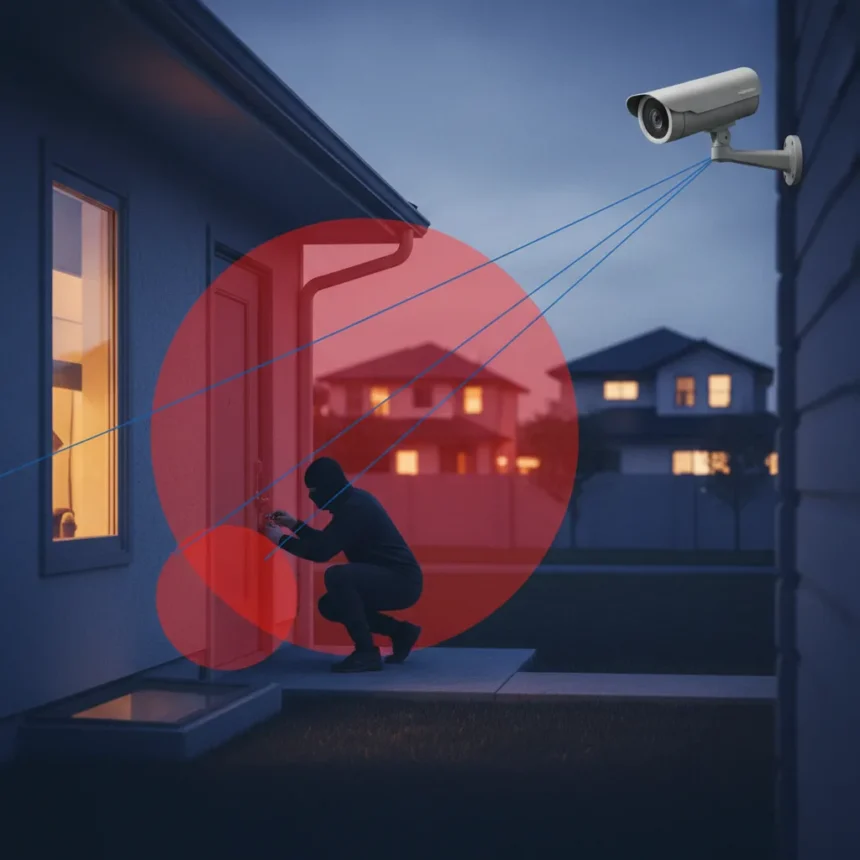
Security camera blind spots are areas of your property that fall outside the range or field of view of your surveillance system, creating vulnerability gaps that burglars deliberately seek out and exploit. These gaps represent the most dangerous weakness in any home security setup, yet most homeowners remain unaware they exist until after a break-in occurs.
Key Takeaways
- Security camera blind spots are areas burglars actively target to avoid detection during theft.
- Blind spots occur due to camera placement, limited field of view, and architectural obstacles.
- Burglars study homes before breaking in and specifically look for surveillance coverage gaps.
- Strategic camera placement and overlapping coverage eliminate most blind spots.
- Regular security audits reveal vulnerabilities that static camera systems miss.
Why Burglars Actively Hunt for Security Camera Blind Spots
Burglars do not randomly choose homes to target. They conduct reconnaissance, walking around properties and identifying exactly where cameras are positioned and, more importantly, where they are not. Security camera blind spots represent opportunity—a clear path to entry, theft, or exit that avoids detection entirely. A burglar who finds even a small blind spot can use it to approach a door, disable an alarm, or carry stolen goods away without ever appearing on footage. This is why understanding and eliminating these gaps is not optional for serious home security.
The psychology of burglary is straightforward: criminals take the path of least resistance. If your front door has perfect camera coverage but your side entrance does not, that side entrance becomes the target. If your driveway is monitored but your back patio is dark and uncovered, the burglar will use the back patio. Security camera blind spots are not accidental vulnerabilities—they are invitations.
Common Security Camera Blind Spots in Residential Properties
Most homes have predictable blind spots that repeat across neighborhoods. Understanding these patterns helps you identify and fix them before a burglar does. The most dangerous security camera blind spots typically include entry points like side doors, rear entrances, and basement windows that fall outside the camera’s field of view. Windows positioned above ground level are frequently missed because homeowners assume burglars cannot reach them, but determined intruders can use ladders, adjacent structures, or climbing techniques to access second-story windows that lack surveillance coverage.


Architectural features create additional security camera blind spots. Eaves, overhangs, and roof lines cast shadows that cameras cannot penetrate. Bushes and landscaping, intended to beautify a property, often grow tall enough to block camera views of ground-level entry points. Garages present their own set of blind spots—the area directly above the garage door, the sides of the garage, and the space between the garage and the house are frequently unmonitored. Driveways and parking areas often have gaps where a camera positioned on the house cannot see the far end of the driveway or the street side of parked vehicles.
Interior blind spots matter equally. Hallways, stairwells, and rooms between the main entry point and valuable items like safes, jewelry boxes, or electronics may lack camera coverage. A burglar can enter through a monitored front door, then move through unmonitored interior spaces to steal what they came for without ever being clearly identified on footage.



How to Eliminate Security Camera Blind Spots
Fixing security camera blind spots requires a systematic approach. Start by physically walking your property at different times of day, noting where shadows fall and where camera views end. Look at your home from a burglar’s perspective—what path would you take to avoid detection? That path likely runs through a blind spot. Mark these areas on a map of your property.
Overlapping camera coverage is the most effective solution. Instead of placing one camera to cover an entire side of the house, use multiple cameras with overlapping fields of view. This creates redundancy—if one camera misses a moment, another captures it. Adjust camera angles to eliminate shadows and obstructions. Remove or trim landscaping that blocks camera views. Reposition cameras mounted too high or too low; most cameras are most effective when positioned 8-10 feet above ground, angled slightly downward.
Install cameras at all entry points: front door, back door, side doors, garage entry, and basement windows. Add cameras to cover blind spots created by architectural features—place a camera under an eave to monitor the area the roof overhang hides. Use wide-angle or panoramic cameras to cover larger areas with fewer devices. Test your coverage by walking through the property and checking the live feed on your phone to see exactly what each camera captures and where gaps remain.
Why Professional Security Audits Matter
Many homeowners discover security camera blind spots only after a break-in. A professional security audit, conducted by someone trained to think like a burglar, identifies vulnerabilities before they are exploited. Security professionals look beyond obvious entry points and examine sightlines, lighting, camera overlap, and architectural weaknesses that untrained eyes miss.



A security audit typically includes a walkthrough of the property at different times of day, review of existing camera footage to assess clarity and coverage, identification of blind spots, and recommendations for additional cameras or repositioning. The cost of an audit—typically a few hundred dollars—is negligible compared to the cost of a burglary or the peace of mind gained from knowing your home is truly protected.
Do security cameras actually deter burglars?
Yes, visible cameras do deter many opportunistic burglars who prefer easy targets. However, determined burglars research properties and specifically target homes with security camera blind spots. The presence of cameras alone is not enough—the coverage must be comprehensive and gaps must be eliminated.
Can burglars disable security cameras?
Burglars can disable cameras if they have access to them before entering the home. This is why cameras should be mounted high and out of reach, and why backup power sources and cloud storage are critical. If a burglar destroys a camera, you still have footage from other angles and from cloud backup.
What is the best camera placement to avoid blind spots?
The most effective placement covers all entry points with overlapping views, eliminates shadows and obstructions, and positions cameras 8-10 feet high angled slightly downward. Corners of the property, areas between buildings, and spots obscured by landscaping require special attention. Test coverage by reviewing live feeds from each camera to confirm no gaps exist.
Security camera blind spots are not inevitable—they are the result of poor planning or incomplete coverage. By systematically identifying these vulnerabilities and addressing them with strategic camera placement and overlapping coverage, you eliminate the exact gaps burglars hunt for. The difference between a home that feels secure and one that actually is secure often comes down to whether you have taken the time to find and fix these blind spots before a criminal does.
Where to Buy
This article was written with AI assistance and editorially reviewed.
Source: Tom's Guide