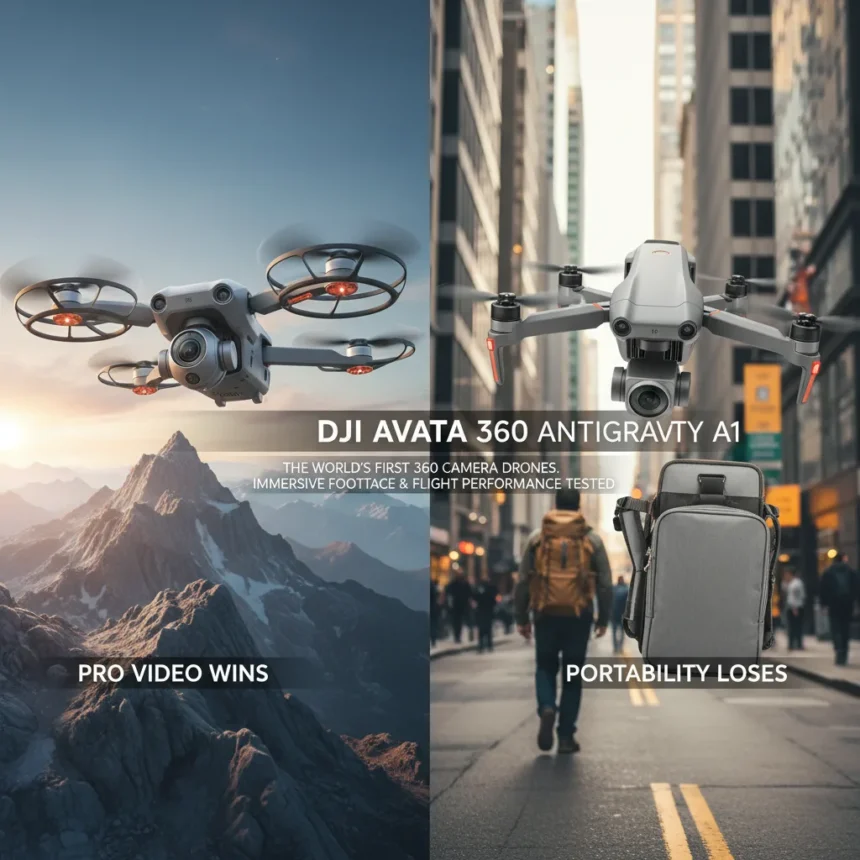
360 camera drones have arrived, and the race is already decisive. The DJI Avata 360 and Antigravity A1 are the world’s first two commercial systems capturing full spherical video from the air, but they target entirely different pilots. After comparing specs, performance, and real-world usability, one clear winner emerges—though not for everyone.
Key Takeaways
- DJI Avata 360 delivers 8K60 10-bit video with superior dynamic range for professional editing and grading.
- Antigravity A1 folds into a travel bag and stays under 250g without the high-capacity battery, avoiding FAA registration.
- DJI’s larger 1/1.1-inch sensors capture 120MP stills versus A1’s 55MP, a significant advantage for panoramic photography.
- A1 offers 24-39 minutes of real-world flight time compared to Avata 360’s 15-20 minutes, extending operational range.
- Avata 360 costs $549 while A1 starts at $1,599, making the choice less obvious than specs alone suggest.
DJI Avata 360 Dominates Video Quality and Sensor Power
The DJI Avata 360 is built for professionals who grade footage in post-production. Its dual 1/1.1-inch square CMOS sensors—each 64MP—produce 120MP still panoramas and 8K60 video in 10-bit D-Log M, delivering one billion colors of tonal separation versus the A1’s 8-bit 16 million colors. This is not a marginal difference. Ten-bit capture preserves shadow and highlight detail that 8-bit footage clips away, giving colorists and editors genuine creative control. The DJI system weighs around 450g, requiring FAA or CAA registration, but that heft buys you sensors that perform in mixed lighting without the noise floor collapse the A1 experiences in low light.
The Antigravity A1 shoots 8K at 30fps in 8-bit, which means sharper, cleaner footage straight out of the camera for social media clips—but at the cost of editing flexibility. A1 users who try to recover blown highlights or lift shadows in post discover they have nowhere to go. For YouTube creators and Instagram producers uploading directly, this is fine. For commercial work, broadcast, or any project requiring color grading, the DJI system is the only choice.
Portability and Regulation: Where the A1 Fights Back
The Antigravity A1 folds into a compact travel package and weighs under 250g with its standard battery, eliminating drone registration requirements in most jurisdictions. The DJI Avata 360’s 450g frame always requires registration, making it a nonstarter for casual weekend pilots or travelers who want zero bureaucracy. Swap the A1 to its High-Capacity Flight Battery and it crosses the 250g threshold, triggering the same regulatory burden as the DJI—but you gain extended range up to 14.3 miles versus the A1’s standard 8 miles.

Real-world flight endurance tells a different story than the spec sheet. The Avata 360 achieves 15-20 minutes of usable flight per battery in typical conditions, while the A1 delivers 24-39 minutes. That translates to more takes, wider coverage areas, and fewer battery swaps on location. The A1 also includes optional prop guards and a more intuitive foldable design—it looks like a travel drone, not a cinewhoop.
Speed, Stabilization, and Collision Avoidance
The DJI Avata 360 reaches 18 m/s compared to the A1’s 16 m/s, a meaningful advantage when chasing fast-moving subjects or executing aggressive FPV movements. Stabilization heavily favors DJI: its single-axis mechanical gimbal paired with RockSteady electronic stabilization technology outperforms the A1’s digital stabilization, especially during dynamic flight. Both systems feature omnidirectional collision avoidance with GPS, Galileo, and BeiDou navigation, but the DJI adds forward-facing LiDAR, which detects obstacles in low light where the A1’s camera-based sensors struggle.



For obstacle-rich environments—dense forests, urban canyons, indoor spaces—the DJI’s LiDAR gives genuine safety confidence. The A1 works fine in open spaces and daylight, but you will feel more cautious in shadows or at dusk.
Storage and Control: DJI’s Pro Advantage
The DJI Avata 360 includes 42GB of internal storage plus microSD expansion (V30+ rated), while the A1 offers 20GB plus microSD. For 8K60 10-bit footage, that extra capacity matters—you are burning through storage fast. The DJI also supports smartphone control via its app, letting you preview, adjust settings, and trigger recording remotely. The A1 does not offer this, limiting your control options to the physical remote.
Price: The Overlooked Factor
The DJI Avata 360 starts at $549, making it an impulse buy for many enthusiasts. The Antigravity A1 begins at $1,599—nearly three times the price—though it often ships with a free landing pad and high-capacity battery bundle. This pricing inversion is surprising: the cheaper system is more powerful, while the expensive one prioritizes portability and ease of use. For casual 360 content creators, the A1 is hard to justify. For professionals, the DJI is a steal.
Which 360 Camera Drone Should You Buy?
Choose the DJI Avata 360 if you care about video quality, editing flexibility, and professional output. Its 10-bit 8K60 capture, larger sensors, and stabilization technology make it the unambiguous winner for anyone doing serious work. The registration hassle is worth the capability jump.



Choose the Antigravity A1 if you value portability, flight time, and simplicity over maximum image quality. It folds, it avoids registration (with the standard battery), and it produces clean, social-ready footage without post-production headaches. The price premium is harder to swallow, but the experience is more accessible.
FAQ
What is the main difference between DJI Avata 360 and Antigravity A1?
The DJI Avata 360 prioritizes professional video quality with 8K60 10-bit capture and larger sensors, while the Antigravity A1 emphasizes portability, longer flight time, and ease of use for casual creators. DJI wins on specs; A1 wins on convenience.
Do both 360 camera drones require FAA registration?
The DJI Avata 360 always requires registration due to its 450g weight. The Antigravity A1 avoids registration with its standard battery (under 250g) but requires it if you upgrade to the High-Capacity Flight Battery.
Which 360 camera drone is better for YouTube content?
The Antigravity A1 produces sharper out-of-camera footage ideal for direct upload, offers longer flight time for more takes, and costs less to own. The DJI Avata 360 gives you more post-production control if you want to color-grade your content professionally.
The 360 camera drone market is brand new, and both systems have legitimate strengths. DJI Avata 360 is the technical victor—it simply captures better video. But the Antigravity A1 proves that specs do not always win. For most pilots, the A1’s ease of use, battery life, and price make it the smarter choice. For the rest, DJI’s power is irresistible.
Where to Buy
$719 at Amazon | $979 at Amazon | $1,279 at Amazon
Edited by the All Things Geek team.
Source: TechRadar