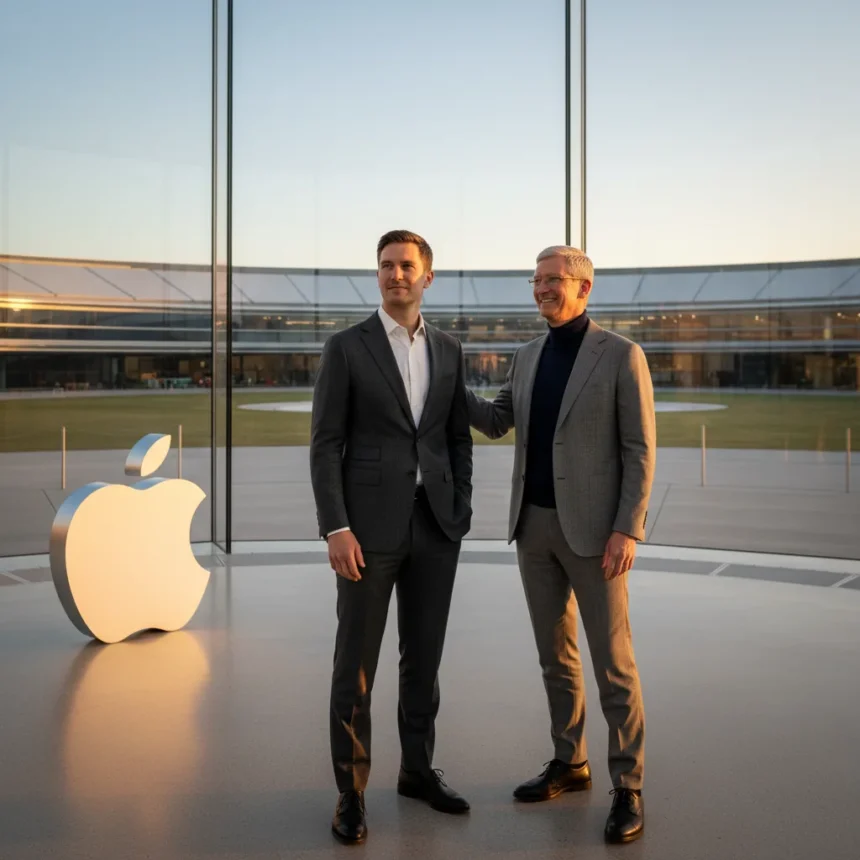
John Ternus is poised to become Apple’s next CEO as Tim Cook transitions to Executive Chairman, marking the company’s first major leadership shift in 15 years. Ternus, 50, currently serves as Apple’s senior vice president for hardware engineering, overseeing the teams and devices responsible for roughly 80 percent of Apple’s revenue. The succession represents Cook’s preference for promoting from within, ensuring continuity and mentorship as the company navigates mounting product challenges.
Key Takeaways
- John Ternus is the leading internal candidate to replace Tim Cook as Apple CEO after 15 years in the role
- Ternus oversees hardware engineering and design teams responsible for 80% of Apple’s revenue
- Cook indicated he plans to remain at Apple for some time, making any transition timeline uncertain
- Ternus faces inherited challenges including Siri limitations, Vision Pro underperformance, and stalled iPhone innovation
- Bloomberg reporting describes Ternus as the clear heir apparent with internal backing
Who Is John Ternus and Why He Matters
John Ternus represents the continuity Apple’s board and leadership want for the post-Cook era. At 50, he is younger than many of Apple’s other senior executives, positioning him for a potentially longer tenure leading one of the world’s most valuable companies. Ternus runs the hardware and design divisions that create the products generating the bulk of Apple’s profits—the iPhone, iPad, Mac, and wearables. Bloomberg’s reporting on the succession question identifies Ternus as the “leading CEO candidate” with “crystal clear” internal signals of his status as heir apparent.
His age and operational focus distinguish him from other potential contenders within Apple’s aging executive ranks. Cook has made explicit his desire for his successor to emerge from within the organization, emphasizing mentorship and institutional knowledge over external recruitment. That preference narrows the field considerably and places Ternus in the strongest position.
The Timing Question: When Does the Transition Happen?
The succession timeline remains deliberately vague, despite renewed speculation following Cook’s 65th birthday in November. Cook addressed retirement rumors directly in a Good Morning America interview, stating he is “planning to stick around for some time yet,” which effectively shut down claims of an imminent departure. Earlier discussions pointed to a possible transition as early as 2026 or 2027, but conflicting reports suggest the timeline could extend further.

Cook has given no indication of an imminent step-down, and his public statements suggest he intends to remain actively involved in Apple’s direction for years to come. The transition to Executive Chairman would allow Cook to maintain influence while gradually handing operational control to Ternus, a structure that could unfold over months or years rather than weeks.
The Challenges Ternus Would Inherit
Assuming the succession occurs, Ternus would inherit a company facing significant product and innovation headwinds. Siri, Apple’s voice assistant, is widely considered broken relative to competitors. The Vision Pro, Apple’s spatial computing bet, is stumbling in the market. Most critically, the iPhone has remained fundamentally unchanged since 2017, raising questions about Apple’s ability to drive the next generation of mobile innovation.



These are not minor cosmetic issues—they represent core challenges to Apple’s competitive position and growth trajectory. Ternus, as the leader of hardware engineering, has direct visibility into these problems and the teams working on solutions. His elevation to CEO would signal whether the board believes he can engineer a turnaround or whether Apple will continue struggling to innovate at the pace its market position demands.
How Does Ternus Compare to Other Apple Leaders?
Within Apple’s executive structure, Ternus occupies a uniquely powerful position. Unlike finance-focused or operations-focused executives who might have emerged from other tech companies, Ternus is a product person deeply embedded in Apple’s engineering culture. His counterparts in the C-suite tend to be older or less directly involved in the creation of revenue-generating hardware. That distinction matters: a CEO who understands the technical constraints and possibilities of building iPhones and Macs operates from a different foundation than one who comes from a sales or administrative background.
Is the Succession Already Decided?
While Bloomberg reporting and multiple sources describe Ternus as the clear favorite, no formal announcement has been made. The board and Cook have not publicly confirmed that Ternus will assume the CEO role, though the internal signals appear unmistakable. Apple typically guards succession planning tightly, and the company is unlikely to make any announcement until the moment of transition is imminent.
What Happens to Tim Cook After He Steps Back?
Cook’s transition to Executive Chairman would keep him engaged with Apple’s strategic direction and board-level decisions while removing him from day-to-day operational duties. This structure allows for a gradual handoff rather than an abrupt departure, reducing the risk of institutional disruption. Cook’s 15-year tenure has been defined by financial discipline and ecosystem expansion—areas where his counsel would remain valuable even in a reduced capacity.



When will Tim Cook officially step down as CEO?
Cook has not announced a specific departure date. He stated in recent interviews that he plans to remain at Apple for “some time yet,” suggesting any transition is not imminent. Speculation intensified after his 65th birthday in November, but conflicting reports point to timelines ranging from 2026 or 2027 to potentially several years away.
Is John Ternus ready to be Apple’s CEO?
Ternus has spent his career at Apple building and leading the hardware engineering teams responsible for the company’s most profitable products. His age, technical expertise, and operational authority position him as the most credible internal candidate. Whether he is ready to navigate Apple’s current innovation challenges—particularly around AI, Vision Pro, and iPhone stagnation—remains an open question only time and performance can answer.
The succession of John Ternus to Apple’s CEO would represent continuity wrapped in change. Cook’s 15-year tenure established Apple as the world’s most profitable company, but it also left unresolved questions about sustained innovation. Ternus inherits not just the title but the burden of proving that Apple’s best product years are not behind it. For investors, employees, and customers watching this transition unfold, the real test will not be whether Ternus becomes CEO—that now appears inevitable—but what he does once he holds the job.
Edited by the All Things Geek team.
Source: TechRadar