






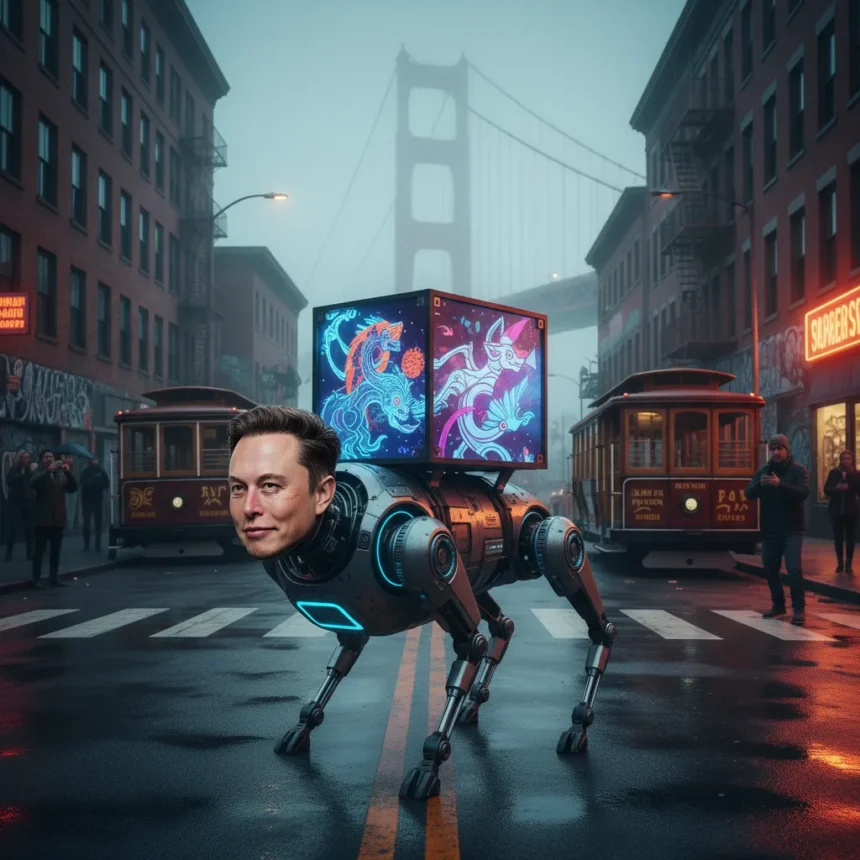
A robot dog Elon Musk’s face is wandering the streets of San Francisco’s SOMA neighborhood, stopping pedestrians in their tracks and generating viral videos on social media. The bot, created by digital artist Mike Winkelmann—known professionally as Beeple—features an eerily realistic silicone head of the world’s richest man and Tesla CEO, designed to promote his upcoming “Regular Animals” art installation at NODE gallery in Palo Alto on April 18.
Key Takeaways
- Robot dog features a realistic silicone head of Elon Musk and roams San Francisco’s SOMA neighborhood near Oracle Park
- Created by digital artist Beeple as street promotion for his “Regular Animals” installation debuting April 18
- Installation includes similar robot dogs with heads of Mark Zuckerberg, Jeff Bezos, Pablo Picasso, Andy Warhol, and Beeple himself
- Robot performs interactive behaviors: raises leg, follows people, squats, attempts to greet real dogs, captures photos, and “poops” printed AI art
- Public reactions ranged from amused to unsettled, with videos showing people stopping to photograph and pat the creation
The Robot Dog Elon Musk Stunt Explained
The robot dog Elon Musk head is not a random publicity stunt—it’s a calculated promotional tool for Beeple’s “Regular Animals” series, which previously appeared at Art Basel Miami in December. The installation transforms autonomous robots into walking art pieces by attaching silicone heads of famous figures and real artists. The Musk-faced bot specifically was designed to stop people in their tracks and get them talking, according to a NODE gallery representative. “Sending Elon into the streets,” the gallery noted, captures the irreverent spirit of the project.
The robot dog Elon Musk version performs a series of deliberately provocative behaviors that blur the line between art, commentary, and spectacle. It raises its leg like a real dog, follows pedestrians, squats, and attempts to interact with actual dogs on the street. Most provocatively, it captures photographs of people and then “poops” out printed copies of AI-generated art. These behaviors transform the installation from passive sculpture into interactive street theater, forcing viewers to confront their own reactions to seeing a billionaire’s face on a dog’s body.
Why This Art Stunt Unsettles Viewers
The robot dog Elon Musk face generated sharply divided reactions online, with some viewers amused and others finding it deeply unsettling. Videos posted on X (formerly Twitter) show real dogs barking at the creation, people stopping to photograph it, and pedestrians patting its head in confusion. The uncanny valley effect—the robot’s hyperrealistic silicone face combined with animal behavior—appears to trigger discomfort in many viewers.



This discomfort is likely intentional. Beeple’s “Regular Animals” series uses billionaire faces to comment on wealth, power, and the dehumanization of celebrity. By placing Musk’s face on a dog performing degrading acts, the installation invites viewers to question their relationship to tech billionaires and the absurdity of treating them as cultural icons. The fact that the robot “poops” AI art—a technology Musk has publicly criticized—adds another layer of satirical commentary.
The Broader “Regular Animals” Installation
The robot dog Elon Musk is one component of a larger series that includes similar creations featuring Mark Zuckerberg, Jeff Bezos, Pablo Picasso, Andy Warhol, and Beeple himself. By mixing billionaires with historical artists, Beeple suggests a false equivalence—positioning tech CEOs as cultural figures worthy of the same reverence as Picasso or Warhol. The installation challenges viewers to question why billionaires command such attention in contemporary culture.



The deployment of these robots in public spaces transforms the gallery experience into street art activism. Rather than confining the work to a white cube, Beeple sent the Musk-faced dog into one of San Francisco’s most visible neighborhoods, ensuring maximum public engagement and media coverage. The stunt worked: videos went viral, news outlets covered it, and the April 18 exhibition launch date is now embedded in public consciousness.
What Happens Next?
The robot dog Elon Musk promotion is timed to build momentum for the NODE gallery exhibition opening on April 18. Whether the installation will generate sustained critical discussion or fade as a viral curiosity remains to be seen. What is clear is that Beeple has successfully weaponized street theater and autonomous robotics to spark conversation about wealth, technology, and celebrity in the digital age. The robot dog wandering San Francisco’s streets is not just art—it’s a statement about who we worship and why.
Will the robot dog Elon Musk appear in other cities?
The research brief does not specify whether the robot dog Elon Musk will be deployed beyond San Francisco or appear in other cities before the April 18 exhibition. The installation previously appeared at Art Basel Miami, suggesting Beeple may tour the work to other major art events, but no future locations have been announced.
Is the robot dog Elon Musk interactive?
Yes. The robot performs multiple interactive behaviors including raising its leg, following people, squatting, attempting to greet real dogs, capturing photographs of pedestrians, and dispensing printed AI-generated art. These actions are designed to force viewers into direct engagement with the artwork rather than passive observation.



What is the point of the Regular Animals installation?
The “Regular Animals” series uses robot dogs with silicone heads of billionaires and famous artists to comment on wealth, power, and celebrity culture. By placing figures like Elon Musk and Mark Zuckerberg in degrading animal scenarios, Beeple invites viewers to question their reverence for tech billionaires and the absurdity of treating them as cultural icons.
The robot dog Elon Musk stunt succeeds because it forces uncomfortable questions into public space. In an era where billionaires command outsized cultural attention, Beeple’s street theater cuts through the noise and makes viewers confront why they find a hyperrealistic Musk-faced dog both fascinating and deeply weird. That tension is the entire point.
This article was written with AI assistance and editorially reviewed.
Source: Creativebloq