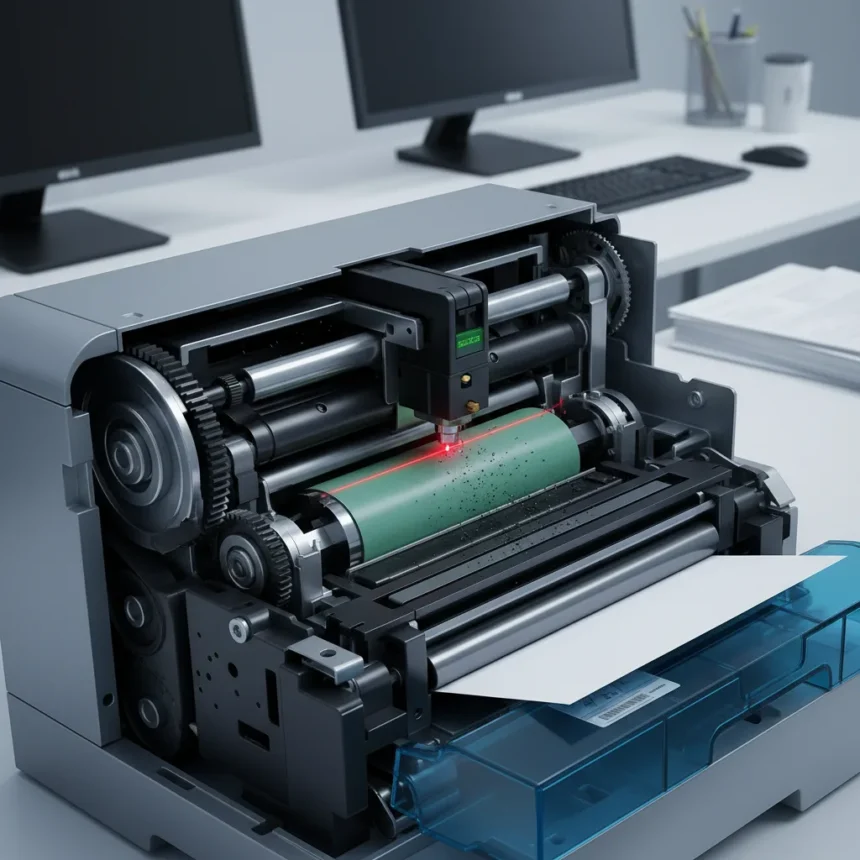
Laser printer technology is far more sophisticated than most people realize. These devices use a laser beam to create an electrostatic image on a photoconductive drum, which then attracts toner particles to form text and images on paper. Despite being ubiquitous in offices and homes worldwide, laser printers remain one of the most misunderstood pieces of technology we interact with daily.
Key Takeaways
- Laser printers use electrostatic imaging with a photoconductive drum to apply toner to paper
- Monochrome laser printers cost significantly less to operate than color laser printers
- Laser printers outperform inkjet models in speed and cost-per-page for high-volume printing
- All-in-one laser printers add scanning and copying but consume more space and cost more
- The electrostatic process in laser printer technology enables precise, fast, and efficient document production
How Laser Printer Technology Actually Works
The core mechanism of laser printer technology relies on a process called electrophotography. A laser beam scans across a rotating photoconductive drum, creating an invisible electrostatic image. This charged pattern attracts toner powder—a dry ink composed of plastic particles and pigment—which clings to the drum’s surface. As paper passes through, the toner transfers onto the sheet and is fused permanently using heat and pressure. This entire sequence happens in seconds, which is why laser printers deliver speed that inkjet devices cannot match.
What makes this process elegant is its precision. The laser can target individual spots on the drum with microscopic accuracy, allowing laser printer technology to produce sharp text and fine detail. The electrostatic charge itself does the heavy lifting—toner particles are attracted to charged areas and repelled from uncharged ones, meaning no mechanical contact is needed between the drum and paper until the final transfer step.
Laser Printers vs. Inkjet: Why Speed and Cost Matter
Laser printers outperform inkjet printers in speed and cost for high-volume printing, making them the standard choice in offices. A monochrome laser printer can produce 30-40 pages per minute, while most inkjet models max out around 15 pages per minute. More importantly, the cost per page drops dramatically with laser printer technology when printing in volume. Toner cartridges yield thousands of pages, whereas inkjet cartridges empty quickly and cost more per page.

Monochrome laser printers are cheaper to buy and run than color laser printers if color is not needed. This explains why most corporate offices still rely on black-and-white models—they deliver the lowest total cost of ownership. Color laser printers exist and have improved significantly, but they require separate toner supplies for cyan, magenta, yellow, and black, plus more complex internal mechanisms. The price gap between monochrome and color laser printer technology remains substantial.
Inkjet printers do have advantages: they handle photo printing better, cost less upfront for occasional users, and take up less space. But for any organization printing hundreds of pages weekly, laser printer technology wins on economics alone.



The Limitations and Trade-offs of Laser Printer Technology
Laser printers are larger and louder than inkjet models, which limits their appeal for small home offices or shared spaces. The internal mechanisms—the rotating drum, the laser assembly, the fuser unit—require substantial housing. Additionally, the heat generated during the fusing process means these devices need cooling time and ventilation, making them noisier than silent inkjet alternatives.
All-in-one printers that include laser scanning, copying, and faxing capabilities add convenience but are more expensive and larger than basic laser printers. If you need only printing, a dedicated laser printer remains the most cost-effective option. All-in-one laser printer technology bundles features that many users never use, driving up the price and footprint unnecessarily.
Another trade-off: laser printers require toner, which must be stored carefully and replaced periodically. Toner powder can create mess during cartridge changes, and the devices themselves need occasional maintenance to prevent dust buildup inside the mechanism. These minor inconveniences are worth tolerating for the speed and economy, but they are real considerations for users accustomed to simpler inkjet workflows.
Why Laser Printer Technology Remains Dominant in Offices
Despite being invented decades ago, laser printer technology has only improved, not been displaced. The fundamental process—electrostatic imaging with toner transfer—remains the gold standard for high-volume document production. Modern laser printers are more reliable, faster, and cheaper to operate than ever before.



The reason is simple: laser printer technology solves a specific problem brilliantly. If you print hundreds of pages monthly, no other technology comes close on speed and cost. This is why enterprise offices, government agencies, and print shops continue to invest in laser equipment. The technology is not flashy, but it is deeply practical.
Are laser printers still worth buying in 2025?
Yes, if you print regularly. Laser printers remain the most economical choice for high-volume printing. Monochrome models are affordable and reliable. If you print fewer than 50 pages monthly, an inkjet might be more practical, but beyond that threshold, laser printer technology delivers better value.
What is the difference between monochrome and color laser printer technology?
Monochrome laser printers use a single black toner cartridge and cost significantly less to buy and operate. Color laser printers require four separate toner supplies and more complex internal mechanisms, driving up both purchase price and per-page costs. Choose monochrome unless color output is essential.
Can laser printers handle specialty paper and media?
Most laser printers handle standard copy paper, cardstock, and envelopes effectively. However, the heat required for the fusing process can damage some specialty media. Check your printer’s manual for approved media types before attempting glossy paper or heat-sensitive materials.
Laser printer technology has proven itself as the workhorse of modern offices for good reason. It combines speed, reliability, and economy in a way that no competing technology has managed to replicate. Understanding how these devices work—and their genuine strengths and limitations—helps you make smarter purchasing decisions and use them more effectively.
Edited by the All Things Geek team.
Source: TechRadar