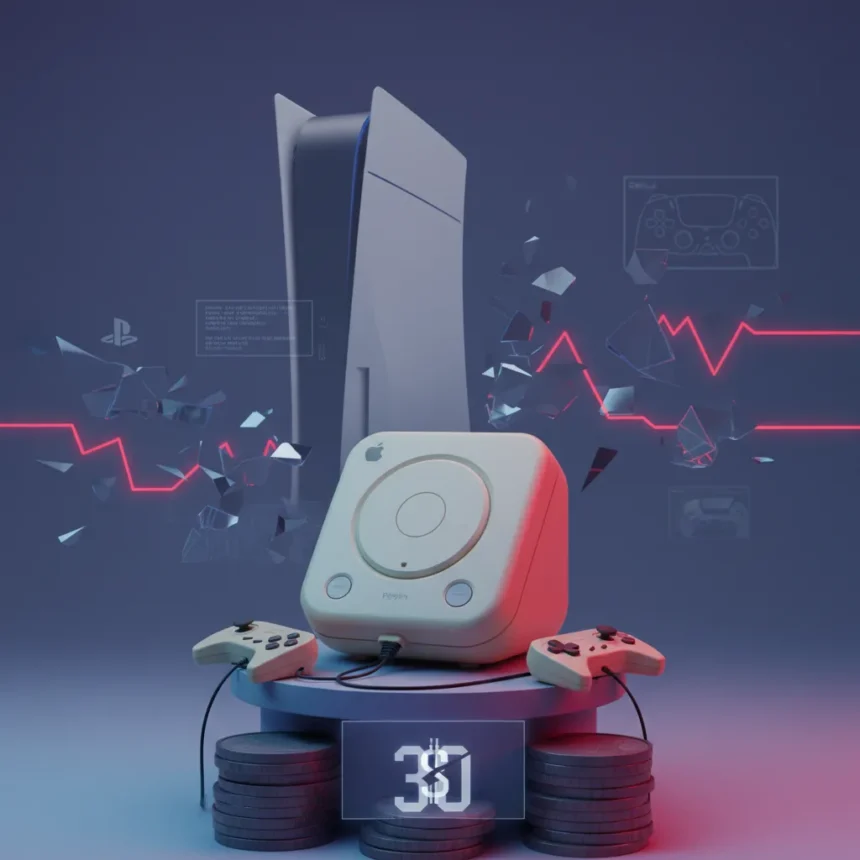
The Apple Pippin console is a multimedia gaming platform developed jointly by Apple Computer and Japanese toy company Bandai, launched in 1996, priced at $599 to $600, and discontinued just one year later in 1997 after selling a mere 42,000 units worldwide. Thirty years on, it remains one of the most spectacular product failures in Apple’s history — and one of the most instructive cautionary tales in gaming hardware.
Key Takeaways
- The Apple Pippin console launched in 1996 at $599–$600, roughly double the price of a Sony PlayStation at the time.
- Only 42,000 units were ever sold before Bandai discontinued the platform in 1997.
- The Pippin ran on a 66 MHz PowerPC 603 processor with just 6 MB of system and video memory.
- Apple provided the logic board and software platform but did not sell the Pippin under its own brand name.
- The Pippin launched ten months before Steve Jobs returned to Apple.
What Was the Apple Pippin Console, Exactly?
The Apple Pippin console was not a traditional games console in the way Sony or Nintendo understood the category. Apple designed it as an open multimedia platform — a thin client intended to run CD-based software, connect to the internet via a built-in 14.4 kb/s modem, and display output through standard TV connections including RCA and S-video. Bandai handled manufacturing and sales, and the device never carried the Apple logo prominently in the market.
Under the hood, the Pippin ran Apple’s classic Mac OS architecture, specifically System 7.5.2, built around a 66 MHz PowerPC 603 processor. It shipped with 6 MB of system and video memory, expandable to 32 MB, and a 4x-speed CD-ROM drive. The controller was a distinctive boomerang-shaped device with a trackball at its centre. On paper, it was a Mac in a console’s body. In practice, it was too slow to compete with purpose-built gaming hardware and too limited to serve as a serious home computer.
Why the Apple Pippin Console Failed So Completely
The Apple Pippin console failed for one reason above all others: it cost twice what its main competitor did. At $599 to $600, the Pippin launched into a market where the Sony PlayStation retailed for $299 to $300 and the Nintendo 64 was available for $199 to $200. That price gap was not a minor inconvenience — it was a fundamental mismatch between what the product offered and what consumers were willing to pay for it.
The $599 launch price is even more striking in today’s terms. Adjusted for inflation, that figure is roughly equivalent to $1,200 now — a sum that, as one analysis noted, could today buy you an Xbox Series X, a PlayStation 5 Slim, and a Switch Lite combined. For 1996 consumers, spending that kind of money on a platform with a thin software library and sluggish performance was simply not a rational choice when a PlayStation sat on the shelf next to it at half the price.
Performance was the second nail in the coffin. The 66 MHz PowerPC 603 was not a gaming chip — it was a general-purpose processor adapted from Apple’s Mac lineup, and it showed. Competing consoles were built from the ground up for fast 3D rendering and responsive gameplay. The Pippin was not. Slow load times, limited memory, and a software catalogue that never grew large enough to justify the hardware made the platform feel half-finished from day one.
Apple Pippin Console vs Sony PlayStation and Nintendo 64
Placed directly against the Sony PlayStation and Nintendo 64, the Apple Pippin console had almost no competitive advantage. The PlayStation launched with strong third-party developer support and a rapidly growing library of titles. The Nintendo 64, despite arriving later, offered performance that embarrassed the Pippin’s ageing Mac architecture. Neither Sony nor Nintendo was trying to sell a multimedia internet terminal — they were selling games, and they did it better and cheaper.
What Bandai and Apple were attempting was arguably ahead of its time — a connected, multimedia home device that could browse the web and run software beyond games. The concept was not wrong. The execution, the pricing, and the timing were. The internet was not yet a mass-market utility in 1996, and consumers had no framework for valuing an internet-connected console when most households were still on dial-up, if connected at all.
The Broader Legacy of Apple’s Gaming Misstep
The Pippin’s collapse landed ten months before Steve Jobs returned to Apple in 1997. Jobs famously stripped Apple’s product line to its essentials when he came back, and the Pippin’s failure was precisely the kind of unfocused, overpriced experiment he spent years dismantling. Apple has never seriously re-entered the dedicated gaming hardware market since, channelling its gaming ambitions instead through the App Store and Apple Arcade on existing iPhone, iPad, and Mac platforms.
The irony is that Apple’s current hardware — particularly the M-series chips — is genuinely capable of serious gaming performance. The company just chose a different distribution model. Whether that was a lesson learned from Pippin or simply a different strategic era is a matter of interpretation.

Is the Apple Pippin console rare today?
Yes. With only 42,000 units ever sold, the Pippin is considered a genuine collector’s rarity. Complete units with the original boomerang controller and accessories command significant prices in retro gaming markets, though exact current valuations vary widely depending on condition and region.
Who actually made the Apple Pippin?
Apple designed the logic board and software platform, while Bandai manufactured and sold the device. It was positioned as an open format rather than a branded Apple product, which contributed to its identity problem — consumers weren’t sure whether they were buying an Apple device, a Bandai toy, or something else entirely.
Could Apple have saved the Pippin with better pricing?
Possibly, but price was only part of the problem. At $299, the Pippin would have competed more directly with the PlayStation, but it still lacked the software library, developer support, and raw gaming performance that Sony and Nintendo offered. A cheaper Pippin might have sold more units — but it’s unlikely it would have survived the era regardless.
Thirty years later, the Apple Pippin console stands as a reminder that even the most innovative companies get it badly wrong sometimes. Apple built a device that was conceptually interesting, technically compromised, and commercially catastrophic. The lesson it left behind — that price, performance, and timing must align before a platform can succeed — is one the entire games industry has since taken to heart.
Edited by the All Things Geek team.
Source: Tom's Hardware