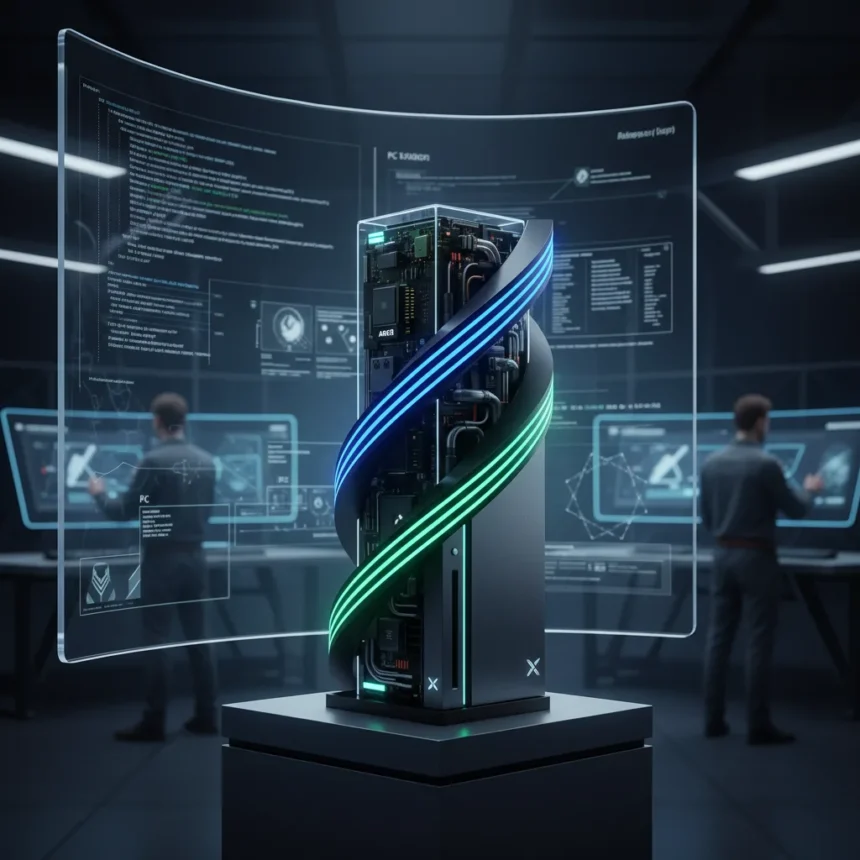
Project Helix is Microsoft’s next-generation Xbox console, a custom AMD SoC-powered device designed to play both Xbox console and PC games from a single piece of hardware. Microsoft officially confirmed the initiative at GDC, pushing back against months of third-party OEM rumors and reaffirming its commitment to building and selling proprietary first-party systems. The announcement marks a watershed moment for the company’s decade-long effort to unify its gaming platforms.
Key Takeaways
- Project Helix is Microsoft’s first-party next-generation console, not a third-party OEM device.
- Custom AMD SoC co-designed for DirectX and FSR (FidelityFX Super Resolution) support.
- Alpha hardware shipping to developers beginning in 2027.
- Console-PC hybrid designed to function as both devices using a single hardware setup.
- Part of Xbox’s 25th anniversary celebration with backward compatibility across four console generations.
What Project Helix Actually Is
Project Helix represents Microsoft’s attempt to solve one of gaming’s fundamental design challenges: creating a single device that functions as both a modern video game console and a full-featured PC. Most hardware makes a choice between these two roles. Project Helix refuses to. The device is powered by a custom AMD SoC co-designed specifically for next-generation DirectX and FSR (FidelityFX Super Resolution) support, unlocking rendering and simulation capabilities unavailable on current hardware.
This is not a handheld. This is not a portable device like the Steam Deck. Project Helix is a stationary console that somehow needs to deliver the streamlined, locked-down experience players expect from Xbox while simultaneously offering the flexibility and game library access of a Windows PC. The engineering challenge is real: a console and a PC are fundamentally different devices with different priorities, and Helix has to be both in one box.
The initiative traces back nearly a decade to OneCore, Microsoft’s 2015 project to unify the Windows 10 operating environment with Xbox consoles. Project Helix is the natural endpoint of that long-term platform convergence strategy. Microsoft has spent years building the technical foundation—DirectStorage, Velocity Architecture, and deep Xbox-to-Windows integration—that makes a hybrid approach feasible.

When Developers Will Get Their Hands on It
Alpha versions of Project Helix hardware are planned to ship to developers beginning in 2027. This timeline is aggressive by console standards. It signals that Microsoft’s engineering teams have made substantial progress and are confident enough in the architecture to start real-world testing in developer studios. The multi-year partnership with AMD underpins this confidence—AMD is co-designing the SoC rather than simply selling off-the-shelf chips.
The 2027 developer alpha window also aligns with Xbox‘s 25th anniversary celebration later in 2026. Microsoft has already committed to rolling out new ways to play iconic past games as part of that milestone, and Project Helix will inherit full backward compatibility across four generations of Xbox hardware. This means games from the original Xbox through Xbox Series X|S will run natively on the new console.
The Hybrid Architecture Problem
How exactly Project Helix bridges console and PC is still unclear. Some analysis suggests the device may use its own compatibility layer rather than shipping with Windows, potentially operating more like the Steam Deck’s Linux-based approach—a specialized OS designed specifically for gaming that can still access a broader library. Other speculation indicates it could boot Windows and run Steam directly, though that approach carries its own trade-offs around performance and user experience.
The Steam Deck comparison is instructive. Valve’s handheld uses a Linux-based machine with a compatibility layer that, despite its elegance, still feels like a workaround in some scenarios. Microsoft’s advantage is that it controls both the hardware and the operating system layers, so Project Helix could theoretically achieve tighter integration than any third-party device. But that integration requires solving the fundamental tension between a console’s simplicity and a PC’s complexity.
What we know for certain is that Project Helix will play your existing Xbox console library and your existing PC game library from the same device. Supporting both DirectX (console) and traditional Windows gaming APIs simultaneously on custom silicon is technically ambitious, but it’s what Microsoft is building toward.
Why Microsoft Needed to Clarify This Now
The official announcement came as a response to persistent rumors that Microsoft was planning to outsource next-generation console manufacturing to third-party OEMs like Asus or other hardware makers. These rumors made sense on the surface—Microsoft had been exploring partnerships with third-party manufacturers for Xbox handheld devices and had shifted some of its focus toward Game Pass and cloud gaming. But they fundamentally misread Microsoft’s strategy.

By confirming Project Helix as a first-party device, Microsoft sent a clear signal to developers, publishers, and investors that it remains committed to owning the hardware layer of its gaming ecosystem. This matters for developer support, for exclusive optimizations, and for the long-term viability of the Xbox brand. A console designed by committee across multiple OEMs would lack the coherence and vision that Project Helix is designed to achieve.
Frequently Asked Questions
When will Project Helix launch to consumers?
Microsoft has not announced a consumer launch date. Alpha hardware is shipping to developers in 2027, but the path from developer hardware to retail availability typically spans 1-2 years. A 2028 or 2029 consumer launch is plausible but unconfirmed.
Will Project Helix run Windows?
Microsoft has not specified whether Project Helix will ship with Windows or a custom OS. Some analysis suggests a specialized gaming OS similar to the Steam Deck’s approach, while other speculation points to Windows support. This detail remains officially unconfirmed.
Can you play Game Pass games on Project Helix?
Yes. Project Helix is designed to play Xbox console and PC games, and Game Pass titles run on both platforms. The console will support the full Xbox game library and backward compatibility across four generations of Xbox hardware.
Project Helix represents Microsoft’s most ambitious hardware gamble in a decade. By refusing to outsource its next-generation console and instead committing to a custom AMD SoC, the company is betting that a unified console-PC hybrid can deliver on both fronts. Developers will get their first hands-on experience in 2027. Until then, the real test is whether Microsoft can actually deliver on the promise of a single device that feels equally at home as a console and as a PC—because if it can, it changes everything about how the next generation of gaming hardware gets built.
Edited by the All Things Geek team.
Source: Windows Central