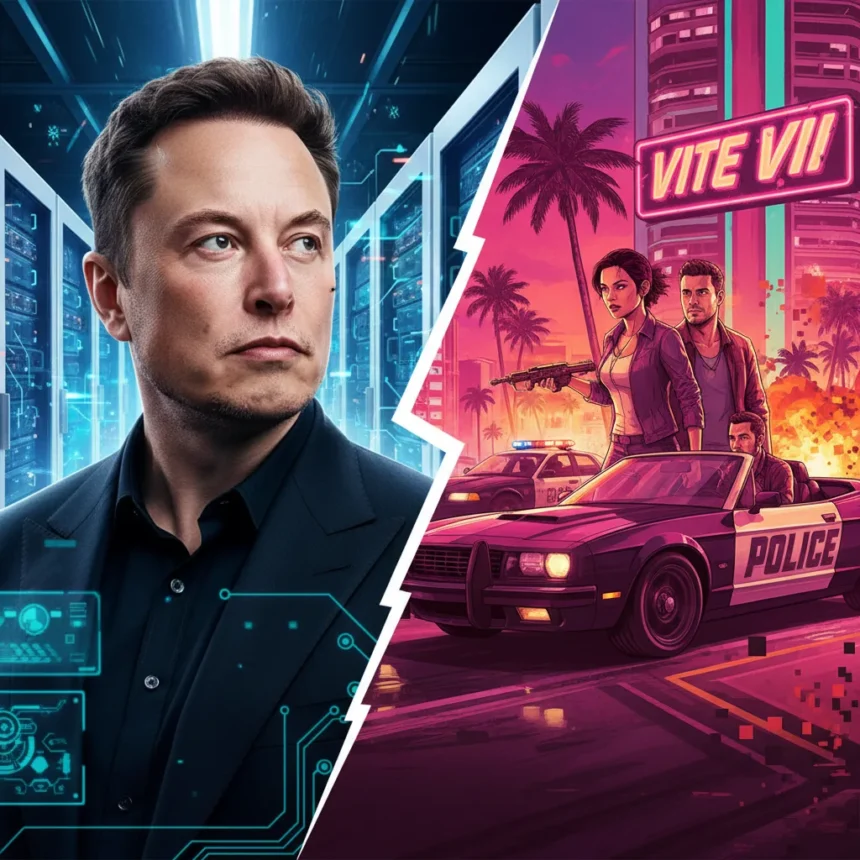
The Elon Musk GTA VI controversy represents far more than one billionaire’s personal gaming preferences. It exposes a fundamental philosophical rift between Silicon Valley’s moral absolutism and the creative freedoms that define modern interactive entertainment. Musk has publicly stated he refuses to play Grand Theft Auto games because he dislikes “doing crime” in virtual worlds, a stance that has triggered broader questions about who gets to dictate acceptable content in gaming.
Key Takeaways
- Elon Musk refuses to play GTA because he objects to committing virtual crimes in-game
- He specifically cited GTA 5’s opening sequence requiring players to shoot police officers
- Take-Two Interactive CEO Strauss Zelnick made a comment about genAI and Musk in relation to GTA 6
- The controversy highlights tensions between tech industry values and gaming culture
- Musk’s stance reflects broader debates about violence in interactive media
Why Musk Won’t Touch Grand Theft Auto
Musk’s objection to GTA stems from a specific moral framework about virtual behavior. He has explained that he cannot engage with games requiring him to “shoot police officers in the opening scene,” referencing GTA 5’s prologue sequence. This is not casual criticism—it reflects a deliberate choice to avoid content he views as ethically problematic, even in fictional contexts. For Musk, the medium’s interactivity creates a moral dimension that passive entertainment like film does not.
This position differs fundamentally from how most gamers and developers approach the medium. Interactive entertainment has long treated moral ambiguity and transgressive gameplay as legitimate creative tools. Players choose to engage with morally complex scenarios precisely because games allow consequence-free exploration of actions they would never take in reality. Musk’s refusal suggests he views this distinction as irrelevant—that performing a virtual crime carries ethical weight regardless of context.
The Broader Industry Response
The gaming industry’s response to Musk’s stance has been restrained but pointed. Take-Two Interactive CEO Strauss Zelnick made a comment about genAI and Musk in relation to GTA 6, suggesting that the conversation extends beyond Musk’s personal preferences into questions about artificial intelligence, creative control, and corporate power. This comment hints at deeper concerns within the industry about billionaire influence over creative expression and the future of game development.


Zelnick’s intervention signals that major publishers view Musk’s position not as a harmless personal choice but as part of a larger pattern of tech billionaires attempting to reshape cultural norms according to their own values. When figures with Musk’s influence and resources publicly reject entire genres or mechanics, it creates pressure on creators, marketers, and platforms to self-censor or modify content to appease powerful voices.
What This Reveals About Tech vs. Gaming Culture
The Elon Musk GTA VI controversy exposes a collision between two incompatible worldviews. Tech culture, particularly in its billionaire variant, often operates from a framework of moral absolutes and personal virtue signaling. Gaming culture, by contrast, has historically embraced moral relativism as a creative strength—the ability to inhabit perspectives, make choices, and experience consequences in safe fictional spaces.


Musk’s refusal to play GTA is ultimately a statement about his values, not a critique of GTA’s design or artistic merit. But when someone with his platform makes such statements, they carry outsized weight. They can influence investment decisions, regulatory scrutiny, and platform policies. The question the industry now faces is whether it will continue defending creative freedom or gradually conform to the preferences of powerful figures who view interactive crime as categorically unacceptable.
Does Musk’s Position Threaten Gaming Freedom?
The immediate answer is no—one billionaire’s personal refusal to play a game poses no direct threat to GTA’s development or distribution. Rockstar Games and Take-Two Interactive have the resources and market position to ignore individual criticism. However, the pattern matters. If Musk’s stance influences other tech billionaires, venture capitalists, or regulatory bodies, it could gradually reshape what kinds of games get funded, published, and promoted.
Gaming has already experienced waves of moral panic and attempted censorship. The Elon Musk GTA VI controversy is different because it comes not from religious groups or politicians but from one of the world’s most influential technologists. His ability to shape narratives, influence policy, and redirect capital gives his personal preferences potential systemic consequences.
FAQ
Why does Elon Musk refuse to play GTA games?
Musk has stated he dislikes “doing crime” in games and specifically mentioned that GTA 5 requires “shooting police officers in the opening scene,” which he “just couldn’t do”. He views performing virtual crimes as ethically problematic regardless of the fictional context.


What did Take-Two’s CEO say about the Musk controversy?
Strauss Zelnick, CEO of Take-Two Interactive, made a comment about genAI and Musk in relation to GTA 6, suggesting the conversation extends beyond Musk’s personal preferences into broader questions about artificial intelligence and creative control.
Is the Elon Musk GTA VI controversy affecting game development?
There is no evidence that Musk’s personal stance has altered GTA 6’s development or design. However, his public criticism highlights tensions between tech industry values and gaming culture that could influence industry decisions over time.
The Elon Musk GTA VI controversy ultimately serves as a cultural barometer. It reveals how differently different industries approach creative expression, moral responsibility, and the boundaries between personal values and public influence. For gaming, the real question is not whether Musk will play GTA—it is whether the industry will maintain its commitment to creative freedom when challenged by billionaires with different moral frameworks.
Edited by the All Things Geek team.
Source: Creativebloq