






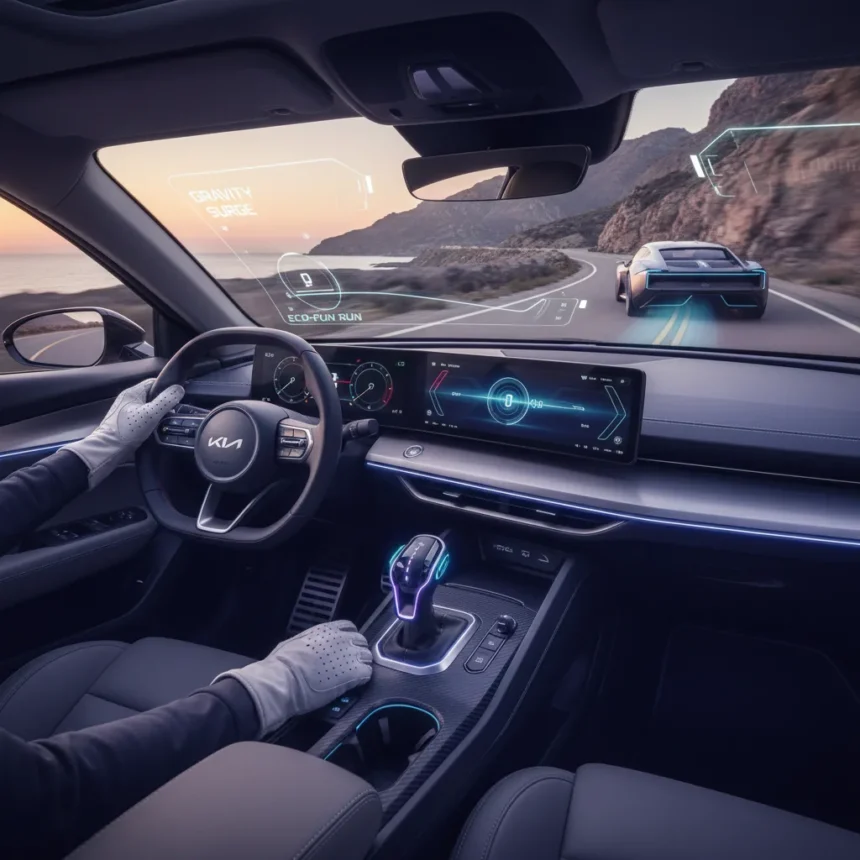
The Kia Vision Meta Turismo concept is a high-performance electric saloon that challenges the notion that EVs must sacrifice excitement for efficiency, debuting as part of Kia’s 80th anniversary celebration and previewing a forthcoming electric flagship model. Revealed as a bold design study, the Kia Vision Meta Turismo concept abandons the minimalist touchscreen interiors that plague modern electric cars in favor of tactile controls—most a joystick serving as the gear shifter—paired with an augmented reality head-up display that transforms driving into an immersive experience shaped by mood and driving style.
Key Takeaways
- The Kia Vision Meta Turismo concept features a joystick gear shifter and yoke steering wheel, rejecting screen-heavy cabin design.
- Three AR-powered driving modes—Speedster, Dreamer, and Gamer—alter the visual and sensory experience based on driver preference and road conditions.
- The concept embodies Kia’s “Opposites United” philosophy, blending dynamic performance with comfort and reality with imagination.
- Kia confirms a production-ready high-performance electric flagship is in development, though no timeline or pricing has been announced.
- The design signals Kia’s shift toward emotional, performance-focused EVs rather than sensible, utilitarian models.
A Torpedo-Shaped Statement on EV Design
Visually, the Kia Vision Meta Turismo concept abandons the rounded, aerodynamic shapes that define most modern EVs. Instead, it adopts a torpedo-like silhouette with an elongated cabin, extreme cab-forward proportions, and a low, wide stance that evokes touring cars from the golden age of motorsport. The exterior wears a searing yellow paint job that commands attention, while aerodynamic fins at the front house the headlights and camera-based side-view mirrors, replacing traditional door-mounted units. An ornate glass canopy stretches across the roof, creating an open-air sensation while maintaining structural integrity.
The design philosophy reflects what Kia calls “Opposites United”—a framework that marries contrasting values into a single coherent aesthetic. Dynamic performance meets comfort. Artistry balances functionality. Reality blends with imagination. In an automotive landscape crowded with boxy, slab-sided electric sedans, the Kia Vision Meta Turismo concept stands out as deliberately provocative, a middle finger to the notion that electric cars must look like appliances.
Three Worlds: How AR Transforms the Drive
The real innovation lies beneath the surface. The Kia Vision Meta Turismo concept features an augmented reality head-up display that adapts to three distinct driving modes, each fundamentally altering how the driver perceives the road and their relationship to the machine. Rather than static readouts of speed and navigation, the AR system becomes a co-creator of the driving experience, warping reality to match the driver’s emotional state.


The Speedster mode activates when you press the accelerator on an open road, unleashing what Kia describes as pure speed instinct. City lights blur. Air flow sweeps across the windshield. The AR HUD distorts space itself as velocity increases, creating a sense of acceleration that transcends the physical limitations of the vehicle. Dynamic Sequential Lighting and synthesized sound effects convey engine rhythm, giving an electric car the visceral feedback of a combustion engine—without the emissions or the noise pollution. For drivers raised on video games, this mode speaks their language.
The Dreamer mode activates when the vehicle stops, unfolding new narratives and sensations during brief pauses in travel. A red light becomes not a frustration but an interlude, a moment to reset and prepare for the next leg of the journey. Finally, the Gamer mode immerses the driver in an AR-shaped world where driving itself becomes an exhilarating game-like experience, complete with challenges and rewards. Jochen Paesen, Kia’s Head of Advanced Design, articulated the underlying philosophy: “If you’re in the right mood it can be a performance machine,” and posed a critical question for a generation of digital natives: “how do you judge excitement in a digital world for those who have grown up in a digital world?”


Joystick Shifter: Reclaiming Tactile Control
Perhaps the most polarizing feature of the Kia Vision Meta Turismo concept is its rejection of the shift stalk or push-button gear selection that dominates modern cabins. Instead, Kia has mounted a joystick—the kind that feels at home in a fighter jet or a racing simulator—as the primary gear shifter. This design choice signals a deliberate move away from screen-heavy interiors toward a richer, more immersive user experience that prioritizes human-centered design alongside advanced technology.
The joystick shifter works in concert with a yoke steering wheel, creating a cockpit aesthetic that recalls high-performance sports cars rather than typical sedans. For enthusiasts weary of touchscreen proliferation, the tactile feedback of a physical joystick represents a small but meaningful rebellion against the digital minimalism that has consumed automotive interiors over the past decade. Whether this approach would prove practical in production remains an open question, but as a statement of intent, it is unmistakable: Kia wants to make electric cars that feel alive.
From Design Study to Production Reality
The Kia Vision Meta Turismo concept began as an internal design study, born from a desire to create a more emotional vehicle aligned with brand values. What started in sketches and digital renderings has now been publicly revealed as a preview of something far more concrete. Kia has confirmed that a high-performance, design-led electric flagship model is in active development, moving from speculation to certainty. The company states it is “no longer a question of ‘if,’ but ‘when'” such a vehicle will reach production.
No pricing, production timeline, or specific launch date has been announced. The Kia Vision Meta Turismo concept remains a concept, but it is a concept with a clear mission: to prove that the transition to electric propulsion does not require sacrificing the joy of driving. In an industry where most manufacturers treat EVs as inevitable necessities rather than objects of desire, Kia’s willingness to embrace audacity—a joystick shifter, a torpedo shape, three immersive AR modes—suggests the automaker understands something fundamental: the future of mobility must be fun, or it will fail to inspire.



How does the Kia Vision Meta Turismo concept differ from typical EV design?
Most production EVs prioritize aerodynamic efficiency and interior screen integration, resulting in rounded shapes and touchscreen-dominated cabins. The Kia Vision Meta Turismo concept rejects both conventions, opting instead for a torpedo-like silhouette with tactile controls like a joystick shifter and a yoke steering wheel, combined with augmented reality driving modes that adapt to driver mood.
Will the Kia Vision Meta Turismo concept actually be produced?
The concept itself will not be produced, but Kia has confirmed that a production-ready high-performance electric flagship model inspired by its design philosophy is in development. No timeline or specifications have been disclosed, so enthusiasts will need to wait for official announcements.
What are the three AR driving modes in the Kia Vision Meta Turismo concept?
Speedster distorts space visually as speed increases, paired with dynamic lighting and sound effects. Dreamer activates at stops to unfold new narratives and sensations. Gamer transforms driving into an AR-shaped experience that feels like a video game. Each mode reshapes how the driver perceives the road and their interaction with the vehicle.
The Kia Vision Meta Turismo concept matters because it exposes a gap in the current EV market. Most electric cars are engineered as rational responses to regulation and sustainability mandates—efficient, practical, forgettable. Kia’s concept argues for something radical: that electric vehicles can be passionate, playful, and genuinely thrilling. Whether the production flagship that follows will retain the joystick shifter and three AR modes remains uncertain, but the message is clear. The future of mobility will not be won by those who simply comply with electrification. It will be won by those who dare to make it fun.
This article was written with AI assistance and editorially reviewed.
Source: TechRadar