Graphene quantum computing just hit a milestone that defies two centuries of physics. Researchers from the Indian Institute of Science and the National Institute for Materials Science in Japan observed graphene samples where electrical and thermal conductivity diverged by more than 200 times at low temperatures—a direct violation of the Wiedemann-Franz law, which states these properties should rise and fall in lockstep.
Key Takeaways
- Graphene violates the Wiedemann-Franz law by exceeding 200 times deviation at low temperatures.
- Electrons flow like a nearly frictionless superfluid at the Dirac point, 100 times less viscous than water.
- Tabletop experiments now simulate extreme physics: black holes, neutron stars, and quantum phase transitions.
- Both charge and heat follow a universal constant tied to quantum of conductance.
- Clean graphene samples enable room-temperature quantum simulations previously requiring extreme conditions.
How Graphene Breaks a Fundamental Law
The Wiedemann-Franz law has governed metal behavior since the 1800s. It dictates that as electrical conductivity increases, thermal conductivity must increase proportionally. Graphene shattered this rule. At the Dirac point—where graphene is neither metal nor insulator—electrical conductivity climbed while thermal conductivity plummeted, and vice versa. This inversion happens because electrons at the Dirac point behave like a Dirac fluid, flowing with almost no friction or resistance. The deviation exceeds 200 times the expected ratio, making it one of the most dramatic violations of a classical physics principle in recent memory.
Why does this matter? Because it reveals graphene operates under different quantum rules than conventional metals. Researchers achieved this by tweaking the electron number in their samples, which enabled collective electron movement roughly 100 times less viscous than water. This frictionless behavior is what allows the material to sidestep a law that has held true for nearly every conductor ever studied.
Graphene Quantum Computing and Tabletop Simulations
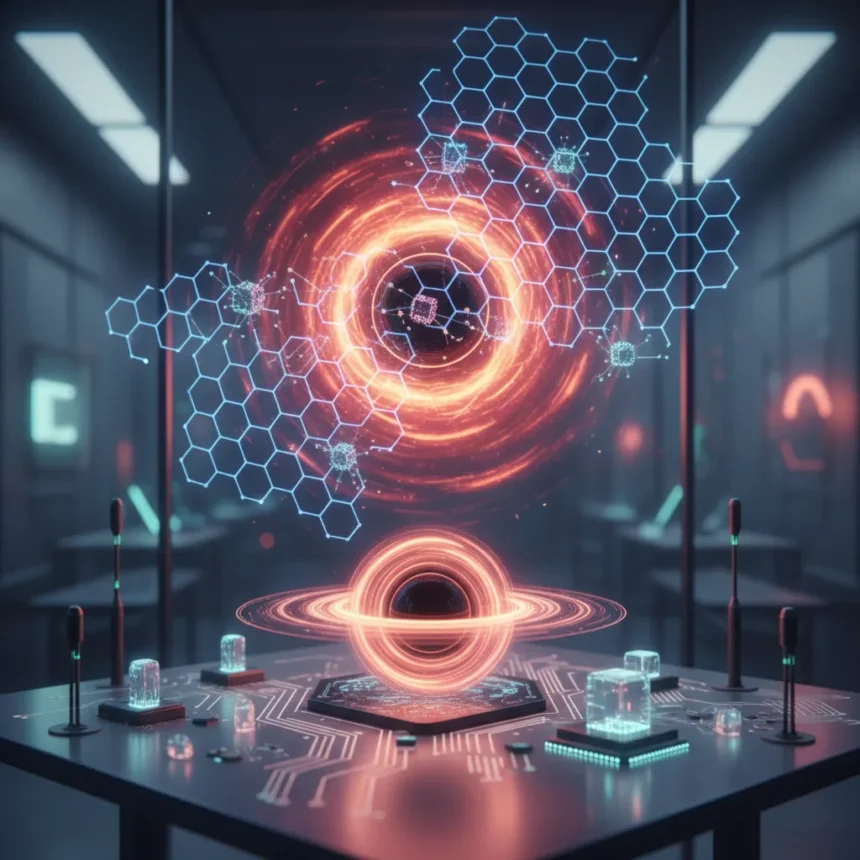
The real breakthrough lies in what this violation enables: tabletop experiments simulating extreme physics. Researchers can now study phenomena like black hole thermodynamics, neutron star behavior, entanglement entropy, and quantum phase transitions at room temperature. Previously, these experiments required either astronomical computational resources or the extreme conditions found only in space. Graphene collapses that barrier.


Both charge and heat conduction in these graphene samples follow a material-independent universal constant tied to the quantum of conductance. This universality is profound—it suggests graphene’s quantum fluid behavior operates by principles that transcend material-specific properties. For graphene quantum computing applications, this opens pathways to quantum sensors capable of detecting individual molecules or nerve signals, zero-loss power transmission, and ultra-efficient electronics. The ability to model cosmic phenomena on a tabletop accelerates research into quantum systems that would otherwise remain theoretical.
Graphene Quantum Computing vs. Traditional Approaches
Traditional metals obey the Wiedemann-Franz law because their electrons scatter predictably. Heat and electricity travel together, constrained by the same microscopic collisions. Graphene’s Dirac fluid breaks this symmetry entirely. The material’s electrons move cooperatively, almost as a single entity, rather than as independent particles. This collective behavior is what allows heat and charge to decouple. Unlike conventional quantum computing approaches that require extreme cooling (near absolute zero) or isolated quantum systems, graphene enables quantum fluid behavior at accessible temperatures, democratizing access to quantum simulation and measurement.



What This Means for Quantum Sensors and Electronics
The implications stretch beyond physics curiosity. Graphene’s violation of the Wiedemann-Franz law creates opportunities for quantum sensors with unprecedented sensitivity. If thermal and electrical properties can be decoupled and controlled, sensors could detect minute changes in thermal conductivity without electrical noise interference—crucial for biological sensing or precision measurement. Additionally, the frictionless electron flow suggests pathways toward zero-loss power transmission and ultra-efficient transistors, though these remain early-stage concepts without current commercial prototypes.
The research used exceptionally clean graphene samples, which proved essential for observing these quantum effects. Impurities scatter electrons and restore conventional behavior, so sample quality directly determines whether graphene exhibits this frictionless fluid state. This purity requirement explains why the effect has been difficult to observe and why this particular team’s results represent a significant experimental achievement.
Why the Dirac Point Matters
The Dirac point is graphene’s sweet spot—the electron density where the material transitions between behaving like a metal and behaving like an insulator. At this precise point, electrons acquire a unique property: they move as if massless, similar to photons. This is where the superfluid behavior emerges. Researchers tweaked electron number by adjusting the graphene samples, tuning them to sit exactly at the Dirac point. Once there, the electrons began flowing collectively with minimal resistance, enabling the dramatic divergence from the Wiedemann-Franz law.
Is graphene quantum computing ready for real-world applications?
Not yet. The research demonstrates a fundamental physics principle and enables tabletop simulations of quantum phenomena, but no quantum computers or sensors using this graphene effect have been commercialized. The experiments are laboratory-based with specially prepared samples. Moving from tabletop physics demonstrations to practical devices requires solving manufacturing, scalability, and integration challenges not addressed in the current research.



What does the Dirac fluid do in graphene?
The Dirac fluid causes electrons to flow collectively with almost no friction or viscosity—roughly 100 times less viscous than water. This frictionless movement is what decouples heat and electrical conductivity, violating the Wiedemann-Franz law. The behavior only occurs at the Dirac point and only in exceptionally clean graphene samples.
Can this graphene discovery improve quantum computing speed?
The research does not directly accelerate quantum computing speed. Instead, it enables tabletop simulations of extreme quantum systems and opens pathways for quantum sensors and zero-loss electronics. These are foundational capabilities that could eventually support faster quantum systems, but the current work focuses on physics simulation and measurement rather than computational performance gains.
Graphene just rewrote a 200-year-old rule of physics. The implications—quantum sensors that detect single molecules, tabletop black hole simulations, frictionless electronics—remain largely theoretical. But for the first time, researchers have demonstrated that under the right conditions, graphene can operate by entirely different quantum laws. That is not just a physics curiosity. It is a roadmap for quantum technologies that sidestep the limitations that have constrained the field for decades.
Edited by the All Things Geek team.
Source: TechRadar