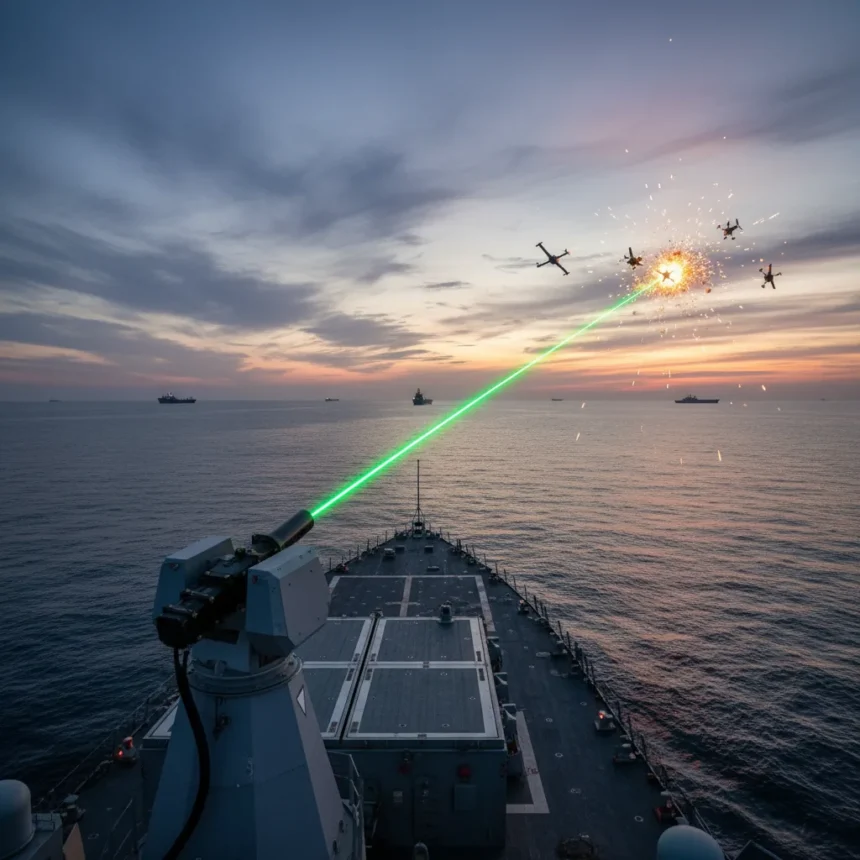
The LOCUST laser drone defense system just proved it can do what missiles cannot: neutralize multiple aerial threats for the price of a coffee. In October 2025, the US Navy tested AeroVironment’s 20kW LOCUST (Laser-Oriented Counter-UAS System) on the USS George H.W. Bush carrier, successfully engaging and destroying multiple drones while the ship was underway. At roughly $5 per kill—or as low as $1 in some operational estimates—the system represents a fundamental shift in how navies will defend against cheap, plentiful drone swarms.
Key Takeaways
- LOCUST neutralized multiple drones on a moving carrier in October 2025 tests aboard USS George H.W. Bush.
- Cost per drone kill is approximately $5 using directed energy, versus thousands for missile interceptors.
- Roll-on/roll-off design requires no permanent ship modifications, enabling rapid fleet-wide deployment.
- System features unlimited magazine depth—no ammo limits, only continuous power requirements.
- AeroVironment’s LOCUST has 3+ years of operational deployment outside the US protecting against aerial threats.
How LOCUST laser drone defense works at sea
The LOCUST laser drone defense system is built on a deceptively simple principle: a 20kW-class laser source, power-conditioning suite, and stabilized gimbal with precision optics that tracks and neutralizes targets in real time. The system integrates electro-optical and infrared cameras with automatic trackers, allowing operators to engage multiple drones either through automated multi-target search or manual control via game controller. On the USS George H.W. Bush, the system proved it could maintain beam coherence and accuracy even as the carrier moved through open water—a critical test that previous land-based demonstrations could not replicate.
What makes LOCUST fundamentally different from traditional air defense is its directed energy architecture. There is no magazine to reload, no ammunition supply chain to manage. As long as the ship generates power, the system can keep firing. This unlimited magazine depth transforms the economics of fleet defense. A single missile costs tens of thousands of dollars. A single laser engagement costs roughly $5 in electrical energy. For a Navy facing swarms of inexpensive drones—some costing only thousands of dollars—this cost asymmetry is decisive.
The system’s roll-on/roll-off design means it can be deployed on ships, ground vehicles like the Joint Light Tactical Vehicle, or infantry squad vehicles without permanent modifications. Operators can roll the pallet-mounted LOCUST onto a vessel, integrate it with the ship’s power system or onboard battery bank, and begin operations within hours rather than the months required for traditional weapons installation. This modularity is transformative for rapid response scenarios.

Why the Navy needed LOCUST laser drone defense now
The threat environment has shifted dramatically in the past five years. Adversaries are deploying cheap, expendable drones by the dozens, even hundreds. Missiles, designed to intercept manned aircraft and expensive targets, are overkill and too slow to rotate through a swarm. Traditional gun-based air defense systems like the 35mm cannon struggle with speed and accuracy against small, fast-moving targets. LOCUST laser drone defense fills this gap with precision, speed, and economics that no other system can match.
The Navy has been testing directed energy weapons for years, but the October 2025 sea trial on USS George H.W. Bush represented the first full demonstration of a palletized 20kW laser system engaging multiple drones from a moving carrier. This is not a laboratory proof of concept—it is operational validation under real-world conditions. John Garrity, Vice President of AeroVironment’s Directed Energy business unit, stated that the system provides protection against drone threats at the speed of deployment, on any platform and domain. The emphasis on speed reflects the urgency: drone swarms do not wait for lengthy procurement cycles.



LOCUST laser drone defense versus competing systems
The directed energy space is crowded with alternatives, each with different strengths. Israel’s Iron Beam, a 100kW laser system, was recently claimed to be operationally deployed, but LOCUST has been battle-tested for over three years outside the US, protecting warfighters, allies, and infrastructure against aerial threats. The higher power of Iron Beam may offer longer engagement ranges, but LOCUST’s proven track record and rapid deployment capability give it a distinct advantage in fleet integration.
The US Army is simultaneously testing a vehicle-mounted Gen 2 LOCUST on the Leonidas Autonomous Ground Vehicle for rapid deployment against drone swarms. Epirus’s Leonidas system, by contrast, uses microwave-based technology that disables multiple drones with a wide beam rather than precision laser targeting. Allen Control Systems’ Bullfrog autonomous machine gun offers a different approach, claiming $10 per drone kill via kinetic ammunition—still double LOCUST’s cost and limited by ammunition supply. The German Navy’s Rheinmetall/MBDA laser demonstrator has passed sea trials with over 100 firings and precision tracking, but no operational deployment timeline has been announced. LOCUST’s combination of proven deployment, cost efficiency, and modularity sets it apart in a crowded field.
What’s next for LOCUST laser drone defense
The October 2025 demonstration on USS George H.W. Bush is not the end of testing—it is the beginning of fleet adoption. AeroVironment has already delivered prototypes to the US Army, and the Navy’s successful sea trial removes the last major question mark: can this system work on a moving ship in real-world conditions? The answer is yes. The next phase is rapid integration across the fleet. Because LOCUST requires no permanent modifications, the Navy can begin rolling the system onto carriers, destroyers, and amphibious vessels within months, not years.
The cost implications are staggering. A single Arleigh Burke-class destroyer armed with LOCUST can neutralize dozens of attacking drones for the cost of a single missile. In a high-intensity conflict against an adversary with abundant cheap UAVs, this shifts the entire calculus of fleet defense from attrition to sustainability. The Navy will not run out of ammunition—it will run out of power, which is a far more manageable logistics problem on a nuclear-powered carrier.



Does LOCUST laser drone defense have any limitations?
Yes. The system’s effectiveness depends on weather conditions—heavy fog, rain, or dust can degrade laser performance. Exact engagement ranges have not been publicly disclosed, though similar systems operate effectively at several thousand feet. The system also requires continuous power, meaning battery-powered platforms or ships with limited electrical capacity may struggle to sustain prolonged engagements against very large swarms. These are engineering challenges, not fundamental flaws, and AeroVironment is actively addressing them in updated versions.
How much will LOCUST laser drone defense cost the Navy to deploy fleet-wide?
The per-drone cost is roughly $5, but the system itself—the laser source, gimbal, fire control suite, and integration—carries significant upfront capital costs that AeroVironment has not publicly disclosed. However, the modularity and lack of permanent ship modifications mean the Navy avoids the hundreds of millions in structural upgrades that would be required for traditional weapons systems. Over a 20-year operational lifetime, LOCUST’s cost per engagement and minimal logistics footprint make it far cheaper than any missile-based alternative.
Is LOCUST laser drone defense better than missiles for air defense?
For drone defense specifically, yes. Missiles are expensive, slow to rotate through a swarm, and require massive logistics chains. LOCUST is cheap, fast, and self-replenishing as long as power is available. For defending against manned aircraft or cruise missiles, traditional air defense remains necessary. But for the drone threat that the Navy faces today, LOCUST laser drone defense is the superior tool—faster, cheaper, and more sustainable against swarm attacks.
The LOCUST laser drone defense system represents a watershed moment in naval air defense. It proves that directed energy is not a future capability—it is operational today, on real ships, against real threats. For a Navy increasingly concerned about drone swarms and budget constraints, LOCUST offers a rare combination: proven effectiveness, radical cost efficiency, and rapid deployment. The October 2025 sea trial was not a demonstration. It was a declaration that the era of missiles as the primary air defense tool is ending.
Edited by the All Things Geek team.
Source: TechRadar