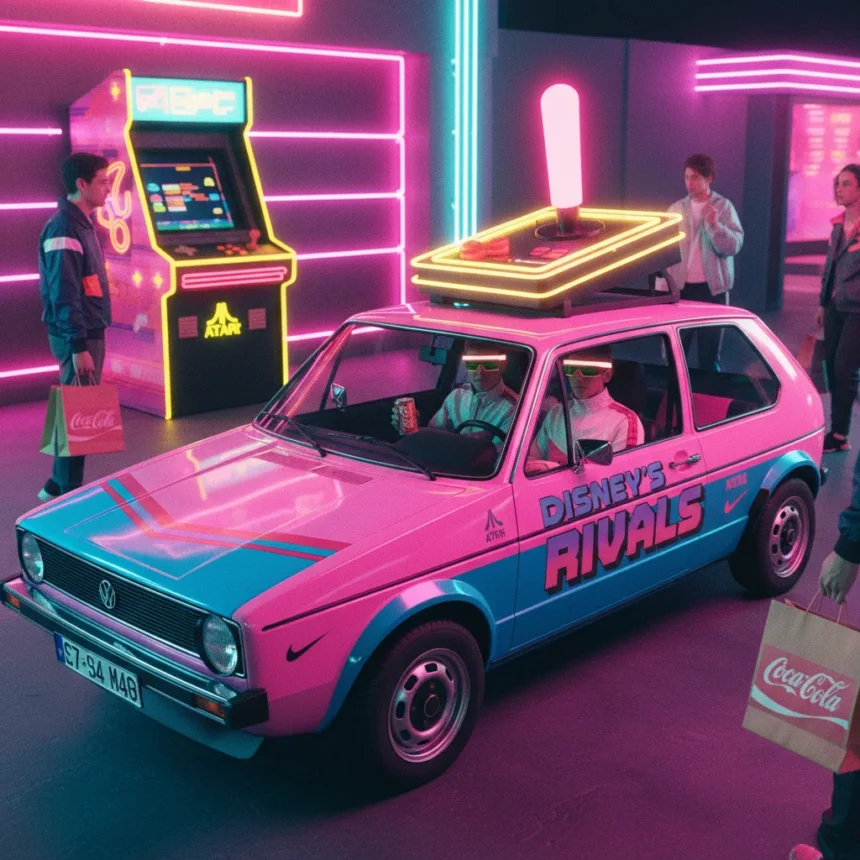
Disney’s TV series Rivals is bringing back a marketing playbook from the 1980s: blatant, unapologetic 1980s brand collaborations woven directly into the show’s visual DNA. Four iconic brands are partnering with the production, including Volkswagen, to blend on-screen authenticity with in-store activations and social media campaigns. The strategy treats product placement not as a dirty word but as a design element that makes the period setting feel lived-in and real.
Key Takeaways
- Rivals features four iconic brand collaborations, including Volkswagen, integrated into on-screen 1980s design.
- Campaign spans on-screen product placement, in-store activations, and social media extensions.
- Strategy echoes Disney’s 1988 film Oliver & Company, which featured Coca-Cola, Kodak, Sony, Panasonic, and McDonald’s in background scenery.
- Volkswagen appears as period-appropriate 1980s models matching the show’s lavish production design.
- Approach revives retro nostalgia marketing amid growing consumer appetite for 1980s aesthetics.
How Rivals Resurrects 1980s Product Placement Strategy
The 1980s were the golden age of shameless product placement in entertainment. Brands didn’t hide in shadows—they lived in the frame. Disney’s Rivals leans hard into this aesthetic, using brand partnerships not to disrupt the narrative but to strengthen it. Volkswagen’s vehicles appear as integral parts of the show’s world, reimagined as period-accurate 1980s models that feel like they belong in the lavish sets rather than intrude upon them.
This approach is not new to Disney. The studio’s 1988 animated feature Oliver & Company pioneered the technique by embedding real-world brands like Coca-Cola, Kodak, Sony, Panasonic, and McDonald’s directly into New York City backgrounds. The goal was realism—to make animated streets feel like actual urban environments where real products existed. Rivals applies the same logic to a television series set in the 1980s, where period-accurate branding becomes a storytelling tool rather than a commercial interruption.
Four Iconic Brands Transform Rivals Into a Living Nostalgia Campaign
The four brand collaborations create a multi-layered marketing ecosystem that extends far beyond the screen. On-screen placements anchor the visual world. In-store activations bring the aesthetic into retail environments where consumers encounter the brands in their daily lives. Social media campaigns amplify the 1980s aesthetic for audiences who grew up in that era or are discovering it for the first time.

Volkswagen’s involvement is particularly strategic. The automaker’s vehicles from the 1980s carry distinct design language—boxy, functional, iconic. By featuring period-appropriate Volkswagen models within Rivals, the partnership creates authenticity that modern vehicles would shatter. The collaboration works because the product itself is part of the decade’s visual vocabulary, not something imposed onto it.
The other three brand partners remain unspecified in available details, but they follow the same logic: iconic 1980s brands whose visual presence strengthens rather than weakens the show’s immersive world.



Why 1980s Nostalgia Drives Modern Marketing Strategy
Consumer appetite for 1980s aesthetics has surged in recent years. From fashion to music to visual design, the decade’s bold colors, geometric shapes, and unapologetic excess appeal to both people who lived through it and younger audiences discovering it for the first time. Rivals taps into this trend by making the 1980s not just a setting but a style statement that bleeds into the real world through brand partnerships.
This strategy differs fundamentally from contemporary product placement, which often tries to be invisible. A smartphone appearing in a modern drama is meant to feel natural, almost unnoticed. But 1980s brand collaborations work differently. They’re meant to be noticed, recognized, and celebrated as artifacts of a specific moment in time. The brands become part of the show’s appeal, not a distraction from it.
Is Rivals the start of a retro nostalgia marketing trend for Disney?
Rivals suggests Disney is testing whether 1980s-focused storytelling can sustain multi-brand partnerships in ways that feel organic rather than transactional. If the campaign succeeds, expect other period pieces to adopt similar strategies. The key difference is authenticity—brands must belong to the era, not feel grafted onto it.
How does Rivals’ approach compare to modern product placement in TV and film?
Modern product placement prioritizes invisibility. A character uses a real brand’s product, and the audience barely registers it. Rivals flips this. The 1980s branding is meant to be visible, recognized, and celebrated. It’s product placement as period design rather than commercial insertion, making the brands part of the show’s visual vocabulary rather than interruptions to it.



Will other streaming services adopt 1980s nostalgia collaborations?
If Rivals proves that audiences embrace period-accurate brand partnerships as authentic design elements, other networks and streamers will likely follow. The success depends on execution—brands must be chosen carefully to match the era, and placements must serve the story rather than feel forced. Done well, 1980s nostalgia collaborations become a marketing model where brands enhance authenticity instead of compromising it.
Disney’s Rivals represents a calculated bet that audiences will embrace 1980s brand collaborations as part of the show’s immersive world rather than resent them as commercialism. By treating product placement as a design element and extending the campaign beyond the screen into retail and social spaces, the strategy transforms what could be seen as advertising into nostalgia marketing that feels intentional and earned. Whether this approach becomes the template for period pieces remains to be seen, but Rivals demonstrates that the right brands in the right era can strengthen rather than undermine storytelling.
Edited by the All Things Geek team.
Source: Creativebloq