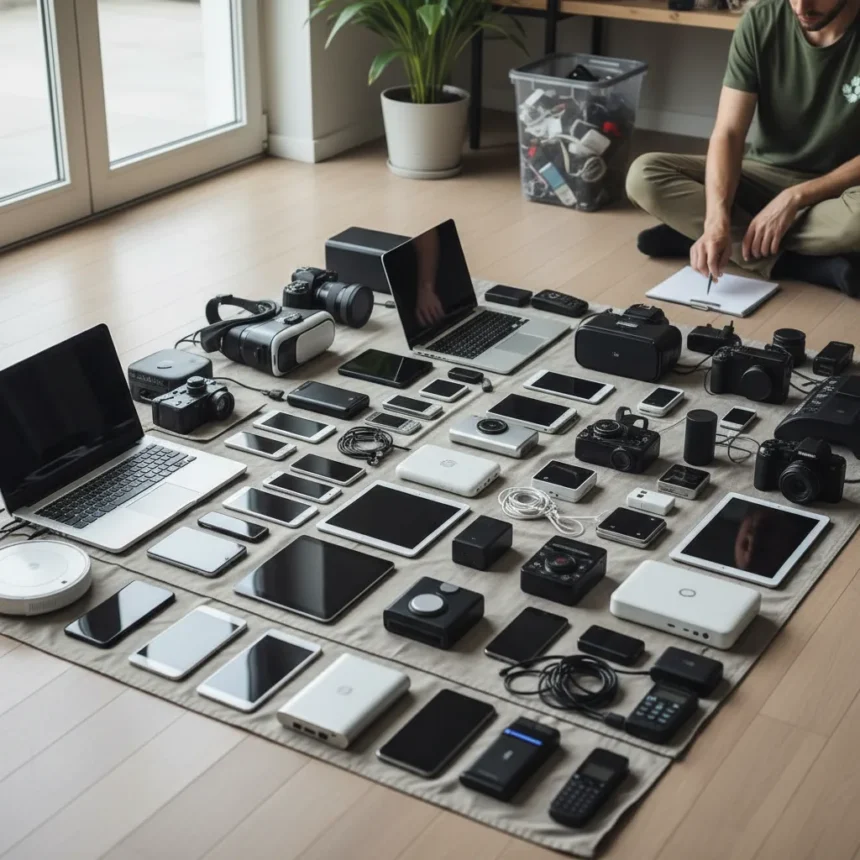
Counting every gadget in your home for Earth Day sounds simple until you actually start doing it. One writer undertook this home gadget inventory exercise and discovered that most of us have far more devices than we realize—and the environmental implications are harder to ignore than we’d like.
Key Takeaways
- A home gadget inventory reveals the true scale of personal tech ownership across households.
- Most people underestimate how many devices they own until they physically count them.
- E-waste from unused and discarded gadgets represents a significant environmental and resource problem.
- Older devices accumulate in drawers and storage, creating hidden electronic waste.
- Understanding personal tech consumption is the first step toward more sustainable purchasing habits.
Why Home Gadget Inventory Matters Now
The home gadget inventory project started as an Earth Day exercise but revealed something far more consequential: the sheer volume of electronics in an average household. When you actually count—not estimate—the smartphones, tablets, laptops, chargers, smart home devices, gaming consoles, cameras, headphones, and miscellaneous USB-powered gadgets, the number becomes staggering. Most households contain dozens of active devices, plus another dozen or more that are broken, obsolete, or simply forgotten in a drawer.
This matters because electronic waste represents one of the fastest-growing waste streams globally. Devices that end up in landfills contain toxic materials, rare earth elements, and valuable metals that could be recovered. A home gadget inventory isn’t just a count—it’s a wake-up call about consumption patterns that have become so normalized we stop seeing them.
What a Home Gadget Inventory Typically Reveals
The act of conducting a home gadget inventory forces a confrontation with reality. Most people discover categories of devices they’d completely forgotten about: old phone chargers for devices they no longer own, backup power banks still sitting in original packaging, smart home devices that never got set up, and cables for technologies that are now obsolete. The inventory also reveals redundancy—how many of us have three or four smartphone chargers, multiple USB-C cables, or backup external hard drives we never use?

What makes this exercise valuable is that it’s personal. Unlike reading statistics about global e-waste, counting your own devices creates immediate context. You’re not reading about a problem in the abstract—you’re holding the problem in your hands, drawer by drawer. The home gadget inventory becomes a physical manifestation of how technology consumption has quietly escalated without conscious decision-making.
The devices that surprise people most are the ones they forgot they owned. Smart speakers gathering dust. Fitness trackers with dead batteries. Tablets replaced by newer models but never recycled. These forgotten gadgets represent not just wasted money but wasted resources—the energy and materials that went into manufacturing something that now serves no purpose.



From Inventory to Action
A home gadget inventory is only useful if it leads somewhere. Counting devices without addressing what to do with them is just accounting. The real value emerges when the inventory becomes a catalyst for change: deciding which devices can be donated, which can be refurbished, which genuinely need to be replaced versus upgraded, and which should be recycled responsibly rather than thrown away.
This process also changes future purchasing behavior. Once you’ve counted your devices and confronted the accumulation, it becomes harder to mindlessly add more. The next time you’re tempted to buy a new gadget, the memory of that inventory—the sheer number of devices already in your home—creates a moment of pause. Do you need this? Or is it just another addition to the pile?
How Many Gadgets Is Too Many?
There’s no universal answer, but a home gadget inventory reveals patterns. Active devices that serve genuine functions—a laptop for work, a phone, a tablet for media, a smart speaker for convenience—are one category. Backup devices and redundant tools are another. Broken devices waiting for repair that will never happen are a third. The inventory forces you to categorize and question each device’s actual purpose in your life.
What’s clear from conducting a home gadget inventory is that most households own far more than they use actively. The gap between owned and used devices represents both personal waste and environmental impact. Closing that gap—either by actually using forgotten devices, passing them to people who will, or recycling them responsibly—is where the exercise becomes meaningful.



Should I count all my gadgets at home?
Yes, especially if you’re curious about your consumption patterns or concerned about e-waste. A home gadget inventory takes a few hours and creates surprising clarity. You’ll likely discover devices you forgot existed and gain perspective on what you actually need versus what you’ve accumulated.
What should I do with gadgets I don’t use?
A home gadget inventory is the perfect opportunity to assess each device. Functional devices in good condition can be donated to schools, nonprofits, or friends. Devices with resale value can be sold through secondhand marketplaces. Broken or obsolete gadgets should be taken to certified e-waste recycling facilities, not thrown in the trash.
Does counting gadgets actually reduce consumption?
A home gadget inventory doesn’t automatically change behavior, but it creates awareness. Once you’ve physically counted your devices and seen the accumulation, future purchasing decisions become more intentional. The inventory serves as a reference point—a reminder of what you already own before buying something new.
The real value of a home gadget inventory isn’t in the number itself. It’s in what that number means: the resources consumed, the environmental cost, and the gap between what we own and what we actually use. Earth Day provided the occasion, but the insight lasts far longer.
Edited by the All Things Geek team.
Source: TechRadar