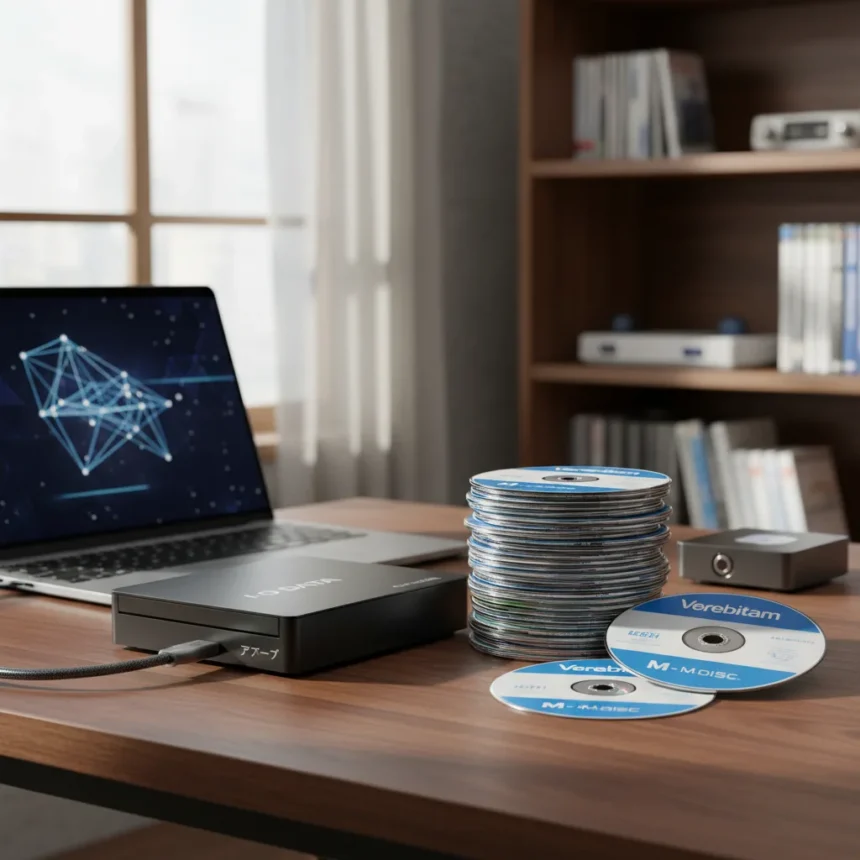
Recordable Blu-ray is not dead. While Sony shut down its last domestic recordable Blu-ray factory in February last year and Buffalo exited the market over the past 14 months, Verbatim Japan and I-O Data have doubled down on their commitment to the format, expanding beyond media to include drive hardware. The announcement defies the broader narrative of optical media’s irrelevance, revealing instead a stubborn niche demand that manufacturers are willing to serve.
Key Takeaways
- Verbatim and I-O Data now supply both recordable Blu-ray discs and drive hardware in Japan.
- Sony and Buffalo have exited the recordable Blu-ray market over the past 14 months.
- The BD Reco external drive, launched in February this year, has attracted significant interest.
- Panasonic remains the sole vertically integrated Japanese optical drive manufacturer.
- Long-term backup and data preservation continue to drive demand for physical media.
Why Recordable Blu-ray Still Matters
The survival of recordable Blu-ray hinges on a simple truth: some users need to own their data on a tangible medium. As Verbatim Japan and I-O Data put it in their joint announcement, “We have once again recognized that the need to ‘record data I want to keep onto a disc I have on hand’ continues to genuinely exist”. This is not nostalgia or technological stubbornness. For archivists, researchers, and organizations managing sensitive information, a Blu-ray disc represents something the cloud cannot: permanent, offline, owner-controlled storage.
The market has shrunk dramatically. Cloud storage, streaming services, and digital distribution have made optical media feel antiquated to most consumers. Yet the manufacturers still standing in Japan recognize that abandonment would eliminate a legitimate use case entirely. I-O Data serves as the sole domestic distributor of Verbatim-branded optical media in Japan, positioning the partnership as the last reliable source for both media and hardware in the region.
The Recordable Blu-ray Landscape After Recent Exits
The competitive field has contracted sharply. Sony, once a pillar of optical media manufacturing, ceased recordable Blu-ray production domestically. Buffalo followed suit. These exits leave Panasonic as the only remaining vertically integrated Japanese manufacturer of optical drives, according to the companies’ statements. Verbatim and I-O Data now operate in a market where they face minimal direct competition but also minimal overall demand.
This paradox explains their strategy. Rather than abandon the space, they are securing components, adjusting production lines, and developing new products to sustain supply. The February release of the BD Reco, a Windows-compatible external Blu-ray drive, represents this commitment in hardware form. The device “has attracted a great deal of interest,” suggesting that users seeking recordable Blu-ray solutions do exist and are actively seeking them out.
What Keeps Recordable Blu-ray Relevant
Recordable Blu-ray persists because certain use cases demand it. Long-term backup for critical files, archival preservation of media collections, and secure data storage all benefit from a format that does not depend on internet connectivity, corporate servers, or proprietary cloud platforms. A physical disc offers permanence in a way digital services cannot guarantee.



The niche is real but small. Global demand for recordable Blu-ray hardware has declined steadily as consumers shifted to streaming and cloud storage. Yet within that shrinking market, the demand for the format itself has not vanished entirely. Organizations and individuals managing irreplaceable data still reach for optical media as a failsafe. Verbatim and I-O Data are betting that this segment, though limited, is large enough to justify continued investment in manufacturing and supply chain management.
Is recordable Blu-ray worth buying for data storage?
Recordable Blu-ray remains a solid choice for long-term archival if you need offline, owner-controlled storage and do not rely on cloud services. The format offers higher capacity than DVD and better longevity than external hard drives in ideal storage conditions. However, it requires compatible hardware, which is now harder to source outside Japan.
Why are manufacturers leaving the recordable Blu-ray market?
Declining consumer demand for physical media, the shift to cloud storage and streaming, and lower profit margins have driven manufacturers like Sony and Buffalo to exit. The market is simply too small to justify factory operations for most producers, leaving only niche-focused companies like Verbatim and I-O Data willing to maintain supply.
Will recordable Blu-ray disappear completely?
Not immediately. Verbatim and I-O Data’s expanded commitment suggests the format will survive in Japan at least, serving archivists, researchers, and data-conscious users who value physical ownership. However, global supply will likely remain limited, and availability outside Japan may become increasingly difficult as manufacturing consolidates further.



Recordable Blu-ray is not making a comeback. It is not becoming mainstream again. But it is not dead either. The format persists in the margins, sustained by manufacturers who recognize that some users genuinely need to keep their data on a disc they can hold in their hand. In an age of cloud dominance, that stubborn insistence on physical media represents something increasingly rare: a choice that prioritizes ownership over convenience.
Edited by the All Things Geek team.
Source: TechRadar