





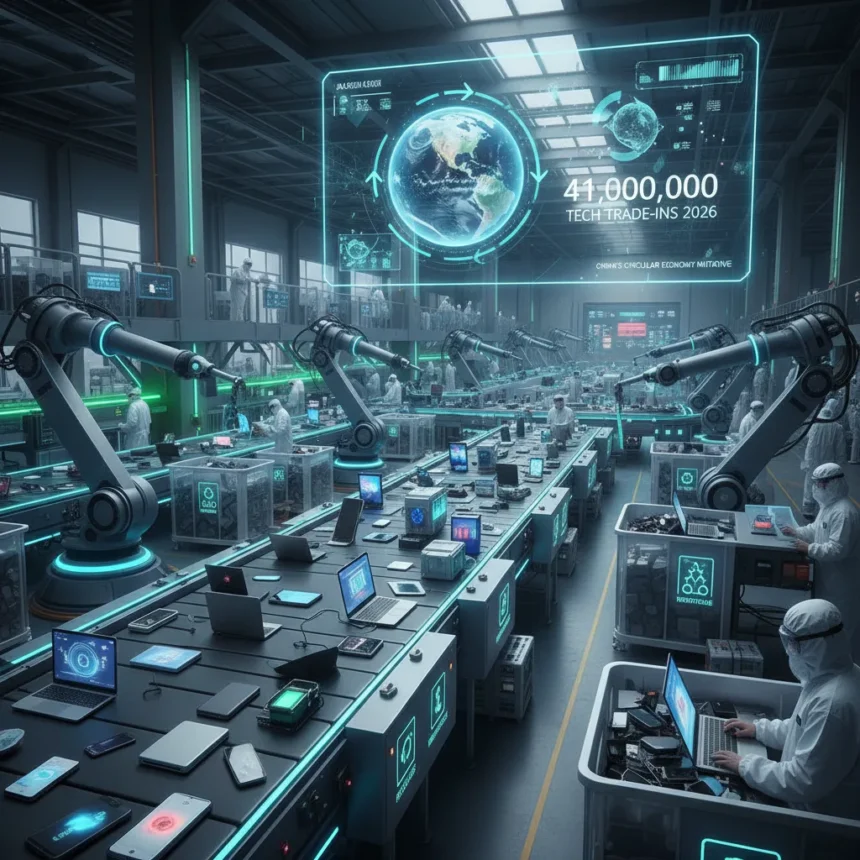
China’s tech recycling trade-in scheme represents one of the world’s largest coordinated efforts to manage electronic waste while incentivizing consumer upgrades. The program processed 41 million tech items in 2026, offering discounts to consumers who traded in older devices. This scale of operation signals a fundamental shift in how the world’s second-largest economy approaches circular economy principles and consumer electronics lifecycle management.
Key Takeaways
- China’s tech recycling scheme processed 41 million items in 2026, the world’s largest by volume.
- Trade-in programs offer consumer discounts while funneling devices into standardized dismantling channels.
- From 2024 to 2025, China recycled 53 million used home appliances and mobile phones.
- Government policies support equipment upgrades and consumer goods trade-ins to promote urban mining.
- Green and intelligent products are prioritized in trade-in program incentives.
How China’s Tech Recycling Trade-In Scheme Works
The tech recycling trade-in scheme operates as a dual-incentive system: consumers receive discounts on new device purchases while their old electronics enter standardized dismantling channels rather than landfills. The 41 million items traded in 2026 represent a significant increase from the 53 million used home appliances and mobile phones processed across standardized dismantling channels from 2024 to 2025. This growth reflects expanding consumer participation and government backing for the initiative.
The mechanics are straightforward. Retailers and manufacturers participate in the program, accepting old devices as partial payment or discount vouchers toward new purchases. These traded-in items then flow into certified recycling facilities equipped to dismantle, sort, and recover valuable materials. Unlike informal e-waste streams that often end up in unregulated operations, this structured approach ensures compliance with environmental standards and material recovery protocols.
Why Government Policy Drives the Scale
China’s government has made large-scale equipment upgrades and consumer goods trade-ins central to its economic strategy, explicitly framing these programs as urban mining initiatives. Urban mining—the extraction of valuable materials from discarded electronics—addresses two simultaneous goals: reducing landfill pressure and securing domestic supplies of rare earth elements and precious metals without relying entirely on virgin mining.

The policy framework prioritizes green and intelligent products in trade-in incentive structures. This means consumers trading in older devices receive better discounts if they upgrade to energy-efficient or smart-enabled models, creating a cascading effect: older technology exits the market faster, manufacturers benefit from accelerated replacement cycles, and the recycling infrastructure processes a steadier stream of materials. The 41 million items in 2026 reflect the cumulative impact of these aligned incentives across government, retail, and manufacturing sectors.
Global Context and Competitive Implications
No other country operates a tech recycling trade-in scheme at China’s scale. The European Union’s right-to-repair directives and extended producer responsibility laws address e-waste differently—through mandates rather than consumer incentives. The United States relies on a patchwork of state-level regulations and voluntary manufacturer programs, resulting in far lower recycling rates. Japan’s established take-back systems focus on manufacturers’ direct responsibility rather than consumer-facing discount incentives.



China’s approach is distinctive because it weaponizes consumer behavior. By offering immediate discounts on new purchases, the program overcomes the primary barrier to device recycling: lack of perceived value. A consumer who receives a 200-yuan discount on a new phone by trading in an old one is far more likely to participate than one who must separately arrange drop-off at a recycling center. This behavioral insight, scaled across 1.4 billion people, produces the 41 million figure—a volume that competitors cannot match without similar policy integration.
Material Recovery and Supply Chain Resilience
The 41 million devices processed in 2026 represent not just environmental stewardship but resource security. Smartphones, laptops, and tablets contain copper, aluminum, cobalt, and rare earth elements critical to manufacturing. Recycling 41 million devices recovers tons of these materials, reducing China’s dependence on virgin mining and imports. The broader context shows China recycled approximately 380 million tonnes of renewable resources in 2025, with the tech recycling scheme forming one component of a much larger circular economy push.
For manufacturers, this creates a secondary supply chain of recovered materials. A smartphone recycled through the trade-in program yields usable copper and gold within weeks, not years. This accelerated material recovery loop improves supply chain resilience—particularly valuable given global semiconductor and rare earth element tensions. Competitors operating in markets without similar trade-in infrastructure face longer material sourcing timelines and higher virgin material costs.
Is China’s tech recycling trade-in scheme profitable for consumers?
Yes, consumers receive immediate discounts on new device purchases when trading in old electronics through the program. The discount value varies by device age, condition, and model, but participation is economically rational for most users upgrading anyway. The real benefit lies in avoiding the hassle of selling used devices privately while securing a guaranteed discount at point of purchase.



How does China’s scheme compare to other countries’ e-waste programs?
China’s tech recycling trade-in scheme is unique in combining consumer incentives (discounts) with mandatory standardized recycling channels. Most Western programs rely on either manufacturer take-back systems or voluntary consumer participation without purchase incentives. China’s integration of discounts into retail transactions drives participation rates far exceeding voluntary programs, explaining the 41 million annual volume.
What happens to devices after they’re traded in?
Traded-in devices enter certified dismantling facilities where they are sorted, disassembled, and processed for material recovery. Usable components may be refurbished for secondary markets, while others are separated into material streams—copper, aluminum, plastics—for industrial reuse. This standardized approach prevents devices from entering informal recycling channels where environmental and labor standards are not enforced.
China’s 41 million tech items traded in 2026 represent far more than a recycling statistic. The scheme demonstrates how government policy, consumer incentives, and industrial infrastructure can align to create circular economy outcomes at scale. For the rest of the world, it raises an uncomfortable question: if consumer discounts drive recycling participation this effectively, why aren’t other nations adopting similar models?
Edited by the All Things Geek team.
Source: TechRadar




