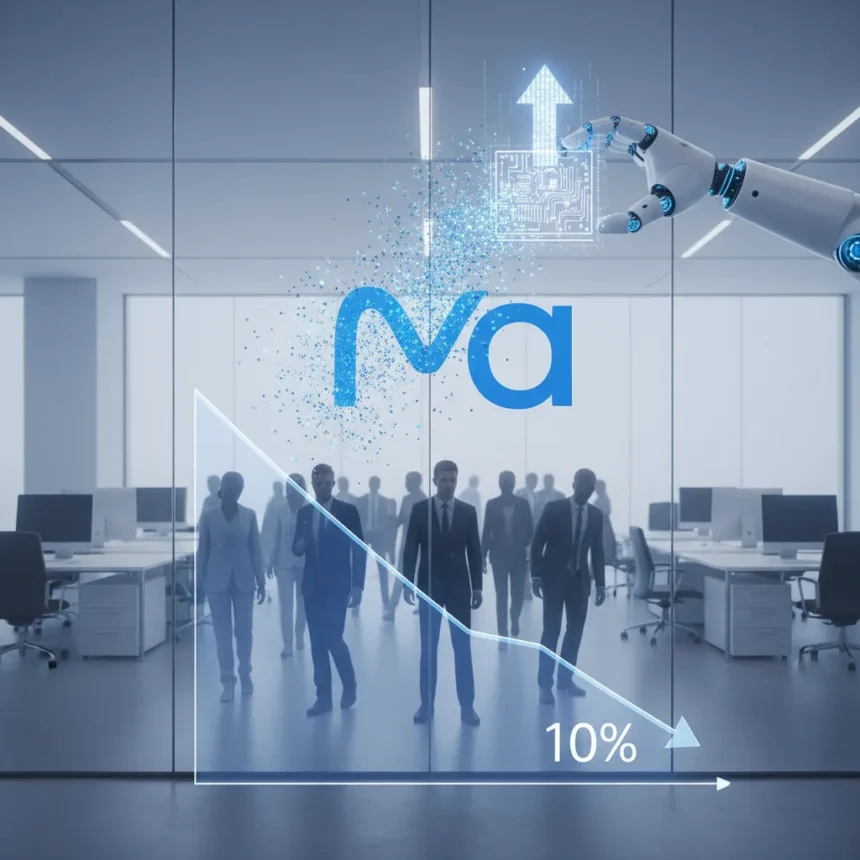
Tech industry AI layoffs have become the defining employment story of 2026, with Meta announcing plans to cut approximately 8,000 employees—roughly 10% of its global workforce—starting May 20, 2026, followed by additional reductions later in the year. The move reflects a fundamental shift in how technology companies allocate resources: away from headcount growth and toward artificial intelligence infrastructure, even as Meta reports strong financial performance.
Key Takeaways
- Meta plans to lay off 8,000 employees (10% of workforce) starting May 20, 2026, with more cuts planned later in 2026
- Tech industry AI layoffs have eliminated 73,000+ jobs in the first four months of 2026, with 25% directly attributed to AI
- Marketing and middle management roles are primary targets as AI automates ad tools and internal processes
- Meta’s AI ad tools reached a $60 billion annual run rate in Q3 2025, driving efficiency gains
- This follows Meta’s previous “year of efficiency” three years ago, which cut over 20,000 employees
Why Tech Industry AI Layoffs Are Accelerating in 2026
The tech industry AI layoffs trend reflects a deliberate strategic pivot. Meta frames the cuts as part of “continued effort to run the company more efficiently,” but the underlying driver is automation. AI is replacing roles faster than companies can redeploy workers, particularly in entry-level and middle-management positions where AI tools can handle routine tasks. Marketing departments face especially heavy cuts as machine learning algorithms now handle ad targeting and optimization tasks that previously required teams of specialists.
The scale of tech industry AI layoffs extends far beyond Meta. Amazon cut up to 30,000 corporate employees (10% of its workforce) in late 2025 specifically to fund generative AI productivity initiatives. Microsoft eliminated 3% of its workforce—approximately 7,000 people—to reallocate resources toward AI investments. Block, the fintech company, took the most aggressive approach, cutting 40% of its staff while explicitly stating that “AI is doing a lot of these jobs”. Across the sector, only AI-focused roles are seeing consistent hiring growth while traditional engineering and support positions shrink.
The financial paradox is striking: Meta reported strong revenue growth with US social ad revenues forecast to surpass $100 billion in 2026. Yet despite this prosperity, the company is cutting deeper than ever. This signals that tech leadership views AI automation not as a temporary efficiency measure but as a permanent restructuring of how technology companies operate.



Tech Industry AI Layoffs and the Broader 2026 Employment Collapse
Through the first four months of 2026, the tech sector has shed 73,000 to 73,212 jobs, with approximately 25% of those losses directly attributed to AI adoption. Meta’s announcement will accelerate this trend. If the company follows through on its stated plans and executes additional cuts beyond the initial 8,000, it could contribute another 10,000+ positions to the 2026 total, potentially exceeding the entire job loss count from 2024.
What distinguishes tech industry AI layoffs from previous cycles is the permanence. During the 2023 “year of efficiency,” many observers expected companies to rehire once market conditions improved. Instead, companies are using AI to eliminate the need for rehiring altogether. Middle managers who once supervised teams of five or six people now manage smaller units because AI handles workflow coordination. Junior developers who once learned by fixing bugs in production code now compete with AI code generation tools. The career ladder itself is being dismantled.



What Meta’s Cuts Mean for the Tech Workforce
Meta’s layoffs target specific departments with brutal precision. Marketing and business operations roles are being eliminated en masse as AI advertising tools mature. Middle management layers are being flattened because AI can handle task delegation and performance monitoring that previously required human oversight. The company is betting that fewer, more senior people paired with sophisticated AI tools can deliver the same output as larger teams.
The timing matters. By announcing cuts in April 2026 with a May 20 start date, Meta gives itself a compressed window to identify which employees to retain and which to let go. This approach contrasts with gradual attrition or voluntary separation programs—it is a clean break designed to reshape the organization’s structure permanently. Additional cuts “later in 2026” suggest Meta is pacing the reductions to avoid overwhelming its HR and legal teams while still completing the transformation within a single calendar year.
For workers outside Meta, the message is equally clear: if you are in a role that AI can automate—and the list is growing—your job is at risk regardless of company profitability. This is not a cyclical downturn. It is structural change driven by technology advancement, and it will reshape the tech industry for years to come.
How does Meta’s 10% layoff compare to other tech companies?
Meta’s 10% cut is significant but not the most aggressive in 2026. Amazon cut 10% of corporate staff, while Block eliminated 40% of its workforce specifically citing AI automation. Microsoft’s 3% reduction was the smallest among major players, though still substantial in absolute numbers. The pattern shows no consensus on the “right” level of AI-driven restructuring—companies are experimenting with different cutoff points to find the optimal AI-to-human workforce ratio.


Will Meta hire for AI roles after these layoffs?
Meta has not announced specific AI hiring plans to offset the 8,000 cuts. Across the tech industry, AI-focused positions are the only category seeing consistent hiring growth, but the number of new AI roles does not come close to matching the layoffs. Workers laid off from marketing or operations roles cannot easily transition to machine learning engineering positions, creating a skills mismatch that will leave many displaced employees unable to find comparable work within their current companies.
When will the broader tech industry AI layoffs end?
There is no clear endpoint. Meta’s announcement of “additional cuts planned later in 2026” suggests the company expects to make multiple rounds. As AI tools become more capable, the pressure to automate additional roles will intensify, likely extending tech industry AI layoffs well into 2027 and beyond. The restructuring is not a one-time event—it is a continuous process as each new AI capability creates opportunities to eliminate more human positions.
Meta’s decision to cut 8,000 jobs despite record financial health marks a turning point in how technology companies view their workforces. Efficiency is no longer about doing more with less—it is about doing as much as possible with artificial intelligence instead of people. The tech industry AI layoffs will continue until companies believe they have reached the optimal balance between human judgment and machine automation. For the workers caught in this transition, that optimization process feels like displacement, not progress.
Edited by the All Things Geek team.
Source: Tom's Guide