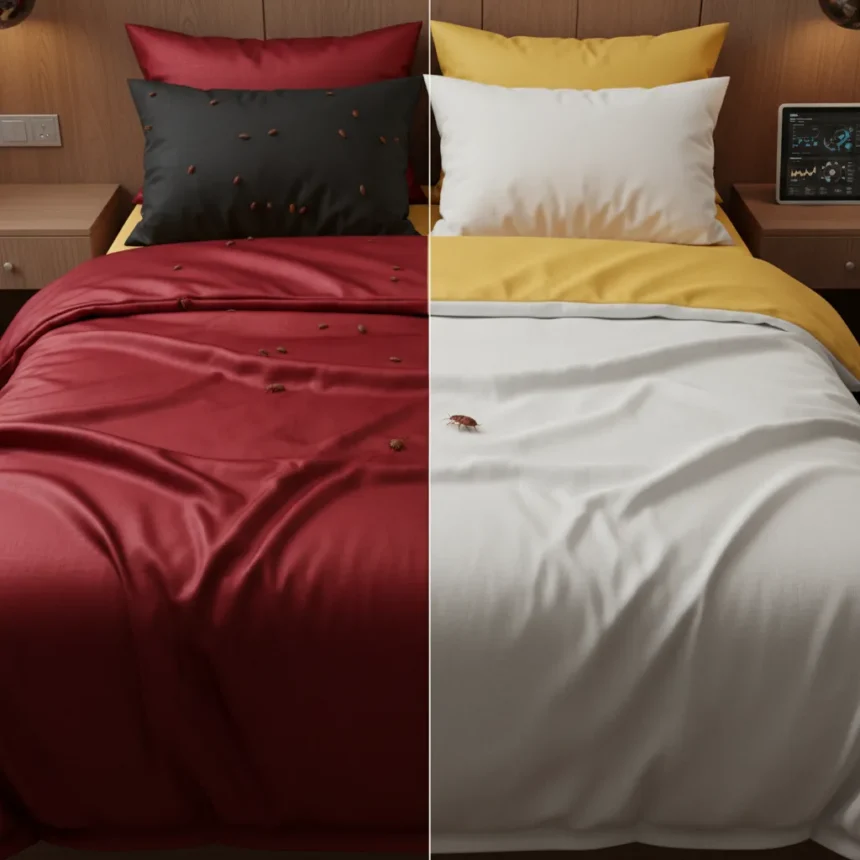
Bed bug sheet color directly influences your infestation risk. Researchers from the University of Florida and Union College tested bed bugs in colored tent-like shelters and found they overwhelmingly prefer red (28.5% choice rate) and black (23.4% choice rate) over other colors, according to findings published in the Journal of Medical Entomology. This preference has major implications for how you should choose bedding and monitor your home for infestations.
Key Takeaways
- Bed bugs choose red tents 28.5% of the time and black tents 23.4% of the time in lab tests
- Researchers initially believed bed bugs were attracted to red due to blood-feeding, but revised their hypothesis to aggregation behavior
- Yellow and green colors repel bed bugs because they associate these shades with brightly lit areas
- Bed bugs can hide under beds for up to nine months without feeding
- Established infestations ignore color preferences, especially when bed bugs hunt in darkness
Why Bed Bugs Prefer Red and Black Fabrics
The bed bug sheet color preference emerged from controlled laboratory conditions where researchers offered bed bugs a choice of colored harborages—tiny tent-like shelters mimicking real hiding spots. The insects had 10 minutes to choose under varying conditions: male versus female, young versus old, fed versus hungry, and alone versus in groups. Red and black dominated their choices across nearly all test scenarios.
Scientists initially hypothesized that bed bugs gravitated toward red because of their blood-feeding behavior, assuming they were drawn to the color of their preferred food source. That assumption proved wrong. The revised explanation is far more interesting: bed bugs prefer red and black because they are themselves reddish-brown insects that naturally aggregate with their own kind. In other words, they are attracted to colors that match their own bodies, creating a kind of visual camouflage and safety in numbers. This aggregation behavior explains why infestations cluster in specific areas rather than spreading randomly throughout a home.
Which Bed Bug Sheet Colors Offer Protection
Yellow and green tents were actively avoided by bed bugs in testing. Researchers attribute this aversion to the insects’ association of bright colors with well-lit environments, which bed bugs instinctively avoid since they are nocturnal hunters that thrive in darkness. White sheets also ranked low in bed bug preference, making light-colored bedding a smarter choice than dark alternatives.

However, do not mistake color choice for a complete prevention strategy. Hungry bed bugs largely ignore color preferences when actively seeking shelter, and established infestations operating in the dark will not be deterred by switching to yellow or green sheets alone. The color preference matters most when bed bugs are choosing between available hiding spots—not when they are desperate or already entrenched in your home.
How to Inspect Your Bed for Bed Bugs
Color preferences are one layer of defense, but detection remains your most powerful tool. The federal Office of Disease Prevention and Health Promotion recommends using a flashlight to systematically inspect your mattress, box spring, and bed frame. Pay special attention to the underside of mattresses and along seams, where bed bugs commonly hide. Also check nearby furniture like nightstands, as bed bugs will colonize adjacent surfaces. Look for the insects themselves—small, reddish-brown bugs roughly the size of an apple seed—or their telltale droppings, which appear as tiny dark spots on fabric.



Bed bugs can remain hidden under beds for up to nine months without feeding, so a single inspection may miss an infestation. If you suspect an infestation, inspect multiple times over several weeks or contact a professional pest control service. Do not rely on visual checks alone as your only defense.
Practical Implications for Travelers and Homeowners
If you travel frequently, the bed bug sheet color research has direct applications. Packing bright suitcases in light green or yellow shades may offer marginal protection compared to dark luggage, though this is not a substitute for inspecting hotel rooms before unpacking. Check the mattress seams and headboard of your hotel bed before settling in, and keep your suitcase off the floor and away from the bed during your stay.
For your home, the takeaway is straightforward: white or light-colored sheets are preferable to red or black from a bed bug perspective, but this choice alone will not prevent infestations if bed bugs are actively seeking shelter or already established in your bedroom. Sheet color is one small factor in a larger pest management strategy that includes regular inspections, prompt cleaning of bedding, and professional treatment if an infestation is confirmed.
Can changing sheet color eliminate bed bugs?
No. While bed bugs prefer red and black, established infestations will not be eliminated by switching to yellow or white sheets. Bed bugs operate primarily in darkness where they see color poorly, and hungry insects ignore color preferences entirely. Sheet color is a minor deterrent at best, not a treatment solution.



How long can bed bugs survive without feeding?
Bed bugs can hide under beds and remain viable for up to nine months without a blood meal. This extended survival period is why a single inspection may not catch an infestation and why professional pest control is often necessary.
What colors do bed bugs hate the most?
Bed bugs actively avoid yellow and green, associating these bright colors with well-lit environments they instinctively shun. White is also low on their preference list. However, color aversion only matters when bed bugs have choices—hungry or established populations will ignore these preferences.
The bed bug sheet color research reveals a genuine biological preference but also exposes a common misconception: that switching bedding colors alone will solve an infestation. The real value lies in understanding bed bug behavior well enough to improve inspections and make smarter choices about travel luggage and home monitoring. Use this knowledge as one tool in a comprehensive approach that includes vigilance, regular inspections, and professional intervention when needed.
Where to Buy
15% OFFLinenspaMattress Encasement (twin)$21.24$24.99shop now | 19% OFFBedsureSheet Set (twin)$19.99$24.69shop now | 42% OFFFEPPOMattress Vacuum$69.99$119.99shop now | 29% OFFHarrisFood Grade Diatomaceous Earth$17.85$24.99shop now
Edited by the All Things Geek team.
Source: Tom's Guide