The best TVs for World Cup viewing balance brightness, contrast, and color accuracy—and with the tournament weeks away, now is the time to upgrade. Whether you prioritize the inky blacks of OLED or the eye-searing brightness of mini-LED, the right choice depends on your room’s lighting and budget.
Key Takeaways
- Mini-LED TVs deliver superior brightness and contrast compared to traditional LED panels, ideal for sports in bright rooms.
- Hisense U8N outperforms Samsung QN90D in brightness while matching its gaming and picture quality credentials.
- LG OLEDs excel at color and black levels but lag behind Samsung in mini-LED brightness.
- TCL C805 and C855 offer exceptional picture quality at mid-range UK prices, making them value leaders for World Cup viewing.
- Dolby Vision and HDR10+ support on Hisense and TCL models ensures comprehensive HDR compatibility for broadcast sports.
Mini-LED Brightness Wins the World Cup Battle
Mini-LED technology dominates for sports viewing because it delivers exceptional brightness and contrast without sacrificing color depth. The Hisense U8N stands out as the best mini-LED option for most viewers, combining superior picture and sound quality with excellent gaming features and value. It outperforms the Samsung QN90D in raw brightness—a critical advantage when watching football under daylight or in rooms with high ambient light. The TCL QM851G also beats the Samsung QN90D on brightness, proving that premium performance no longer requires premium pricing.
Mini-LED’s architectural advantage lies in its backlighting zones, which can dim independently to create deeper blacks while maintaining bright highlights. This contrast capability makes replays, goal celebrations, and stadium lighting pop with realism. For sports fans in bright living rooms, mini-LED edges out OLED because peak brightness matters more than perfect blacks.
LG OLEDs Deliver Unmatched Picture Quality
LG’s OLED lineup remains the gold standard for picture quality and features, with the webOS platform offering seamless navigation and streaming app access. OLEDs excel at rendering true blacks because each pixel produces its own light—there is no backlight to dim selectively. This pixel-level control creates stunning color accuracy and eliminates blooming around bright objects against dark backgrounds.



The trade-off: OLEDs produce less peak brightness than mini-LEDs, which can be a disadvantage if your viewing room gets direct sunlight or you prioritize sports viewing in bright conditions. However, for evening World Cup matches and cinematic picture quality, LG OLEDs remain the preferred choice. The upcoming LG C5 OLED is positioned as the best overall TV option entering 2026, per Tom’s Guide.
TCL and Hisense Challenge the Premium Brands
TCL and Hisense have disrupted the TV market by delivering premium brightness, contrast, and features at mid-range and budget prices. The TCL C805 outperforms its price tag in picture quality and gaming performance, earning recognition as a UK value leader. The TCL C855 steps up with premium quality at a mid-range price, delivering superb UK value for viewers unwilling to pay Samsung or LG flagship prices. Both models support Dolby Vision and HDR10+ for comprehensive HDR compatibility, ensuring broadcast sports content displays with full dynamic range.



The Hisense U6N offers an affordable entry point to mini-LED technology with solid picture quality, while the Hisense U8N sits at the sweet spot of features, brightness, and price. These brands crash the premium party by offering unbelievably good value, forcing established players to justify their higher prices through ecosystem advantages rather than raw performance alone.
Samsung Mini-LEDs: Bright but Outmatched
Samsung’s mini-LED models, particularly the QN90D, deliver impressive brightness and gaming features but face stiff competition from Hisense and TCL alternatives. The QN90D is bright enough for any viewing environment, yet the Hisense U8N and TCL QM851G both exceed its brightness performance. Samsung’s strength lies in its gaming optimization and brand ecosystem integration, but for pure World Cup viewing, the brightness gap favors Hisense and TCL.
Samsung’s upcoming 2026 models, including the S95H OLED and R95H Micro-RGB, suggest the company is investing heavily in next-generation display technology to reclaim performance leadership. For now, if you are committed to Samsung, expect to pay more for equivalent brightness compared to Hisense or TCL alternatives.
Platform and Features Matter for Streaming
Hisense and TCL both run Google TV, an intuitive platform that supports all major streaming services and handles app discovery better than some proprietary systems. LG uses webOS, which offers excellent performance and a polished interface. Google TV’s advantage is simplicity: no learning curve, no proprietary app ecosystem to navigate. For World Cup streaming apps, both platforms handle the load without stuttering.



Gaming features also differ: Hisense and TCL models include variable refresh rate (VRR) support and low input lag modes, making them competitive with Samsung for console and PC gaming. If you plan to use your World Cup TV for gaming between matches, mini-LED models from Hisense and TCL deliver better value than LG OLEDs.
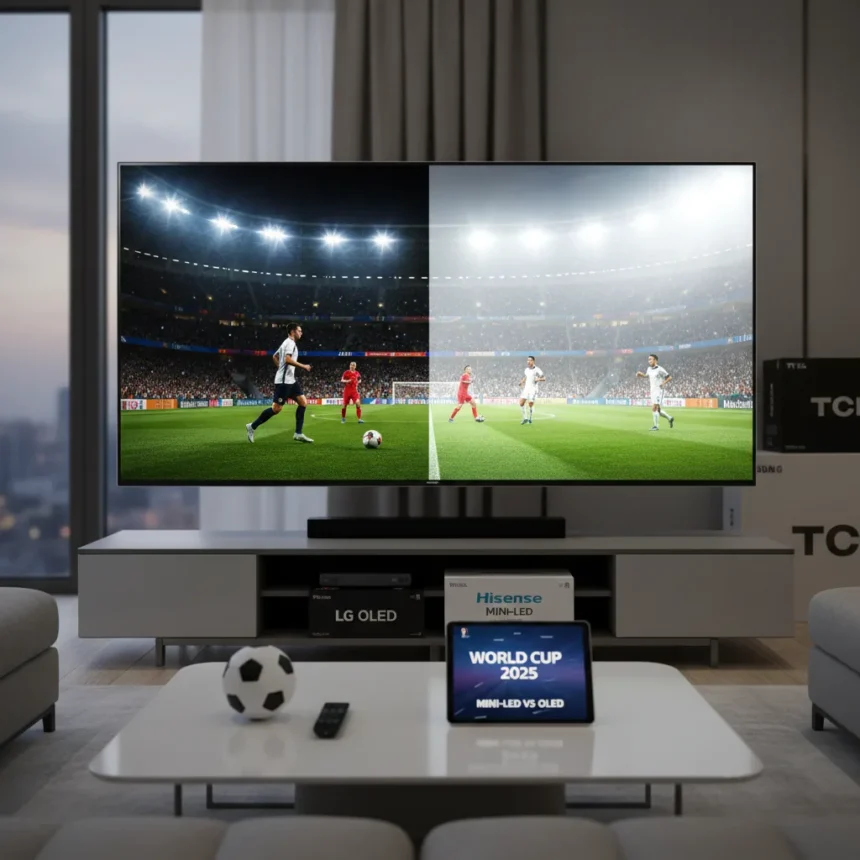
OLED vs Mini-LED: Which Suits World Cup Viewing?
OLED and mini-LED represent different philosophies. OLEDs prioritize color accuracy, black levels, and contrast ratio perfection—ideal for cinematic content and evening viewing. Mini-LEDs prioritize brightness and sustained contrast in bright rooms, making them superior for daytime sports viewing and high-ambient-light environments. For World Cup viewing specifically, consider your room’s lighting: if you watch primarily in the evening with lights dimmed, OLED’s superior blacks justify the cost. If daylight or bright overhead lights are present during matches, mini-LED’s brightness advantage is decisive.
Should I buy a TV right now for the World Cup?
Yes. With the World Cup weeks away, waiting for 2026 models means missing the tournament on a new screen. Hisense and TCL mini-LEDs offer the best value-to-performance ratio right now, while LG OLEDs remain the top choice for picture quality if budget allows. Samsung mini-LEDs are solid but outperformed in brightness by cheaper alternatives.
What’s the difference between mini-LED and OLED for sports?
Mini-LED uses thousands of independently controlled backlight zones to achieve high brightness and contrast, excelling in bright rooms and during daytime viewing. OLED uses self-emissive pixels for perfect blacks and color accuracy, better suited to dimly lit rooms and evening viewing. For live sports, mini-LED’s brightness advantage matters more than OLED’s black perfection.
Are TCL and Hisense TVs reliable for long-term use?
Both brands offer solid warranties and have improved reliability significantly. TCL and Hisense mini-LED models deliver performance comparable to Samsung and LG at lower prices, making them smart choices if you prioritize value over brand prestige. Check retailer reviews and warranty terms before purchasing, as they vary by region.
The best TV for World Cup 2025 depends on your budget and room conditions. If you have a bright living room and want maximum brightness for daytime matches, the Hisense U8N or TCL C855 deliver unbeatable value. If you prioritize evening viewing and cinematic picture quality, LG OLEDs remain the top choice despite lower peak brightness. Samsung mini-LEDs are solid performers but no longer offer the performance-to-price advantage they once did. Make your choice now—the tournament waits for no one.
Where to Buy
Hisense U8QG 75-inch 4K mini-LED TV (2025): | $898 | $747.99 | TCL QM6K 75-inch 4K mini-LED TV (2025): | $447.99
Edited by the All Things Geek team.
Source: TechRadar