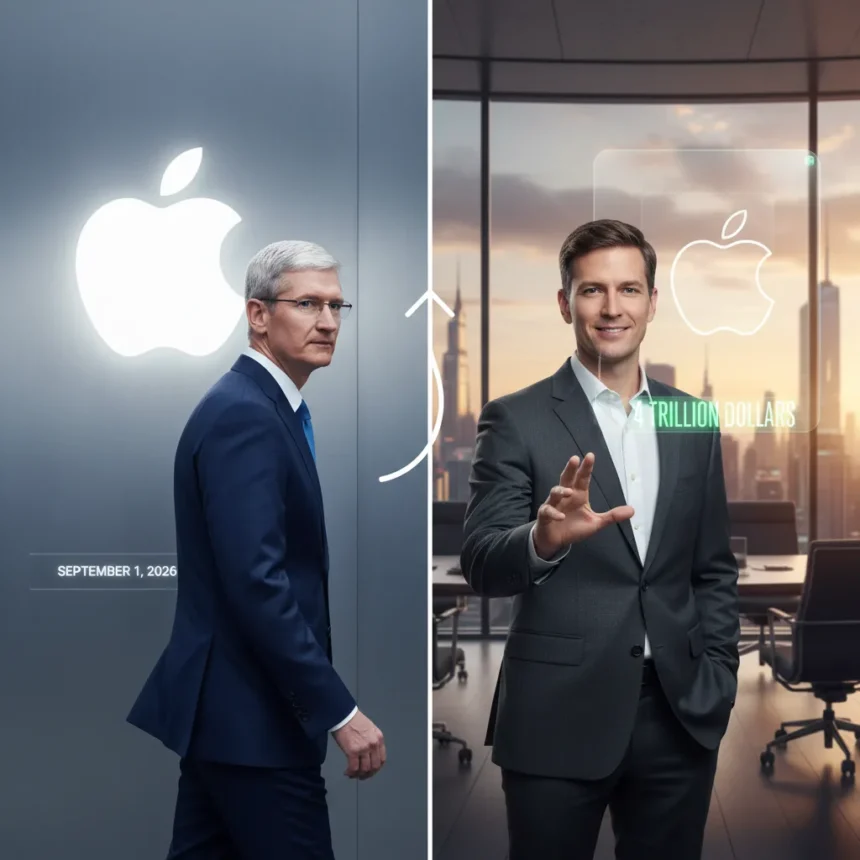
Tim Cook stepping down as Apple CEO marks one of the most significant leadership transitions in tech history, announced Monday ahead of an effective date of September 1, 2026. The move comes as Apple’s market value reaches $4 trillion, positioning the company at its peak financial performance as it hands the reins to 50-year-old hardware executive John Ternus.
Key Takeaways
- Tim Cook announced his resignation as Apple CEO, effective September 1, 2026
- John Ternus, a 50-year-old hardware executive, will become the next CEO
- Apple’s market value stands at $4 trillion at the time of announcement
- Cook cited strong financials and an incredible product pipeline as reasons for stepping down now
- The transition aims to ensure the smoothest possible handover of leadership
Why Cook Is Stepping Down at Peak Performance
Cook’s decision to step down now, rather than waiting for external pressure or forced succession, reflects a deliberate strategy to ensure stability at the world’s most valuable company. He cited strong financials, an incredible pipeline, and a desire for the best-ever transition as the driving factors behind the timing. This is not a company in crisis—it is a company at the height of its power, which makes the voluntary nature of the transition unusual in modern tech leadership.
The $4 trillion valuation underscores Apple’s financial dominance. Cook has overseen Apple’s transformation from a computer maker into a services and ecosystem powerhouse, expanding into wearables, services, and AI. By stepping down while the company is thriving, Cook avoids the messy succession battles that often plague major corporations. The move signals confidence in both the company’s trajectory and in Ternus as his successor.
Who Is John Ternus and What Does He Bring?
John Ternus, at 50 years old, brings deep hardware expertise to the CEO role—a critical asset for a company whose identity is built on physical devices. As a hardware executive, Ternus understands the engineering, supply chain, and product design challenges that define Apple’s competitive advantage. His background positions him as someone who can maintain Apple’s hardware-first philosophy while navigating the increasing importance of software and services.

Ternus steps into a role that has been transformed by Cook’s tenure. The CEO position at Apple is no longer about individual product genius—it is about managing a global ecosystem, maintaining relationships with suppliers and regulators, and balancing hardware innovation with services growth. Ternus’s appointment suggests the board believes he can execute that broader vision.
What This Means for Apple’s Future
The transition happens at a moment when Apple faces pressure to prove its AI capabilities matter to customers. Recent hardware launches, including the iPhone 16 series with its A18 and A18 Pro chips and Camera Control feature, represent the company’s push into artificial intelligence. Ternus will inherit a company with momentum but also with questions about whether Apple Intelligence—the company’s answer to generative AI—can justify premium pricing and drive upgrade cycles.



Cook’s departure also removes one of tech’s most recognizable figures from day-to-day operations. Cook has been the public face of Apple since 2011, navigating regulatory scrutiny, supply chain crises, and the challenge of following Steve Jobs. His successor will need to establish his own credibility with investors, employees, and the media while maintaining the operational discipline Cook instilled.
How This Compares to Past Tech Leadership Transitions
Apple’s transition stands in sharp contrast to the chaos that often surrounds CEO changes in tech. When Steve Jobs stepped back from daily operations before his death, Apple’s succession was uncertain and contentious. Cook’s decision to announce his replacement well in advance, while the company is performing at peak levels, gives Ternus time to prepare and investors time to adjust expectations. This is a textbook example of planned succession done right—something most tech companies struggle with.
When Does Cook Actually Leave?
Cook will remain as CEO until September 1, 2026, giving the company nearly 18 months to execute the transition. This timeline is deliberately generous, allowing Ternus to shadow Cook, maintain continuity with major projects, and ensure that no critical initiatives are disrupted. It also gives investors and partners time to build confidence in the new leadership before the formal handover occurs.
FAQ
Why is Tim Cook stepping down now instead of waiting longer?
Cook cited strong financials, an incredible product pipeline, and a desire to ensure the best-ever transition as his reasons. By stepping down while Apple is thriving at $4 trillion in market value, he avoids the appearance of being forced out and gives his successor the strongest possible foundation.



What is John Ternus known for at Apple?
Ternus is a hardware executive with deep expertise in product design and engineering. His background in hardware makes him well-suited to lead a company whose identity is built on physical devices, from iPhones to Macs to wearables.
Will Apple’s strategy change under John Ternus?
While Ternus brings his own perspective, the transition is designed to ensure continuity rather than radical change. Apple’s core strategy—premium hardware, integrated software, and ecosystem lock-in—is unlikely to shift dramatically, though Ternus may accelerate or adjust priorities around AI and services.
Tim Cook’s departure marks the end of an era for Apple, but it also represents confidence in the company’s future. By orchestrating a planned succession at peak performance, Cook has given Apple the rare gift of a smooth leadership transition in an industry where such moments are typically marked by chaos and uncertainty. The real test comes when Ternus takes the helm on September 1, 2026, and must prove he can maintain Apple’s momentum in an increasingly competitive and AI-driven tech landscape.
Edited by the All Things Geek team.
Source: TechRadar