

Tesla Supercharger virtual queue system is rolling out next quarter at select high-demand charging locations to eliminate the chaos of line-jumping at overcrowded stations. For years, drivers have jostled for position at busy hubs, with conflicts escalating into screaming arguments during peak travel times. Tesla’s response is a digital queue that assigns charging slots algorithmically, notifies drivers when their turn arrives, and prevents out-of-turn charging via app warnings and vehicle display alerts.
Key Takeaways
- Tesla Supercharger virtual queue system pilots launch Q2 at select busy locations worldwide.
- System applies to roughly 1% of charging sessions overall, but far more frequent at urban hotspots like LA, New York, and Toronto during peak times.
- Tesla app version 4.56.0 includes the feature with notifications if earlier spots open up.
- Queue-jumping triggers a warning: “There is a queue at this station. Are you sure you want to start a charging session now?”.
- Tesla’s network spans over 60,000 charging points at 6,000+ locations globally.
Why Tesla Supercharger fights are escalating
Conflicts at Superchargers have intensified as the network approaches saturation at popular destinations. Holiday weekends, major road trip corridors, and urban charging hubs see wait times that strain driver patience. Without an official queue system, the “first come, first served” rule devolved into a free-for-all where drivers would arrive, find a station occupied, and circle looking for an opening—or worse, attempt to unplug someone else’s vehicle. The lack of transparency meant no one knew how long they’d wait or whether a spot would open soon. Tesla Supercharger virtual queue system addresses this directly by creating order from chaos.
How the Tesla Supercharger virtual queue works
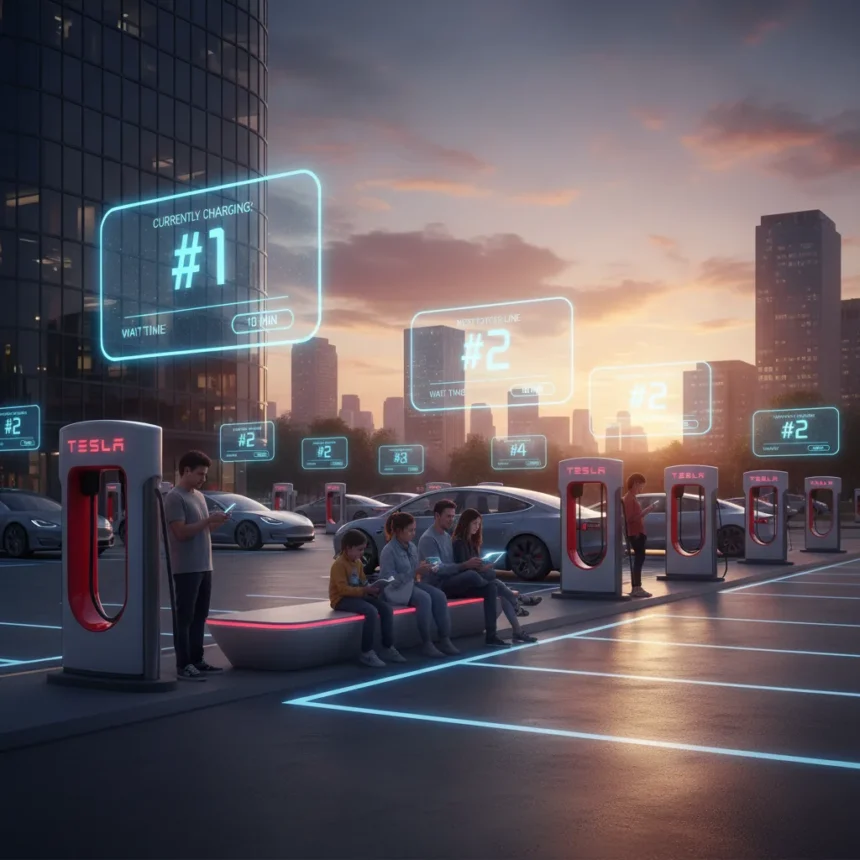
When a driver approaches a full Supercharger station, the Tesla app or in-car touchscreen displays an option to join the virtual queue. The system assigns positions based on join time, displaying the driver’s place in line and estimated wait duration on their screen. When their turn arrives, the Tesla app sends a notification and indicates which charging stall is reserved—potentially via a pulsing blue light or an on-screen message like “Use the Supercharger post that is pulsing blue”. VIN locking technology prevents out-of-turn charging attempts, and drivers forfeit their position if they leave the charging area. The Tesla Supercharger virtual queue also includes a warning message for anyone attempting to skip ahead, making the social pressure to wait transparent and unavoidable.
Non-Tesla EV owners will likely join via the Tesla app, though Tesla owners may receive priority access at Superchargers. This approach preserves the ecosystem advantage while extending the feature to the growing number of non-Tesla EVs using the network.



When and where the rollout happens
Pilot testing begins next quarter at select high-demand Supercharger sites, with potential worldwide expansion later in the year if initial feedback is positive. The feature integrates into the existing Tesla app and vehicle software via update 4.56.0, requiring no hardware changes or additional fees. Rollout prioritizes the busiest urban locations—LA, New York, Toronto—where queue-jumping incidents are most frequent. Tesla Supercharger virtual queue effectiveness depends heavily on driver discipline; without forcible enforcement beyond warnings, some queue-jumping will likely persist. The system’s real strength lies in transparency and social accountability rather than technical prevention.
Does the virtual queue solve the real problem?
Tesla’s approach trades physical conflict for digital order, but leaves a critical gap: enforcement. A warning message stops many drivers, but determined queue-jumpers can still attempt to charge out of turn. The system works best when drivers accept the queue’s legitimacy—which, in a high-stress travel scenario, is not guaranteed. Competitors like Electrify America and EVgo lack comparable queue systems, giving Tesla a public relations advantage even if the mechanism itself is imperfect. The real test comes during peak travel periods when wait times stretch past 30 minutes and driver frustration peaks.



Can non-Tesla drivers use the Tesla Supercharger virtual queue?
Non-Tesla EV owners can join the queue via the Tesla app, though implementation details remain unclear. Tesla owners may receive priority positioning, preserving the ecosystem advantage. The feature rolls out to non-Tesla EVs as part of the pilot, but specific access mechanics and whether non-Teslas see the same estimated wait times remain unconfirmed.
What happens if you leave the queue?
Drivers automatically forfeit their position if they leave the charging area. This prevents drivers from reserving a spot, driving away to grab food, and returning hours later expecting their place to still exist. The rule encourages genuine wait-time management rather than phantom reservations.
Tesla Supercharger virtual queue system is not a perfect solution, but it tackles a real problem that has festered for years. By introducing transparency and social accountability, Tesla removes the guesswork and conflict that turns charging stops into confrontations. The pilot will reveal whether digital order can survive the friction of real-world travel stress—and whether drivers will accept a queue when they could, in theory, plug in anyway.
This article was written with AI assistance and editorially reviewed.



Source: TechRadar