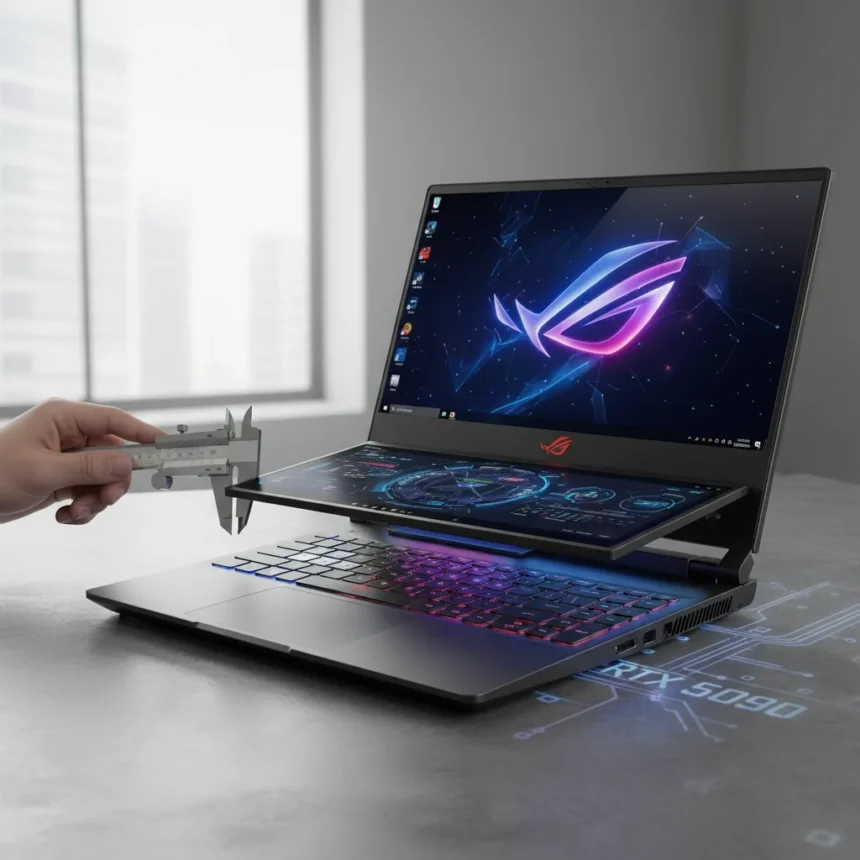
The ASUS ROG Zephyrus Duo RTX 5090 is a gaming laptop featuring dual 16-inch OLED touchscreens, an NVIDIA GeForce RTX 5090 Laptop GPU, and up to 64GB RAM, announced at CES 2026. It weighs 6.28 pounds and represents one of the most audacious attempts to squeeze flagship hardware into a portable form factor. After testing the machine, the question is not whether ASUS succeeded in fitting an RTX 5090 inside—it clearly did. The question is whether fitting everything into one chassis actually improves how you game and work.
Key Takeaways
- Dual 16-inch OLED touchscreens enable novel multitasking workflows for creators and gamers.
- RTX 5090 Laptop GPU and Intel Core Ultra 9 386H deliver flagship performance in a 6.28-pound package.
- Thermal management in a dual-screen chassis creates real usability tradeoffs.
- Up to 2TB PCIe Gen 5 SSD and 64GB RAM support demanding creative workloads.
- Dual-screen gaming laptops remain niche—the value proposition depends entirely on your workflow.
The ASUS ROG Zephyrus Duo RTX 5090 Architecture: How They Fit It All
The engineering challenge here is not trivial. Fitting an RTX 5090 Laptop GPU, the Intel Core Ultra 9 386H processor, dual 16-inch OLED panels, and a functional cooling system into a chassis that weighs just 6.28 pounds requires serious compromises. ASUS solved this by stacking components vertically and using the secondary screen as a heat-dissipating element rather than just a display. The result is a machine that feels like a prototype of what gaming laptops could become, not a refinement of what they already are.
The dual OLED touchscreen setup is the defining feature here. Unlike traditional gaming laptops that hide performance behind a single display, the Zephyrus Duo gives you a second canvas for streaming overlays, Discord, browser windows, or creative tools. For streamers and content creators, this is genuinely useful. For pure gamers, it is a luxury that adds weight and complexity to a device that already demands thermal discipline.
Performance and Thermal Reality: Where Dual Screens Create Friction
The RTX 5090 Laptop GPU is the fastest mobile GPU available, and the Core Ultra 9 386H is a capable processor. On paper, this is a dream machine for 4K gaming and AI workloads. In practice, fitting both into a dual-screen chassis means thermal management becomes a constant background anxiety. The secondary screen, while clever, also means less internal airflow and tighter component spacing than a single-screen rival would allow.


This is not a failure—the machine performs at a high level. But it is a reality check. A single-screen gaming laptop with the same GPU and processor could run cooler, quieter, and potentially at higher sustained clock speeds. The Zephyrus Duo trades some of that thermal headroom for versatility. Whether that trade is worth it depends entirely on whether you actually use the second screen for work that justifies carrying it.
Storage, RAM, and Upgradability: No Compromises Here
ASUS did not cut corners on internal specs. The machine supports up to 64GB of RAM and up to 2TB of PCIe Gen 5 SSD storage. For a laptop that aims at creators and gamers alike, these specs are appropriate. The PCIe Gen 5 SSD is particularly important for video editing and 3D rendering workflows where sustained sequential throughput matters.



What the brief does not specify is whether the RAM and storage are user-upgradeable. Modern gaming laptops increasingly solder RAM and storage, making future upgrades impossible. If ASUS locked down both, the 64GB ceiling becomes a real constraint for anyone planning to keep this machine for five years. This is a question you should ask before buying.
Dual-Screen Gaming Laptops: A Niche That Remains Niche
The ASUS ROG Zephyrus Duo is not the first dual-screen gaming laptop, and it likely will not be the last. But the category remains a small corner of the market because the use case is specific. If you are a streamer who wants game footage on one screen and chat on the other without a second device, this makes sense. If you are a 3D artist who wants viewport controls on the secondary screen, there is real value. If you are a pure gamer who just wants the highest frame rates possible, a lighter single-screen machine with the same GPU would serve you better.
The Zephyrus Duo forces you to justify the complexity. It is not a universal gaming laptop—it is a specialist tool. ASUS has engineered it well, but engineering excellence does not automatically equal market fit.
Does the RTX 5090 Justify the Price and Weight?
The research brief does not disclose pricing, so I cannot tell you whether the Zephyrus Duo is overpriced relative to single-screen competitors with identical specs. What I can say is that the RTX 5090 Laptop GPU is the fastest mobile GPU available, and pairing it with the Core Ultra 9 386H creates a machine capable of handling 4K gaming, AI inference, and professional creative work. The question is not whether the hardware is fast—it is whether you need both screens to justify carrying the extra weight and thermal complexity.



Is the ASUS ROG Zephyrus Duo RTX 5090 worth buying?
Buy it if you are a streamer, content creator, or professional who genuinely uses dual-screen workflows. The secondary OLED touchscreen is genuinely useful for these roles, and the RTX 5090 Laptop GPU delivers the performance to match. Skip it if you are a pure gamer looking for the absolute fastest single-screen laptop at the lightest weight—you will find better value elsewhere.
Can you upgrade the RAM and storage on the Zephyrus Duo?
The research brief does not specify whether RAM and storage are user-upgradeable. Before purchasing, contact ASUS support to confirm whether the 64GB RAM and 2TB SSD can be replaced or expanded after purchase. Modern gaming laptops increasingly solder these components, making future upgrades impossible.
How does the Zephyrus Duo compare to single-screen gaming laptops with the same GPU?
A single-screen laptop with an RTX 5090 Laptop GPU and Core Ultra 9 386H would likely run cooler and quieter due to less constrained internal airflow and component spacing. The Zephyrus Duo trades some thermal efficiency for the secondary screen’s creative and streaming utility. The choice depends on whether you actually use that second display for work.
The ASUS ROG Zephyrus Duo RTX 5090 is an impressive engineering achievement, but it is also a reminder that the most advanced hardware does not always deliver the most practical computing experience. Dual screens are genuinely useful for specific workflows. For everyone else, a lighter, thermally simpler machine might be the smarter choice.
Where to Buy
Edited by the All Things Geek team.
Source: Windows Central