






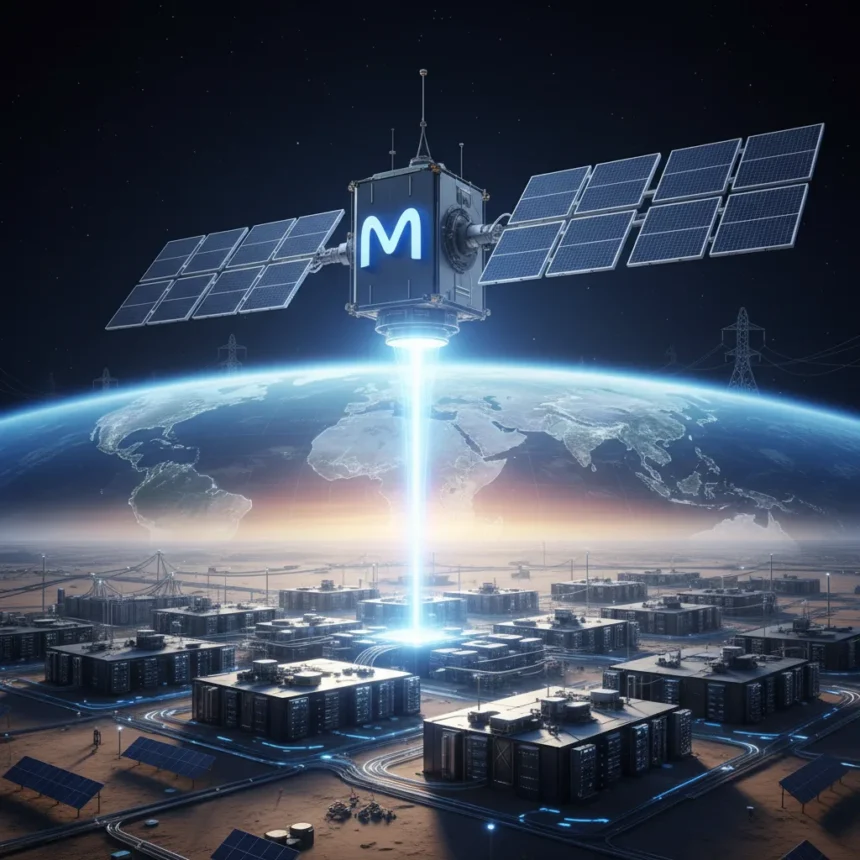
Space-based solar power just stopped being science fiction. Meta signed a capacity reservation agreement with Overview Energy for early access to up to 1 GW of space-based solar power to support US data centers and AI infrastructure, marking the first major corporate bet on harvesting sunlight from orbit. The move exposes a hard truth: terrestrial grids and conventional renewables cannot keep pace with AI’s appetite for electricity.
Key Takeaways
- Meta reserves 1 GW of orbital solar capacity from Overview Energy, targeting 2030 commercial deployment.
- Satellites in geosynchronous orbit (22,000 miles up) beam low-intensity infrared light to existing solar farms for 24/7 power generation.
- Meta’s 2024 data centers consumed over 18,000 GWh annually, equivalent to powering 1.7 million US homes.
- Overview Energy’s approach avoids dedicated ground infrastructure by leveraging existing terrestrial solar farms.
- Orbital solar yields roughly 5x more energy than ground systems by eliminating the day-night cycle.
Why Meta Needs Power From Space
Meta consumed over 18,000 GWh of electricity in 2024 alone, a figure that dwarfs the annual consumption of entire nations. That is equivalent to powering 1.7 million US homes for a year. AI model training and inference are voracious energy consumers, and Meta’s infrastructure appetite is growing faster than the grid can supply. The company committed to securing 30 GW of renewables by 2035, including 6.6 GW of nuclear deals, but even that may not be enough. Space-based solar power represents a way to bypass grid constraints entirely, delivering power directly to data center campuses without waiting for new transmission infrastructure or competing for land with other industries.
Nat Sahlstrom, Meta’s vice president of energy and sustainability, framed the deal as transformative: space solar technology enables hyperscalers to secure clean power with reliable siting and speed to power. Translation: Meta gets energy when and where it needs it, without the years-long permitting battles that plague terrestrial solar and wind farms.
How Space-Based Solar Actually Works
Overview Energy, founded in 2022 and based in Ashburn, Virginia, emerged from stealth in December 2024 with a radical departure from traditional space solar concepts. Rather than building massive rectennas (specialized receiving antennas) on the ground, Overview beams low-intensity near-infrared light to existing terrestrial solar photovoltaic farms, converting that light into electricity using equipment already deployed. The satellites orbit in geosynchronous orbit at approximately 22,000 miles above Earth, allowing them to hover over the same geographic location continuously and harvest sunlight 24/7.



The beam itself is invisible, less intense than direct sunlight, and designed to be passively safe for humans, animals, and aircraft. Overview demonstrated the concept from a Cessna aircraft at 16,500 feet in November, proving power could be transmitted wirelessly without harming people or equipment on the ground. The company plans an initial satellite demonstration in low Earth orbit in January 2028, with commercial power production in geosynchronous orbit targeted for 2030.
The efficiency advantage is stark. Orbital solar avoids atmospheric attenuation and eliminates the day-night cycle, yielding roughly 5x more energy than terrestrial systems. Overview introduced a new metric to quantify this: megawatt photons, the amount of light needed to generate 1 MW of electricity. For hyperscalers, that efficiency translates to fewer satellites needed and faster cost parity with conventional power sources.



Space Solar Versus Meta’s Other Bets
Meta is hedging its energy future across multiple fronts. The company signed 6.6 GW of nuclear power deals by 2035, a massive commitment to dispatchable baseload power. Nuclear offers reliability and density but requires decades of regulatory approval and site development. Space-based solar complements nuclear by providing additional renewable capacity without land constraints or grid interconnections. The real contrast is with terrestrial solar and wind, which require new transmission infrastructure, face permitting delays, and compete for limited suitable land. Overview’s approach sidesteps all three problems by piggybacking on existing solar farms.
The industry is shifting. Hyperscalers like Meta are increasingly moving away from relying on the public grid, instead building behind-the-meter solar and storage parks on their own property. Space-based solar accelerates this trend by removing the final constraint: the rotation of the Earth. A data center powered by orbital solar plus on-site storage becomes genuinely independent from grid demand fluctuations.
The Unproven Parts
Before celebrating, consider what remains unproven. Overview has not deployed a commercial satellite in geosynchronous orbit or transmitted power at scale to a live grid. A Cessna demo at 16,500 feet is not the same as a satellite 22,000 miles up maintaining beam coherence through atmospheric interference. The 2030 commercial timeline assumes no major technical setbacks, regulatory delays, or cost overruns—a risky assumption for a technology that has never operated at this scale. Meta’s agreement contains no disclosed financial terms, cost-per-megawatt figures, or binding commitments, suggesting this is a pre-order with substantial execution risk.
The research brief also mentions a 100 GWh long-duration storage deal with Noon Energy, but no details on that partnership have emerged. Storage is critical for space solar to work reliably—the beam cannot be interrupted by weather or satellite maintenance, so batteries must bridge gaps. Without clarity on the storage component, the full power delivery picture remains incomplete.



Why This Matters Right Now
AI data center electricity demand is projected to double or triple by 2028, equivalent to Ireland’s entire 2023 power consumption. No single energy source can meet that demand alone. Meta’s space solar bet signals that hyperscalers are abandoning the hope that grids will adapt in time. Instead, they are building energy independence through a portfolio of nuclear, terrestrial renewables, and now orbital solar. Other hyperscalers—Google, Amazon, Microsoft—will likely follow. This is not a niche experiment. It is a structural shift in how the largest tech companies source power.
Can Space Solar Compete Economically?
Cost remains the elephant in the room. Overview has not disclosed pricing for its space solar capacity, and Meta has not revealed what it is paying for 1 GW of reserved power. Without those numbers, it is impossible to assess whether orbital solar is economically viable or merely a hype play backed by venture capital. The technology’s 5x efficiency advantage over terrestrial solar is compelling, but a satellite launch, deployment, and 15-year operation is expensive. If costs exceed grid electricity plus transmission, the deal makes no economic sense regardless of the energy density gains.
The 2030 timeline is also aggressive. Regulatory approval for orbital power beaming, spectrum allocation, and coordination with aviation authorities could easily add years to deployment. Meta may be betting that regulatory bodies will fast-track approval given the urgency of AI infrastructure buildout, but that is an assumption, not a guarantee.
Is space-based solar power ready for commercial use?
Not yet. Overview has demonstrated the concept at small scale but has not operated a commercial satellite in geosynchronous orbit or delivered power to a live grid. The technology is proven in principle but unproven at the scale and duration required for hyperscaler infrastructure. 2030 is the target, but technical challenges, regulatory delays, or cost overruns could push that timeline back.
How much power will Meta actually get from this deal?
Meta reserved up to 1 GW of capacity, but the actual deployment depends on Overview’s satellite construction and launch schedule. 1 GW is meaningful—it would power roughly 750,000 US homes—but it represents only about 3% of Meta’s 2035 renewable energy target of 30 GW. This is a supplement to nuclear and terrestrial solar, not a replacement.
Why doesn’t Meta just build more solar and wind farms?
Land, permitting, and time. Terrestrial solar and wind farms require suitable geography, years of environmental review, transmission infrastructure upgrades, and grid coordination. Space-based solar bypasses these constraints by delivering power directly to data centers without new land use or grid interconnections. For a hyperscaler facing explosive AI demand, the speed and siting flexibility of orbital solar justify the technological and financial risk.
Meta’s space solar bet is a symptom of a deeper problem: the grid cannot scale fast enough to meet AI’s energy demands. Whether Overview Energy delivers on its 2030 promise will determine whether space-based solar becomes a viable pillar of hyperscaler infrastructure or remains an expensive experiment. For now, Meta is betting the farm on the former. The next four years will reveal whether that confidence is justified.
This article was written with AI assistance and editorially reviewed.
Source: Tom's Hardware